

BAOQi / INVESTORS
Invest in Taiwan’s own defense decision AI.
BAOQi builds sovereign defense AI and the coordination layer that turns affordable vehicles into mission teams. ZERO brings Formation and Kata—reusable patterns of team coordination—into ALAYA Wargame. BABYLON Market assembles complementary vehicles; ALAYA compares their mission effectiveness and fleet cost before partner integration.
The investment thesis is team intelligence: vehicles with different capabilities and costs contribute complementary strengths through Formation, Kata and adaptive roles. Value comes from shared mission outcomes, total fleet cost and reusable decision-making knowledge across platforms. Mission-first design guides how the team and its components are selected.
Earlier SHEEPDOG product walkthrough
Watch on YouTube
Enter through one mission. Expand through a shared platform.
Start with a funded deployment. Grow through annual licensing and continuing integration.
Read the full introduction
Start with a funded decision-support or integration program. Expand through software licensing, deployment support, model adaptation and continuing capability development. Each engagement can add reusable interfaces, mission knowledge and configuration data to the same platform.
Turn the first deployment into continuing revenue
Funded deployment
Enter through a unit-specific program
Annual licensing
License ZERO, ALAYA and BABYLON
Continuing expansion
Model adaptation, mission modules and partner integration
Capital allocation
Product milestones funded by capital
Development targetsFirst on-premise ZERO deployment and annual license; at least two units or institutions using ALAYA mission modules.
At least three partner adapters in use, first supplier-delivered BABYLON configuration and second funded deployment program.
Explore every capability
Open a capability for the full story01Restore departures sooner. Build the budget around the outcome
Model repair machinery, clearance work, material waits, parallel crews and usable departure segments. Compare first departure, full recovery, aircraft waiting time and readiness investment.
Explore the workflow ↗02Which road opens first—and who gets out sooner?
Place machinery, crews, airlift and evacuation vehicles on a real road network. Compare plans that account for equipment arrivals, road dependencies, patient deadlines and time spent waiting.
Explore the workflow ↗03Start with what you own. See what the mission still needs
Use the visual Build Bay to compose vehicles and modules, organize BOMs and missing parts, inspect capability limits and energy estimates, prepare quote worksheets, and take configurations into ALAYA.
Explore the workflow ↗04Make each rerun explain its differences
Connect decision logs, event timelines, AAR, source versions and hashes. Sensor CSV comparison and spatial playback turn research results into reproducible deliverables.
Explore the workflow ↗Build toward the next mission
Product roadmap01Unit-specific models and on-premise deployment
The product roadmap brings domain adaptation, unit knowledge bases, model evaluation, on-premise and offline deployment, and continuous updates under the institution's control.
02Build a strategy pipeline that compounds across missions
Extend existing Red–Blue evaluation and candidate selection into continuous large-model self-play, cross-scenario comparison, Formation and Kata knowledge, and distillation into edge policies.
03Carry simulated team roles into field integration
Expand synchronized autopilots, edge tactic cards, platform interfaces, sensor calibration and multi-vehicle trials, extending the mission evidence chain into deployment.
04Turn supply-chain data into mission assets that can be recomposed
Expand inventory dependencies, component provenance, alternatives, complete-kit validation, maintenance, replenishment and supplier data, connecting configuration with procurement and lifecycle cost.
TRACTION / PUBLIC RECORD
What has already happened, in order.
Status today: ZERO pilot in progress on Taiwan’s national high-performance computing resources, with closed-door demonstrations for partner units. Guiding institution: NTU Unmanned Vehicles Research and Development Center. ALAYA Wargame runs ten mission scenarios; BABYLON Build Bay is live at tdth.org.
Europe–Japan Dual-Use Innovation Showcase
Founder presented Tactical AI for Unmanned Vehicle Teams at Plug and Play Japan, then joined The Autonomy Stack panel with Orcrist Technologies and Synteza AI at From Prototype to Production – Japan (EDTH × Deloitte Tohmatsu Venture Support).
Taiwan Defense Tech Hackathon 2026
Supporting organizer of the Taipei event: preparation, partner coordination, resource connections and on-site support.
ZERO × ALAYA × BABYLON at CTMS 2026
Exhibited at the Taichung AI & Smart Manufacturing Show, Booth 121, with on-screen mission planning, heterogeneous coordination and supply-chain configuration demonstrations.
Simulator demonstrated at the Taiwan Unmanned Systems Strategy Forum
Public demonstration at National Chung Hsing University under the SHEEPDOG program name, now ALAYA Wargame.
Identity-under-uncertainty and Resilience Mapper published
Research capability for preserving uncertainty and reviewing decision evidence, plus a browser-based geospatial resilience demonstration and the OSSInt 2026 submission package.
Turing Certs MOU; NTU Garage cohort
Memorandum of understanding with Turing Certs announced; selected for the NTU Garage startup community in 2025.
Why now
The networks are in. Judgment is the bottleneck.
Defence, police and fire services are all wiring the field back to the command post: backbone networks, mobile command vehicles, live drone video. Information now arrives faster than a team can read it, and who goes where, first, is still worked out on a whiteboard. The equipment is funded; the missing layer is judgment. ZERO reduces the flow and hands people a short list of decisions, each with sourced options, to approve.
30 relay stations live
22 backbone and 8 reinforcement sites on microwave, digital radio and satellite paths, funded with NT$30 million from the county budget.
81 mobile command vehicles
The first 11 cost about NT$946 million, with satellite and 5G video uplink and multi-system integration. Each one is a forward command post.
Search-and-rescue drones issued
44 rough-terrain drone kits and 22 rescue video management systems, with 159 certified pilots trained.
Sources: Yahoo News, 2026-10-21 · CNA, 2026-07-02 · Economic Daily News, 2025-11-21
NEAREST REVENUE / ZERO SOVEREIGN DEFENSE AI
The fastest path to revenue is also the foundation of everything else.
Defense units, research institutes and manufacturers in Taiwan share one blocker: commercial AI assistants refuse ballistics, weapon-systems engineering and tactical questions, and every prompt leaves the country. ZERO is BAOQi’s sovereign defense model, built to be funded by the units that need it.
A sovereign model units can own
Non-PRC open weights under a defense-use license, adapted on defense engineering and tactical corpora, with physics engines in the loop, hosted on Taiwan compute and deployable fully offline. Policy set by the operating authority; every exchange audited.
Build program, then recurring
A funded build program per unit or institute (model, adaptation, physics tools, on-premise deployment), followed by an annual license with updates and support and a continuous-training service as doctrine, platforms and data change.
Every tactical system runs on it
The Red–Blue AI Foundry, Formation and Kata generation in ALAYA and BABYLON’s configuration reasoning all run on ZERO. Each funded deployment seeds the next product sale inside the same unit.
Status: pilot in progress on Taiwan’s national high-performance computing resources; closed-door demonstrations for partner units. Guiding institution: NTU Unmanned Vehicles Research and Development Center.
MISSION SCENARIOS
Multi-vehicle coordination is the core. Four missions show its value.
Start with 05 → 01 → 03 → 08: multi-vehicle coordination, search intelligence, layered defense and mission economics.
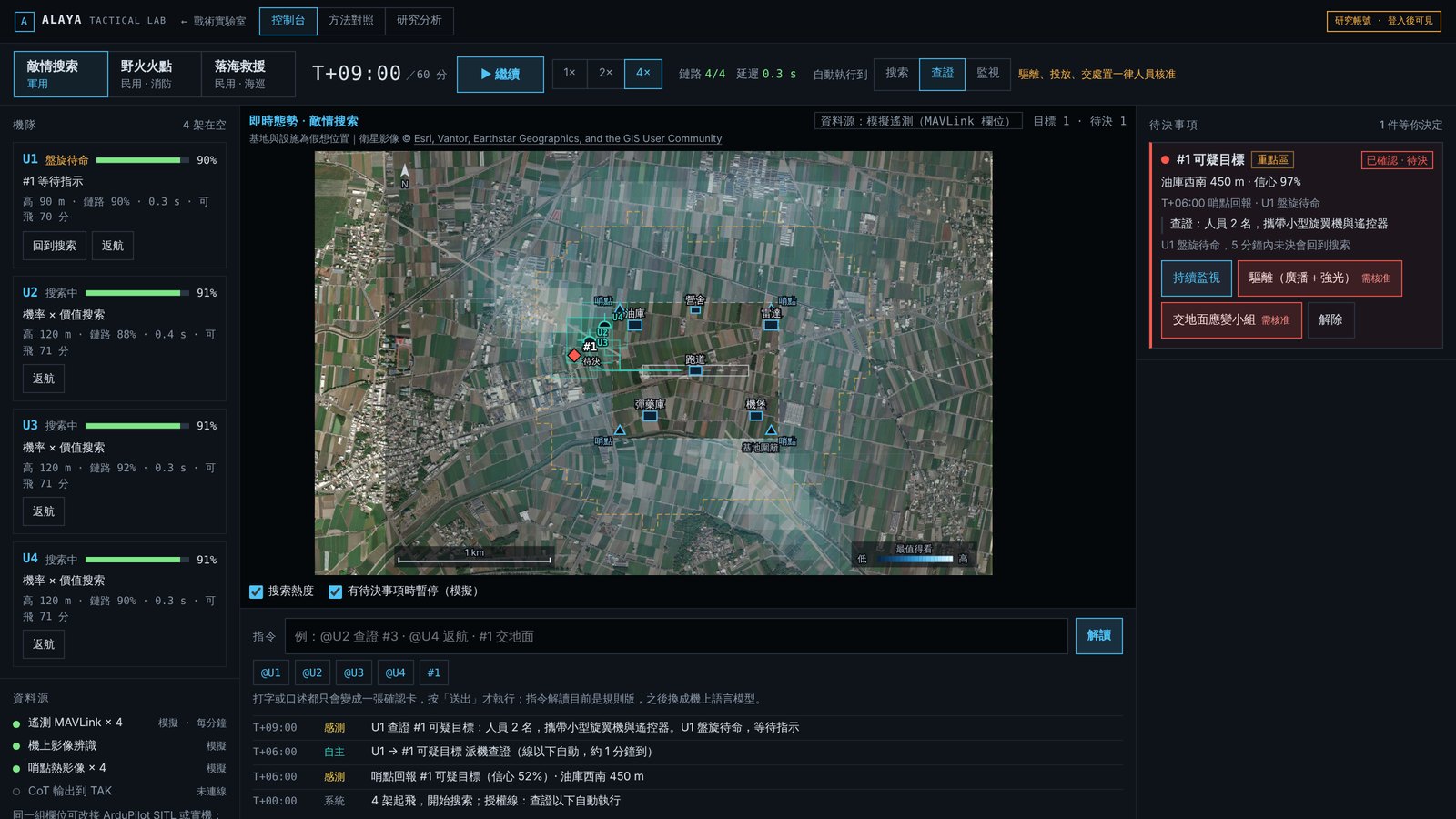
The situation changes. The team changes roles.
In this example, three aircraft complement one another through role allocation and handoffs, showing how coordinated teamwork carries a changing mission.
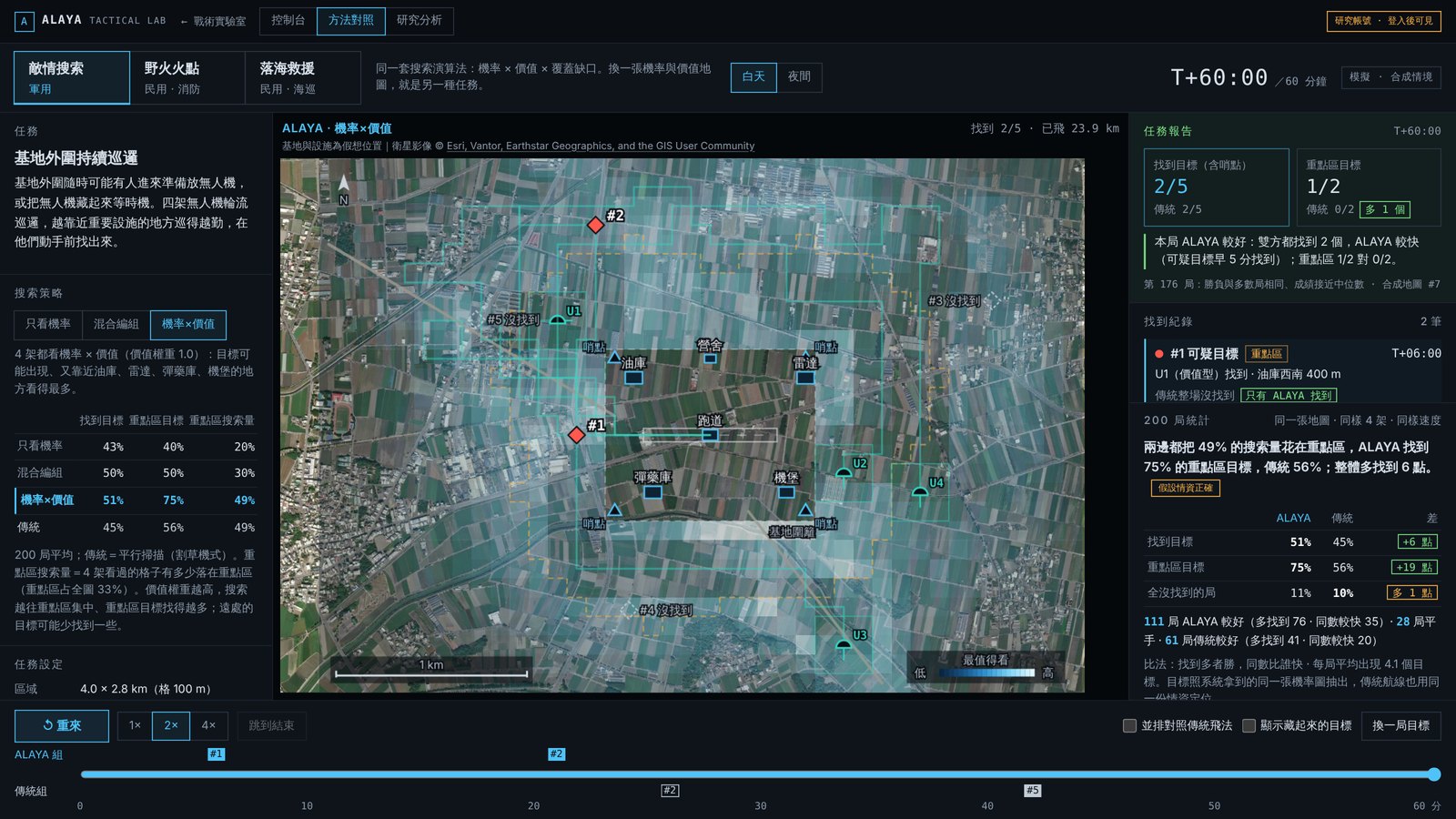
Put search effort where it matters.
Probability-guided search shows how the same fleet can use limited time more effectively.
Defend as a system, layer by layer.
A shared mission picture brings successive defensive layers and available assets into one coordinated response.
Make every resource count.
Compare mission effect, expenditure, time and remaining capability to see what each plan buys.
THE PLATFORM
A common intelligence layer across equipment and missions.
Formation describes adjustable team configurations and role relationships. Kata provides coordination patterns that can be selected, adapted and recombined as conditions change. Together, they connect mission goals, vehicle selection, simulation evaluation and partner integration.
ZERO / Inside ALAYA
The tactical generation engine within ALAYA Wargame.
Develop Formation, Kata and role-allocation knowledge into reusable tactical models; compare candidate approaches and carry mission experience into the next decision.
ALAYA
Turn separate vehicles into an adaptive team.
Evaluate heterogeneous multi-vehicle teamwork, role changes and mission continuity in simulation. Compare mission effectiveness alongside the total cost of complementary fleet configurations.
BABYLON Market
Turn mission demand into a system configuration.
Select complementary vehicles, sensors, communications and compute around team roles. Combine capability, compatibility and cost to reduce dependence on expensive individual platforms.
WHY THIS MODEL CREATES VALUE
Mission value. Capital efficiency.
Reusable software, cross-vendor integration and configuration data let the same intelligence serve more vehicles and missions. Formation and Kata knowledge, platform interfaces and mission data build on one another, making each integration a foundation for the next team.
Each mission improves the next starting point.
Formation, Kata, mission models and outcome assessments form a tactical knowledge library that can support new mission modules and future planning. Reusing this knowledge across missions expands the value of the software without starting each configuration from scratch.
Each interface opens more combinations.
Common capability models and reusable platform adapters turn each integration into an asset for the next vehicle, partner and complementary team. Shared adapters make partner equipment easier to adopt within new mission teams.
Each solution strengthens the configuration engine.
Capability, compatibility, fleet cost and mission evaluation data strengthen the choice of complementary configurations as the equipment library expands. Comparing total team cost before procurement connects component choices to mission-level value.
More mission knowledge. More compatible platforms. More valuable system combinations.
WHY NOW / TAIWAN’S UNMANNED-SYSTEMS POLICY
NT$240 billion
The defense self-reliance and unmanned-vehicle industry act passed its third reading on 27 August 2026. It provides for six years of annual budget procedures, with NT$40 billion per year as the principle.
Approx. NT$44.2 billion
MOEA’s unmanned-vehicle industry programme spans 2025–2030, with approximately NT$8.3 billion budgeted for 2026. Domestic equipment and supply-chain development strengthen the context for cross-platform integration.
COMMERCIALIZATION
License the intelligence. Integrate the system. Support its evolution.
Three revenue paths connect the same growing asset base to buyers: software licensing, system integration, and continuing updates and support.
Mission software and modules
For defense and security organizations, training teams and research institutions.
Platform access, Formation and Kata mission modules, tactical evaluation and fleet configuration tools form the software licensing offer.
A mission-ready system architecture
For vehicle manufacturers, OEMs and system integrators.
Reusable platform adapters, edge integration, complementary fleet configuration and deployment support form the project delivery offer.
A platform that grows with the mission
For organizations expanding platforms, sites or mission sets.
New Formation and Kata content, software updates, equipment configuration support and maintenance extend the value of each deployment.
Enter through a concrete mission. Deliver a repeatable integration. Expand through software, new modules and continuing support.
COMPETITIVE LANDSCAPE
Where BAOQi sits next to comparable systems.
Three systems investors will compare us with, and where each one is strong. BAOQi does not replace vehicle autonomy or a prime’s C2; it is the vendor-neutral tactical layer above partner autopilots, built for affordable mixed fleets and hosted on sovereign compute.
Mission autonomy and C2 across a prime’s ecosystem
Strongest when paired with its own hardware family and allied-program integration; a mature, well-funded reference for AI-enabled command and control. Priced and hosted for US and allied primes.
BAOQi difference: hardware-neutral above any partner autopilot, Taiwan-hosted ZERO under the operating authority’s policy, and a cost tier built around commercial, attritable vehicles.
AI pilot inside the vehicle
Vehicle-level autonomy proven on its own airframes and in fighter-class trials. Operates at the flight-control layer that BAOQi deliberately leaves to partners.
BAOQi difference: complementary, not a substitute. ALAYA and ZERO coordinate teams of vehicles that may each run their own autonomy stack.
Open flight stack and operating system for drone makers
A widely adopted vehicle OS and ground-station ecosystem built on open standards, strong on manufacturer adoption and interoperability.
BAOQi difference: sits above vehicle operating systems as the mission and role-allocation layer; AuterionOS-class stacks are candidate partner execution systems, not competitors for the tactical layer.
Sovereign model plus coordination layer for affordable mixed fleets
Where the advantage is verifiable: tactical patterns generated continuously by the Red–Blue AI Foundry, a model that runs on Taiwan compute and answers defense questions commercial assistants refuse, configuration data tied to Taiwan’s component supply chain, and a per-unit funded-build model that produces revenue before platform-level programs close.
Where we are behind: fielded hours, program scale and capital. We state this plainly rather than claim no comparable systems exist.
COMPARABLE COMPANIES
Where BAOQi sits next to Sakana AI, Shield AI and Anduril.
Public figures as of October 2026. The closest path is Sakana AI: a sovereign AI lab that moved into defense command-and-control and intelligence analysis. Shield AI and Anduril are the decision-layer references, at a very different scale.
| Core product | Latest valuation | Revenue | Defense track | Hardware | |
|---|---|---|---|---|---|
| BAOQi | ZERO sovereign defense AI that calls its own tools; ALAYA simulation and execution; BABYLON vehicle build bay | Pre-round | No defense revenue yet | In discussion with Taiwan armed-forces users | Integrates partner platforms; does not build airframes |
| Sakana AI | Sovereign Japanese LLMs and AI agents | ≈ ¥400B / US$2.6B (Nov 2025) | Not disclosed | Mar 2026 ATLA command-and-control research; Aug 2026 MoD intelligence-analysis agent pilot | None |
| Shield AI | Hivemind autonomy with its own V-BAT and X-BAT aircraft | US$12.7B (Mar 2026) | 2026 guidance ≥ US$540M | V-BAT used in operations in Ukraine | Software sold with its own aircraft |
| Anduril | Lattice command software plus its own drones, rocket motors, radar and undersea sensors | US$61B (May 2026) | US$2.25B in 2025 | Arsenal-1 production plant in Ohio | Fully vertically integrated |
What we take from this: start the way Sakana did, with research-and-demonstration scope a command can approve quickly, and keep every number traceable to the engine that computed it. We stay hardware-neutral and work as the second line next to systems like Lattice and Hivemind.
Sources: AIsmiley (2026-08) · TechNews (2025-11) · Fortune (2026-03) · SiliconANGLE (2026-05)
WHAT CAPITAL UNLOCKS
Turn engineering progress into scalable product assets.
Investment connects product development to outcomes that customers and integration partners can use.
Explore the four capital priorities
A reusable mission AI library
Develop tactical models, mission modules and outcome assessment into a product library that can serve more scenarios.
Unlocks broader software and mission-module licensing.
Repeatable cross-platform integration
Package capability interfaces, platform adapters and edge coordination into a consistent integration toolkit.
Makes the next vehicle or partner easier to bring into the platform.
A mission configuration knowledge base
Connect equipment capabilities, compatibility and supply-chain information to concrete system configurations.
Expands the range of solutions BABYLON can help assemble.
A repeatable commercial delivery model
Build licensing packages, integration deliverables, deployment methods and an update-and-support offering around the closed-loop platform.
Turns individual projects into a path for continuing platform adoption.
Where the round goes
Read the full introduction
ZERO model adaptation, physics tools and compute: 40%. ALAYA and BABYLON productization and the cross-platform integration toolkit: 25%. Deployments, partner integration and customer entry: 20%. Team: 15%. Round size and terms are discussed directly with qualified investors.
What the capital has to show
Read the full introduction
Within 12 months: first on-premise ZERO deployment at a funding unit or institute; first annual licence signed; ALAYA mission modules in use by at least two units or institutes. Within 18 months: at least three partner platform adapters in production use; first BABYLON configuration delivered with Taiwan suppliers; second funded build program under way.
FOUNDER & EXECUTION
A product perspective across hardware, software and operations.
BAOQi is founder-led in Hsinchu, Taiwan, with product architecture and partner development connected to the same mission.
BAOQi · TAIWAN
Wenteng Chang
Founder & CEO
Baoqi Smart Tech Co., Ltd. · Hsinchu, Taiwan
Wenteng Chang’s background spans semiconductor and networking products, product management, computer vision and founding and operating a physical training academy. He leads product definition, system architecture, prototyping and commercialization at BAOQi.
The focus: connect Taiwan’s equipment and engineering strengths with a mission AI platform that can expand across partners, platforms and applications.
NTU Unmanned Vehicles Research and Development Center
Guiding institution for ZERO and the research talent pipeline; NTU Garage cohort company.
EDTH network and Taiwan Defense Tech Hackathon
Supporting organizer of the 2026 Taipei hackathon; presented and sat on the Autonomy Stack panel at EDTH’s Japan events with Deloitte Tohmatsu Venture Support.
Turing Certs, CTMS 2026 exhibitors, Taiwan component suppliers
MOU with Turing Certs; industry outreach through the Taichung AI & Smart Manufacturing Show; supplier data entering BABYLON Market.
BABYLON Market → ALAYA Wargame → Partner Integration
Back the platform that makes the whole team more capable.
Discuss the product roadmap, capital milestones and strategic role your investment or partnership can play.