

ZERO / SOVEREIGN DEFENSE AI · TACTICAL KNOWLEDGE
ZERO
Sovereign defense language model and tactical knowledge engine
Your policy. Your compute. Your data. No vendor veto.
Once the networks are in, information arrives faster than people can read it. ZERO reduces it first, then hands people only the decisions to make, each with sourced options, to approve.
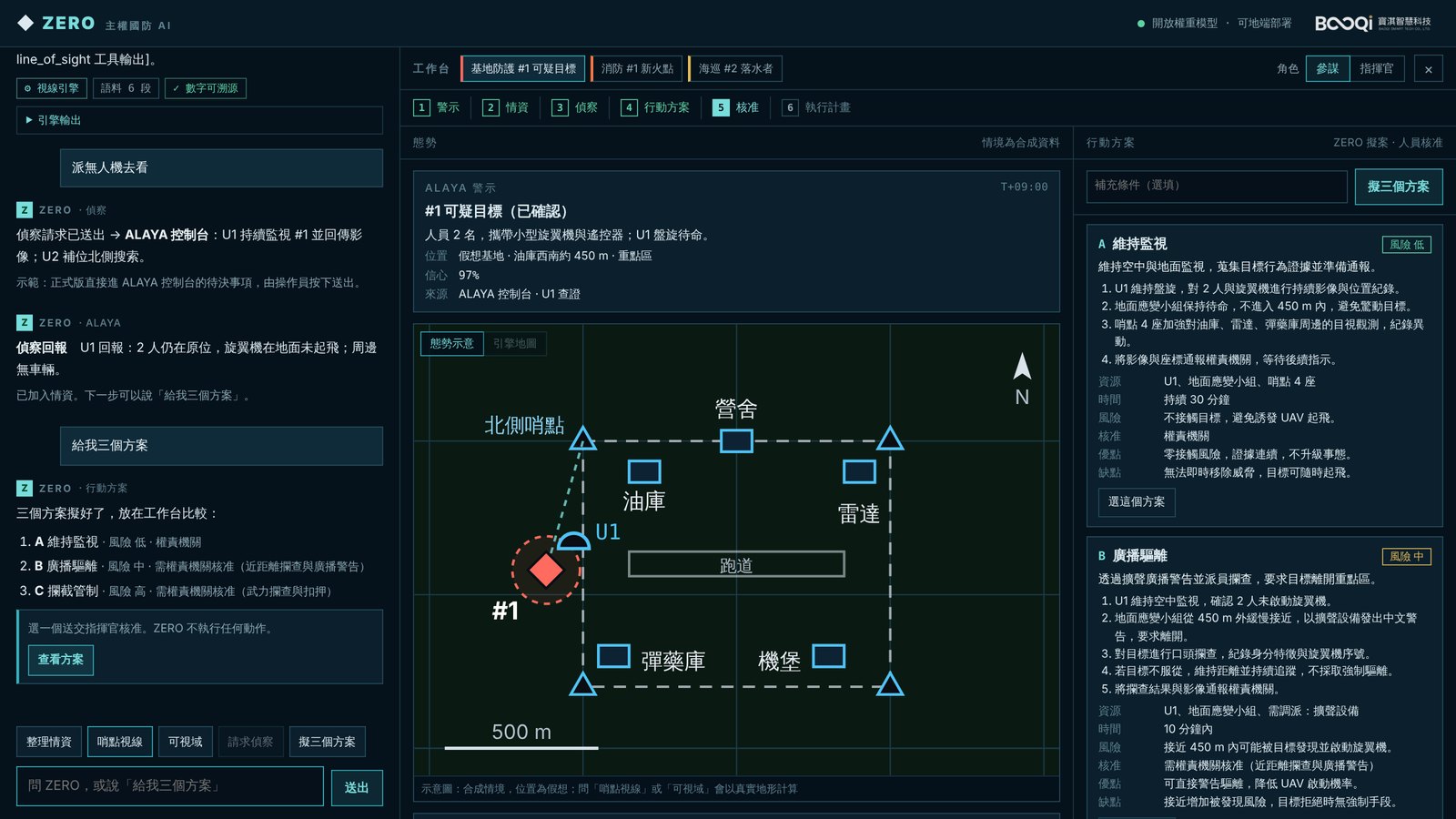
ZERO is BAOQi’s sovereign defense AI model: open, non-PRC model weights adapted for defense engineering and tactical work, trained and hosted on Taiwan-based compute, and deployable fully offline inside a unit’s own facility. Commercial AI assistants refuse ballistics, weapon-systems engineering and tactical questions because a foreign vendor’s content policy says so. ZERO answers to the policy set by the authority that operates it, with a full audit trail and a human in command. The same model is the engine behind ZERO’s Formation and Kata tactical knowledge and the Red–Blue AI Foundry that runs inside ALAYA.
ZERO / 90 SECONDS
See ZERO at work.
Real system footage only: the exterior-ballistics engine computing a firing solution, viewshed analysis on real Taiwan terrain, the weekly worldwide patent-intelligence radar, scheduling optimization for runway repair sequencing with a trace of every tool call, and what comes next — a tactics engine seeded with Ukraine’s battle-proven experience, two AIs sparring around the clock.
ZERO / WHY A SOVEREIGN MODEL
Defense research cannot run on someone else’s content policy.
Researchers at universities, defense labs and manufacturers share the same experience: the tool that accelerates everything else stops working exactly where defense work begins.
Refusals stall the work
Exterior ballistics, fragmentation, propulsion, counter-UAS tactics: routine engineering questions that commercial assistants decline. The refusal is a vendor decision, not a technical limit.
Questions leave the country
Every prompt sent to a foreign cloud is a record of what your unit is working on. Sovereign deployment keeps questions, documents and results inside your own perimeter.
Doctrine is local
Terminology, doctrine, suppliers and the threat picture are Taiwan’s. A model adapted on local defense corpora, with Traditional Chinese as a first-class language, speaks the language of the people who use it.
ZERO / WHAT IT IS
A defense model stack, not a chatbot.
Four layers, each owned by the operating unit.
Open weights you control
Open-weight models under permissive licenses that allow defense use. No PRC-origin models, no licenses that exclude military applications. The weights stay in your hands.
Tuned for the work
Adapted on ballistics, weapon-systems engineering, tactical doctrine and unmanned-systems corpora, benchmarked against a tactical question bank for refusal rate and answer quality.
Numbers from engines, not guesses
Verified numerical engines handle what language models must not estimate: exterior ballistics, flight dynamics and Monte-Carlo trade studies run as tools the model calls, checks and reports on.
Answers that cite your sources
Retrieval over the unit’s own documents, test records and standards, so every answer points back to material the unit already trusts.
ZERO / INTENT INFERENCE
Predict the reaction, not just the trajectory.
ZERO’s name comes from one idea: anticipate what the other side will do next from its goals and attention, not only from physics. Physics extrapolates a track; intent inference answers what the operator behind it does when the picture changes.
Opponent parameters from observation
An observer vehicle estimates the opposing operator’s reaction delay, slew rate, dwell and re-ready time from where it points. A lost engagement still returns the parameters for the next one.
Attention as a resource
A decoy flies an arc that pulls the opponent’s aim away from the strike axis while the observer keeps measuring. Timing windows are derived from the estimated parameters, not assumed.
Measured, not asserted
In simulation against a 60°/s ground truth the estimator returned 52–68°/s; the strike vehicle stayed 82–90° off the opponent’s axis with zero exposure. The method is documented in the Research Library; the tuned recipes stay internal.
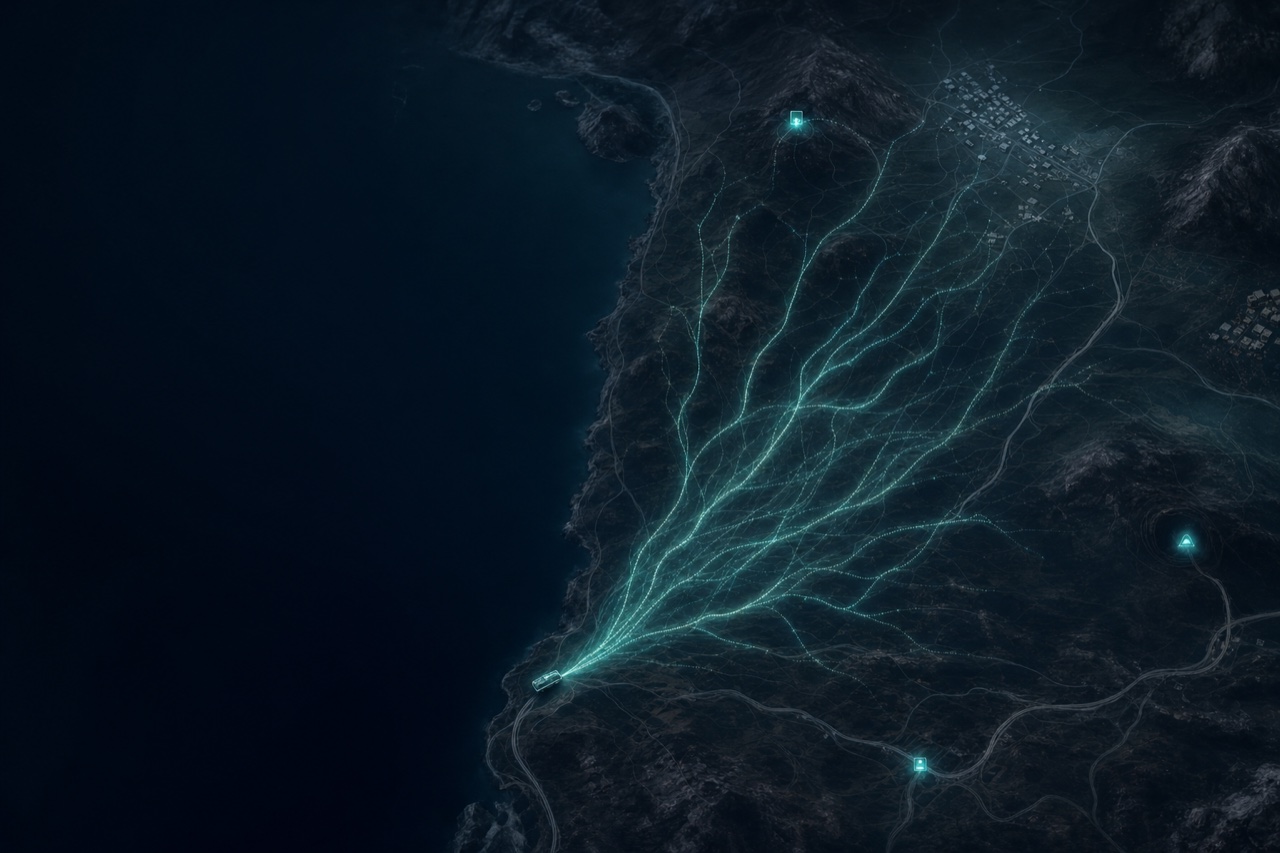
Intent inference fails differently from physics: a wrong track drifts, a wrong intent runs confidently in the wrong direction. ZERO therefore keeps competing hypotheses alive and leaves the decision with the operator.
ZERO / AGENT CAPABILITIES
It reads, watches, listens and writes code.
A defense model that can only chat is a demo. ZERO is built to work inside a unit’s engineering loop.
Your engineering record
Retrieval over engineering ledgers, test results, decision chronicles and standards. The first corpus is BAOQi’s own ALAYA engineering record: several hundred tests, pull requests and post-mortems.
Ordinary cameras, usable observations
Vision pipelines for pose, gaze direction and object tracking from commodity cameras, the same stack used in BAOQi’s three-vehicle trials.
Briefings into citable text
On-premise speech recognition turns briefings, debriefs and radio logs into searchable, citable text without leaving the building.
Edits, tests, reports
Edits mission modules and configuration, runs the test suite and reports results inside the unit’s repository, the way a coding agent does.
From a spoken concept to a spec
A commander describes an idea in plain language. ZERO turns it, together with the meeting notes and everyone’s suggestions, into pictures, scenario flows and the engineering specification a builder can act on: how many vehicles, which roles, what has to be true for it to work. The numbers in that specification come from the physics tools, not from the model.
ZERO / Tool orchestration
The model picks the tool. People decide the action.
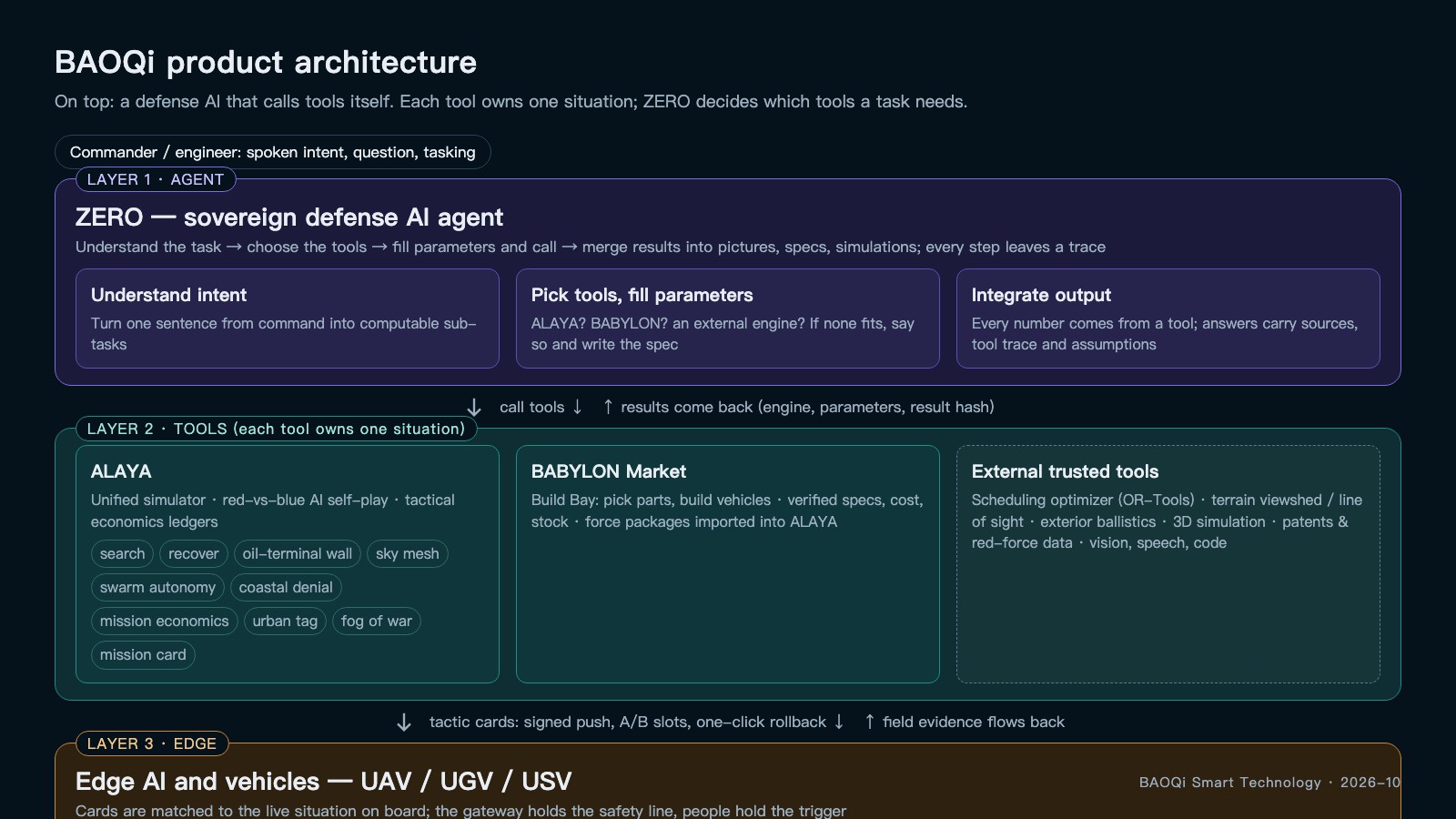
Talk to ZERO the way you would talk to a colleague. It decides how to handle each request: answer directly, search the unit’s corpus, or call a dedicated engine, and it returns the result with its source. There are no modes to switch.
It calls an engine when the question needs one
Ask whether a post can see a target or how far a round will travel, and ZERO calls the viewshed, line-of-sight, radar-horizon or external-ballistics engine itself and puts the terrain map in the workspace. Ask which runway crater to repair first and how to assign the crews, and it calls the scheduling optimizer for the sequence and a Gantt chart. The numbers come from engines, not guesses.
The workspace opens when an alert arrives
When the ALAYA drone system reports a contact, ZERO brings the situation, intelligence and reconnaissance into a workspace and drafts three courses of action, each with resources, time, risk and the approval it needs.
ZERO drafts. It does not execute.
Deterrence, release and hand-off always need an authorized person. Staff submission, commander approval, the execution plan and every step are recorded, and any number without a source is marked unverified.
Live today, and in integration
Live: the model calls the terrain, line-of-sight, radar-horizon, ballistics and scheduling-optimization engines (runway repair sequencing, crew and equipment allocation) on its own, and every call leaves a trace: engine, parameters, assumptions, result hash. In integration: the model tasking ALAYA reconnaissance and the course-of-action workspace directly.
ZERO / VERIFIED ANSWERS · DEFENSE INTELLIGENCE BRIEF
Every number has a source, or it is marked unverified.
Defense work cannot run on confident guesses. ZERO answers the way an analyst is expected to.
Trace it or flag it
Figures in an answer must trace to a document in the unit’s corpus or to a second independent source. What cannot be traced is labelled unverified, never silently asserted, and second-hand summaries are checked against the original.
Verified and inside your perimeter
The same pipeline BAOQi runs for its own analysis: think-tank reports, official budget documents and industry news, verified and summarized every morning. Available as a standalone service, delivered on premise.
ZERO / APPLICATION EXAMPLE · MINE CLEARANCE
Read the minelayer’s logic. Sweep where it matters.
A minefield is not random. It is placed where terrain forces movement, where observers cannot see, and where stopping to clear it costs the most. Reverse that logic and a full-area sweep becomes a prioritized one.
Same engine as the air picture
The opponent-parameter estimation ZERO uses for an operator’s aim applies to a minelayer’s choices: terrain constraints, movement patterns and the disruption it wants to cause become features of a prior.
Probability-guided, already measured
ALAYA’s probability search replaces grid sweeps with expected-detection-per-hour, and keeps unobserved and observed-clear as different states. The same code path drives a demining plan.
Simulate before the first vehicle moves
Run the minelayer’s decision model thousands of times in the digital twin, rank the candidate sites, then dispatch sensors to the ranked list and let the results re-rank it.
Understand how the hunter sets the trap and you become the better hunter, or the better avoider. ZERO turns that principle into a map, a plan and an audit trail.
ZERO / GOVERNANCE
Open to your engineers. Accountable to your command.
ZERO removes the vendor veto, not the chain of command. Procurement and unmanned-vehicle statutes are available for question-answering through Taiwan’s legal databases, and audit logs plus on-premise operation support the confidentiality obligations of classified work.
What the model may discuss is decided by the authority that fields it. Every exchange is auditable, and the model advises; people decide.
ZERO / DEPLOYMENT PATH
From national compute to your own rack.
Three phases, each leaving the unit with more of the infrastructure under its own control.
Pilot on national computing resources
Model selection, defense corpus adaptation and refusal-rate benchmarks on Taiwan’s national high-performance computing resources. Closed-door demonstrations for partner units.
Deployment inside the unit
Installation on the unit’s own GPU servers, fully offline, with the unit’s document base connected and access policy set by the unit.
A model that keeps learning with you
Unit-specific tuning, new corpora, including lessons brought back from allied exchanges, and scheduled model updates under the unit’s control.
ZERO / ENGAGEMENT MODEL
Fund the infrastructure once. Build every tactical system on it.
ZERO is offered to defense units, research institutes and manufacturers as a funded build, followed by licensing and continuous training.
Sovereign model build
A funded program that delivers the model, domain adaptation, physics tools and on-premise deployment to one unit or institute.
Updates and support
Model updates, security patches, new domain corpora and operational support under an annual agreement.
Adaptation as a service
Ongoing adaptation to new doctrine, new platforms and new data as the unit’s mission set grows.
ZERO is the foundation layer. The Red–Blue AI Foundry, where two AI sides play each other around the clock to produce tactical patterns that are compressed into edge AI, Formation and Kata generation in ALAYA, and BABYLON’s configuration reasoning all run on it. A unit that funds ZERO owns the infrastructure every later tactical system is built on.
ZERO / MISSION OUTCOMES
Bring the trade-offs of every option into the decision.
Combine Formation, Kata and dynamic roles to distribute the mission across complementary vehicles. Compare how lower-cost platforms can work together to meet mission needs, with ALAYA assessing the coordination and BABYLON Market connecting it to fleet choices.
Move from seeing one possibility to commanding multiple options. Turn uncertainty into room to act.
ZERO / PLATFORM ASSETS
Every cycle builds tactical assets for the next.
Turn responses, comparisons and lessons from each mission into knowledge that carries across scenarios.
Response and scenario knowledge
Connect changes in the situation with response patterns, expanding the mission contexts the system can address.
Reusable strategy combinations
Retain candidate plans, conditions and selection criteria so the next mission starts with existing strategies.
Comparative results and decision experience
Connect effects, costs and resource trade-offs back to strategy, carrying learning into development and missions.
Research focus: coordination under disrupted communications
ZERO studies how shared Formation and Kata combine with visual observations of teammates’ and opposing forces’ relative positions to support role awareness and mission continuity when communications are limited or unavailable.
ZERO
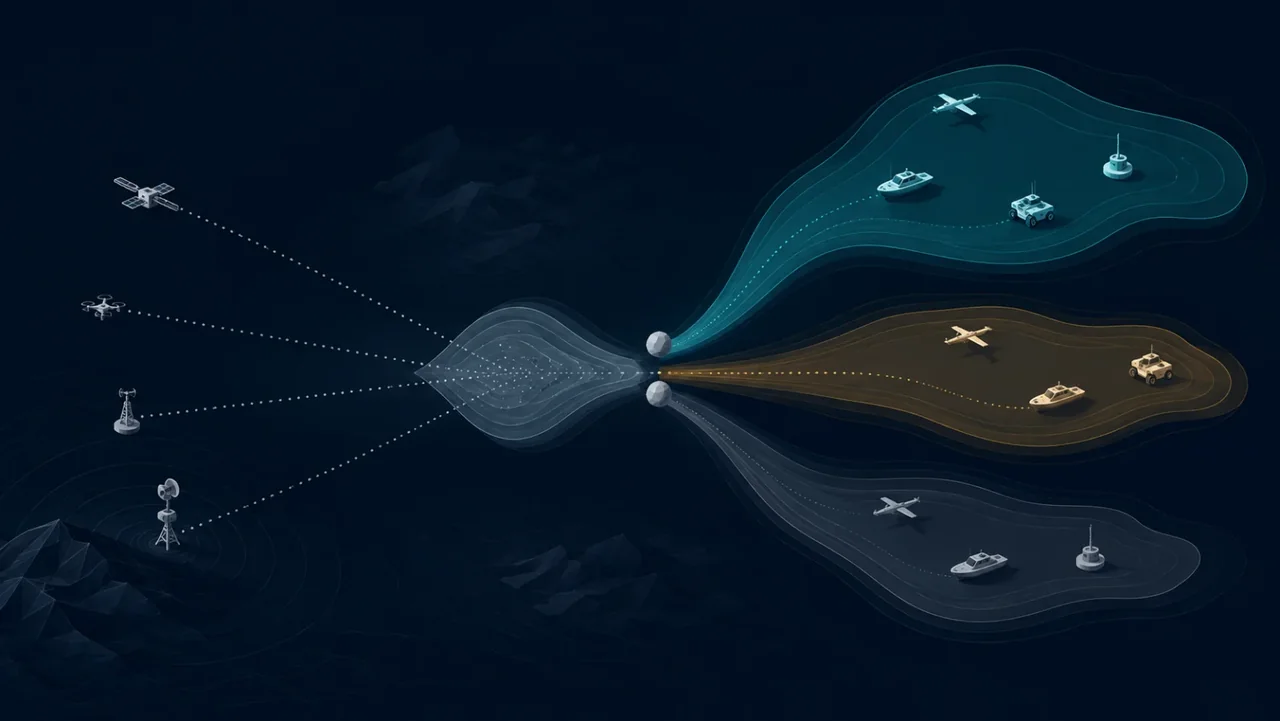
One situation. Multiple possible futures.
ONE MISSION · THREE CORE CAPABILITIES
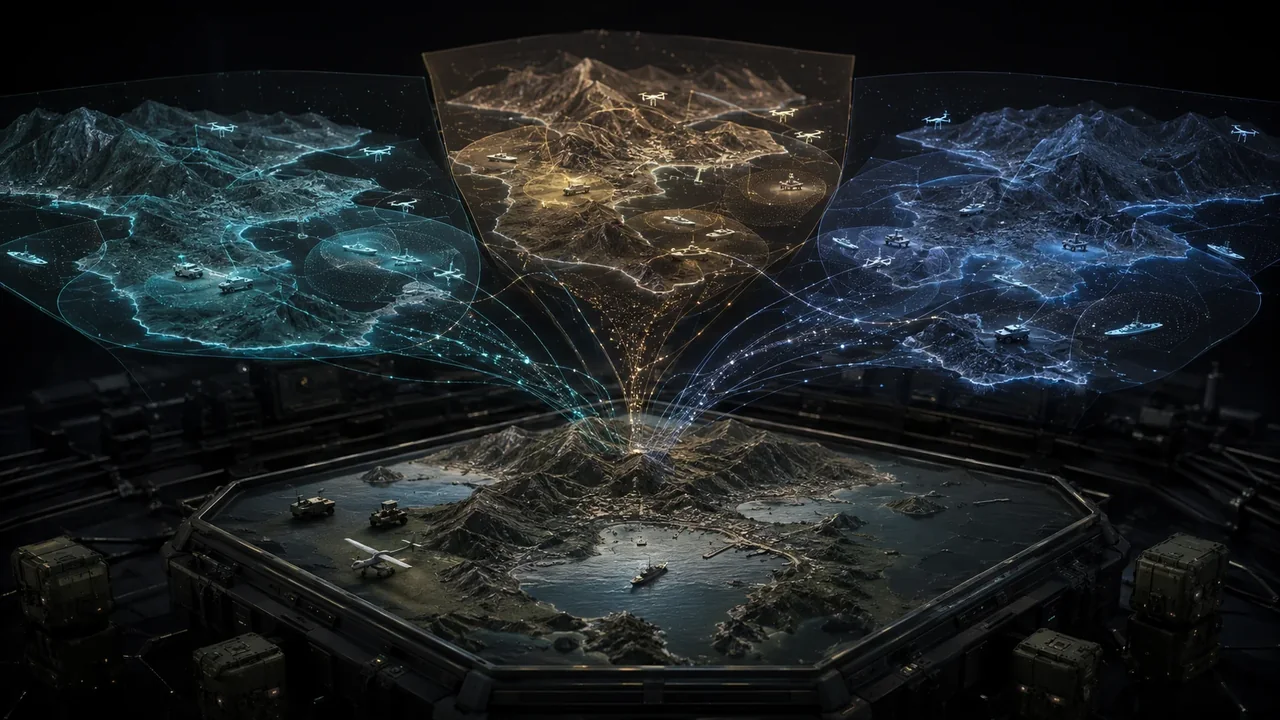
ZERO is one third of a closed loop.
BABYLON describes the body, ZERO generates the tactics, ALAYA validates the team. The full mission loop, system map and partner boundary are on the ALAYA page.
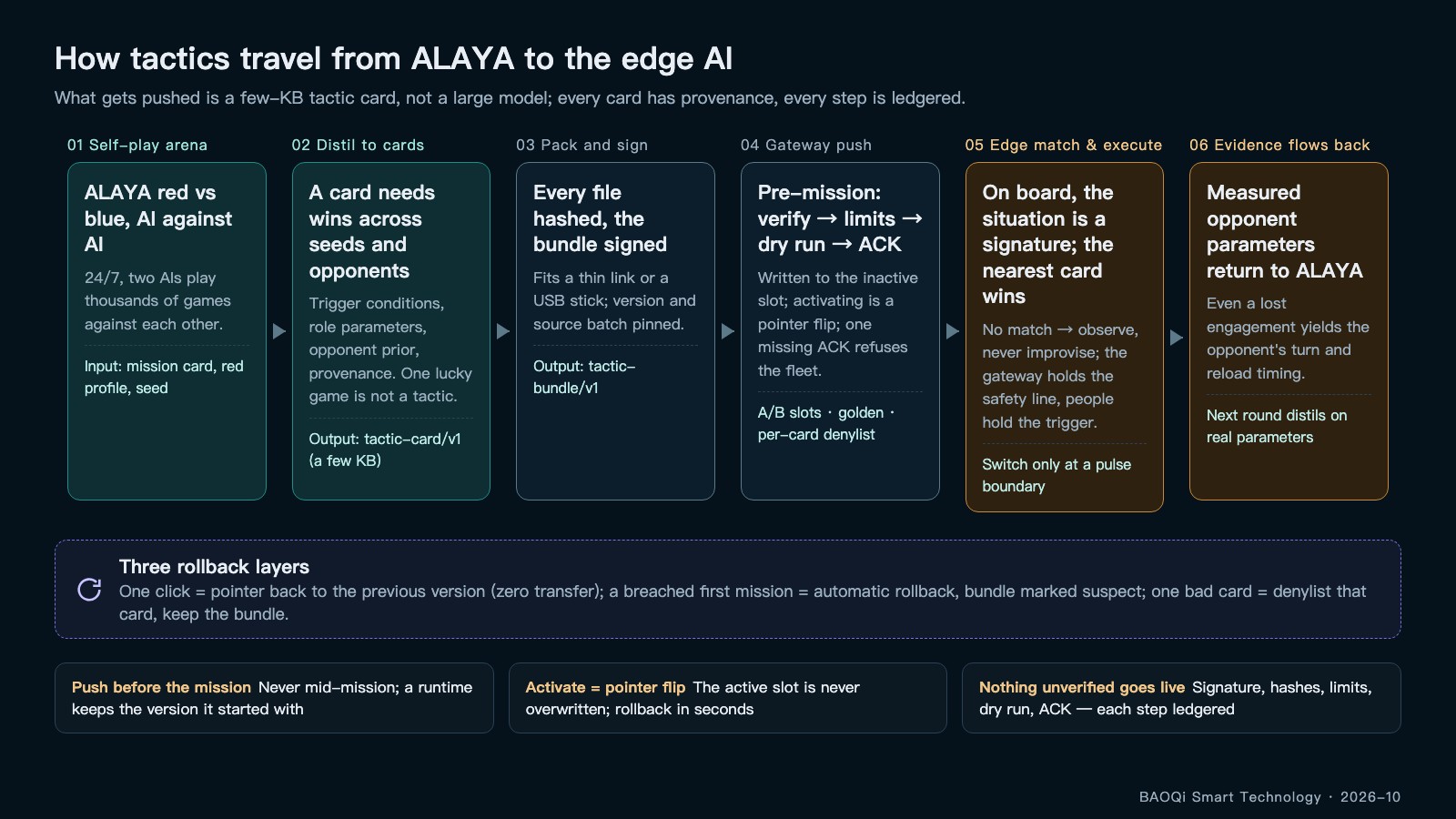
How a tactic gets from the simulator to the aircraft: what ALAYA distils becomes a few-KB tactic card, signed and verified by the gateway before the mission; on board it is matched to the live situation, and field evidence flows back into the next round. The card format, the matcher and the push flow are in the codebase; the next step is virtual-to-physical integration.
TECHNICAL RESOURCES
Engineering & research archive.
Original English research records and engineering references. Historic names and dates remain attached to their evidence.
A working decision loop, from knowledge to task handover
ZERO
Mission and candidate plans
ALAYA
Coordination and scenario comparison
BABYLON
Resources and capability configuration
Explore every capability
Open a capability for the full story01Turn documents, images and briefings into the next decision
Connect retrieval, speech transcription, image understanding and dedicated computational tools. Move from a question to sources, analysis, candidate options and a working record.
02Carry the conversation into a mission handover
ZERO creates reconnaissance requests and execution plans. ALAYA operators acknowledge, report, return and close the same task card, connecting the decision with its follow-through.
Explore the workflow ↗03Make each rerun explain its differences
Connect decision logs, event timelines, AAR, source versions and hashes. Sensor CSV comparison and spatial playback turn research results into reproducible deliverables.
Explore the workflow ↗Build toward the next mission
Product roadmap01Unit-specific models and on-premise deployment
The product roadmap brings domain adaptation, unit knowledge bases, model evaluation, on-premise and offline deployment, and continuous updates under the institution's control.
02Build a strategy pipeline that compounds across missions
Extend existing Red–Blue evaluation and candidate selection into continuous large-model self-play, cross-scenario comparison, Formation and Kata knowledge, and distillation into edge policies.
03Turn maritime anomalies into an explainable review queue
Connect AIS and observations to organize risks and reasons around reporting gaps, speed, loitering and route deviation, with a JSON API for ZERO and map overlays in ALAYA.
04Connect the discussion to the next engineering iteration
Turn meeting concepts into scenarios, specifications and work items, then connect code changes, tests, review and versioned delivery to shorten the path from requirements to validation.
BAOQi
Bring your mission. Build the next solution.
Start with the objective, vehicles and resources. Explore tactical choices, coordinated teams and mission configurations.