

BABYLON / MISSION CONFIGURATION & SUPPLY CHAIN
BABYLON Market
Mission Configuration & Defense Supply-Chain Integration
Know the body before choosing the move.
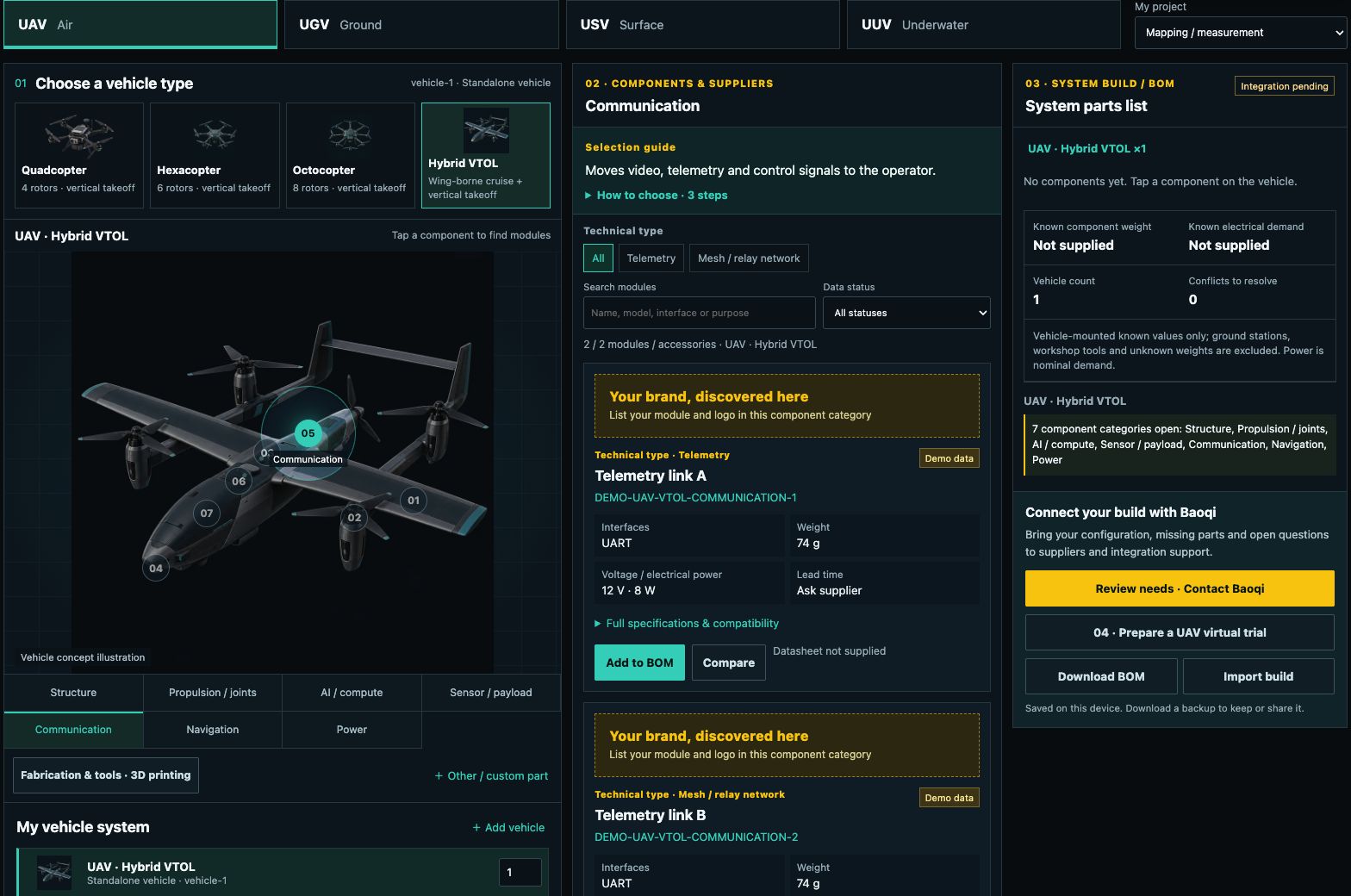
Select the fleet around how it will work together. BABYLON Market connects Formation, Kata and mission roles to complementary vehicles and components, exploring lower-cost teams that reduce dependence on high individual performance. It maps weight, payload, endurance, sensing, communications, compute, compatibility and cost, connecting configuration comparisons and bills of materials with Taiwan’s supply chain.
Think in complementary platforms: high-altitude balloons with FPV aircraft, FPV aircraft with UGVs, and aerial vehicles with USVs. Compare endurance, sensing, mobility, payload and cost to shape the team around the mission.
BABYLON / MISSION OUTCOMES
One mission. See the value of different configurations.
Use ZERO’s formations and coordination patterns to define what the team needs. Select complementary, affordable vehicles in BABYLON Market, then compare mission effectiveness and fleet cost in ALAYA Wargame to find a configuration that fits the mission and budget.
Make the most of what is available. Connect every item of equipment and every budget choice to its mission contribution.
BABYLON / PLATFORM ASSETS
Every configuration builds the foundation for the next.
Turn scattered specifications, supply information and integration experience into configuration knowledge that can be recombined for each mission.
Component and platform capability data
Connect specifications, interfaces and suitable roles so selection starts from mission capability.
Configurations, materials and alternatives
Retain vehicle combinations, bills of materials and upgrade paths so new plans build on prior work.
Supply and system-integration knowledge
Connect who supplies each capability, how it integrates and how the contributors form a complete solution.
ONE MISSION · THREE CORE CAPABILITIES
BABYLON is one third of a closed loop.
BABYLON describes the body, ZERO generates the tactics, ALAYA validates the team. The full mission loop, system map and partner boundary are on the ALAYA page.
BATTLEFIELD ECONOMICS
Measure equipment by its mission contribution.
Consider capability limits, integration cost, endurance and replenishment together. Explore how existing equipment, lower-cost platforms and complementary roles can contribute to an effective force.
Mission effect
What does the configuration contribute?
Resource cost
What does it require to field and sustain?
Capability fit
Which roles fit the available platforms?
Fleet resilience
How does the mission adapt as resources change?
MISSION PARTNER NETWORK
An active network. A selective entry path.
BAOQi already works across autonomous-systems research, vehicle integration and defense innovation. New organizations enter by showing the capability, evidence and ownership they can bring to a mission.
Platforms & vehicle systems
Flight-ready platforms, documented interfaces and accountable integration support.
Payloads, links & edge compute
Sensors, data links, edge AI and mission-ready modules with usable technical data.
Test, manufacturing & sustainment
Verification, production, supply-chain and field-support capacity tied to a milestone.
Research & operational expertise
Mission knowledge, models, datasets and research that can be tested in a defined program.
TECHNICAL RESOURCES
Engineering & research archive.
Original English research records and engineering references. Historic names and dates remain attached to their evidence.
A configuration becomes a plan, a BOM and a budget
ZERO
Mission and candidate plans
BABYLON
Resources and capability configuration
ALAYA
Coordination and scenario comparison
Explore every capability
Open a capability for the full story01Start with what you own. See what the mission still needs
Use the visual Build Bay to compose vehicles and modules, organize BOMs and missing parts, inspect capability limits and energy estimates, prepare quote worksheets, and take configurations into ALAYA.
Explore the workflow ↗02What does the next investment buy the mission?
Compare readiness levels against the same scenarios, with work orders, cost lines and resource gaps. Connect the next vehicle, repair set or budget increment to a measurable change in the plan.
Explore the workflow ↗Build toward the next mission
Product roadmap01Turn supply-chain data into mission assets that can be recomposed
Expand inventory dependencies, component provenance, alternatives, complete-kit validation, maintenance, replenishment and supplier data, connecting configuration with procurement and lifecycle cost.
02Carry simulated team roles into field integration
Expand synchronized autopilots, edge tactic cards, platform interfaces, sensor calibration and multi-vehicle trials, extending the mission evidence chain into deployment.
BAOQi
Bring your mission. Build the next solution.
Start with the objective, vehicles and resources. Explore tactical choices, coordinated teams and mission configurations.