



English
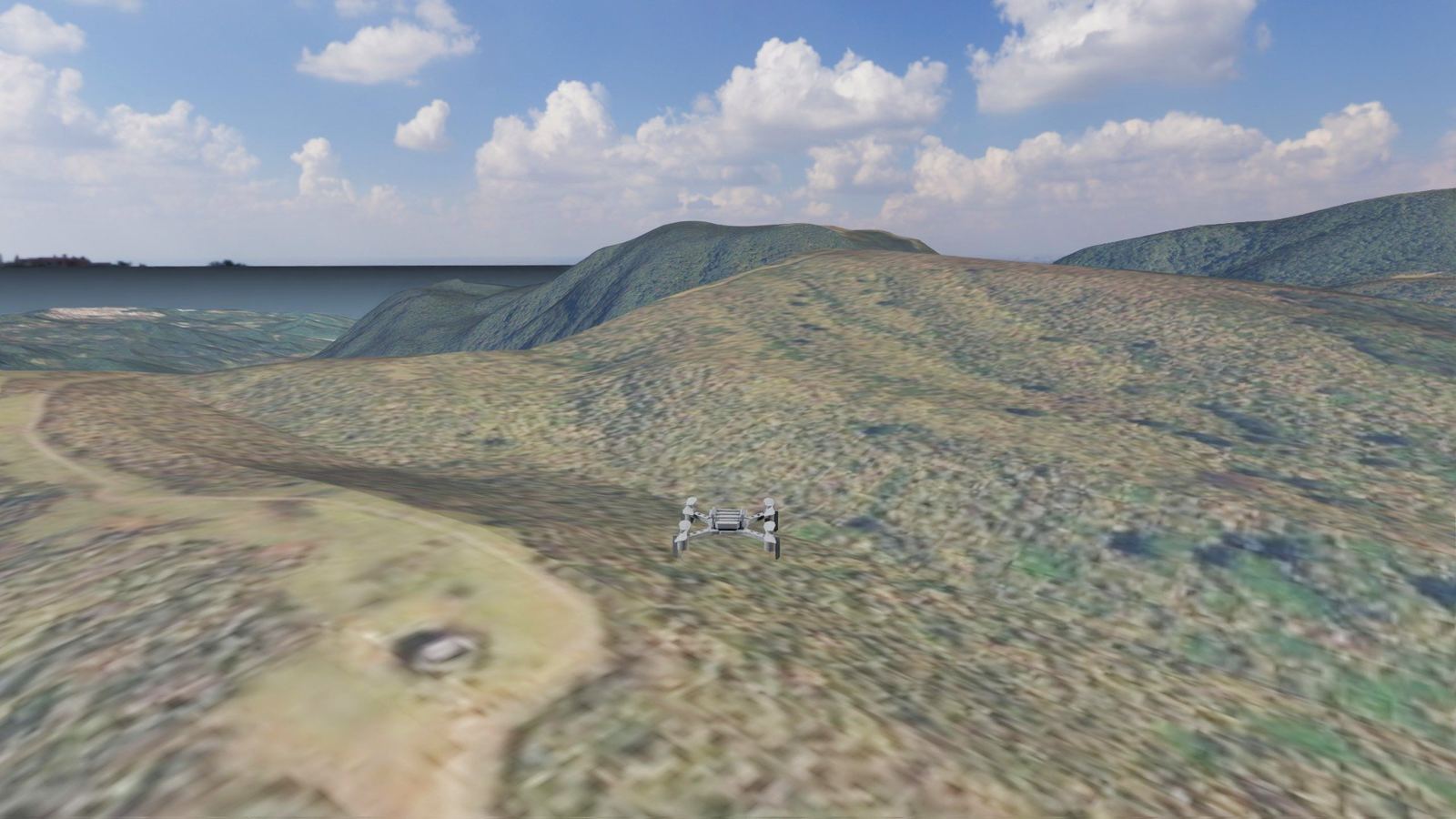
UGV mothership casualty evacuation | four drones search while four recharge on deck — the shift never breaks
The decision layer for unmanned operations
Wargame it before you fly it.
BAOQi turns scattered mission needs, intelligence and vehicle capabilities into courses of action you can evaluate, execute and trace. Whatever aircraft a unit already has, we get the most combat power out of them: before anything launches, the fleet and the plan have already been fought hundreds of times on real terrain.
More vehicles. Decisions can’t keep up.
Sensors, drones and field reports pour into the operations room at once. A commander needs to know before launch: which aircraft go, how they fight, and who takes over when one fails.
Sources: Army combined-arms battalion UAV section establishment (China Times); Han Kuang 42 drone crew numbers (Liberty Times Defense).
Set the mission. The system builds the best fleet and the best plan.
Six steps, one loop. Decision, wargaming and readiness each do their part, and every sortie makes the next wargame sharper.
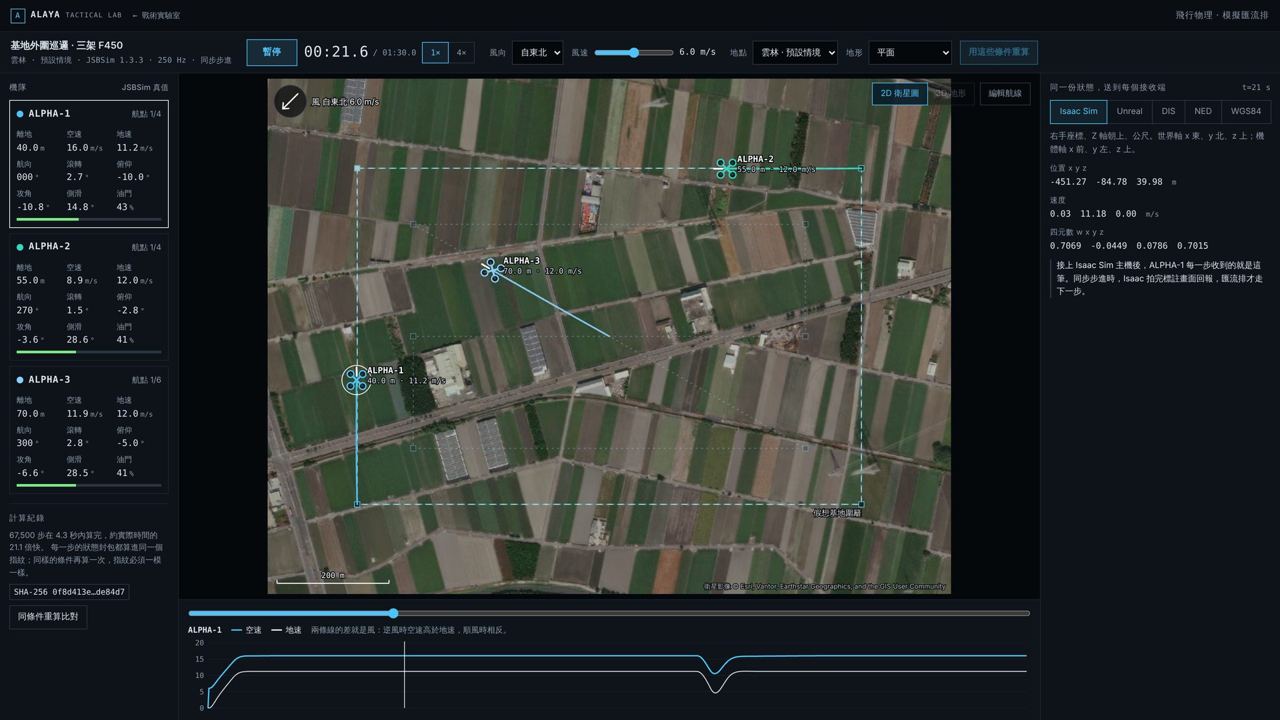
Set the mission
Location, enemy, weather, time limit and budget, set directly on the map.
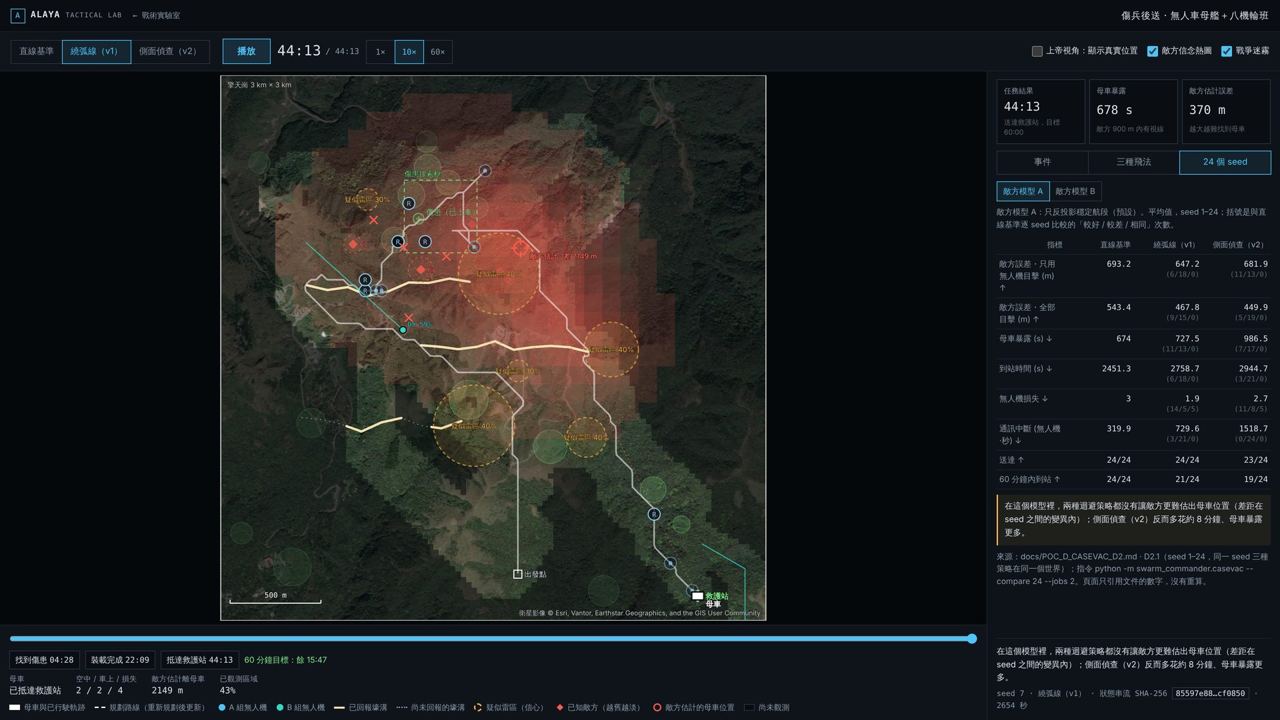
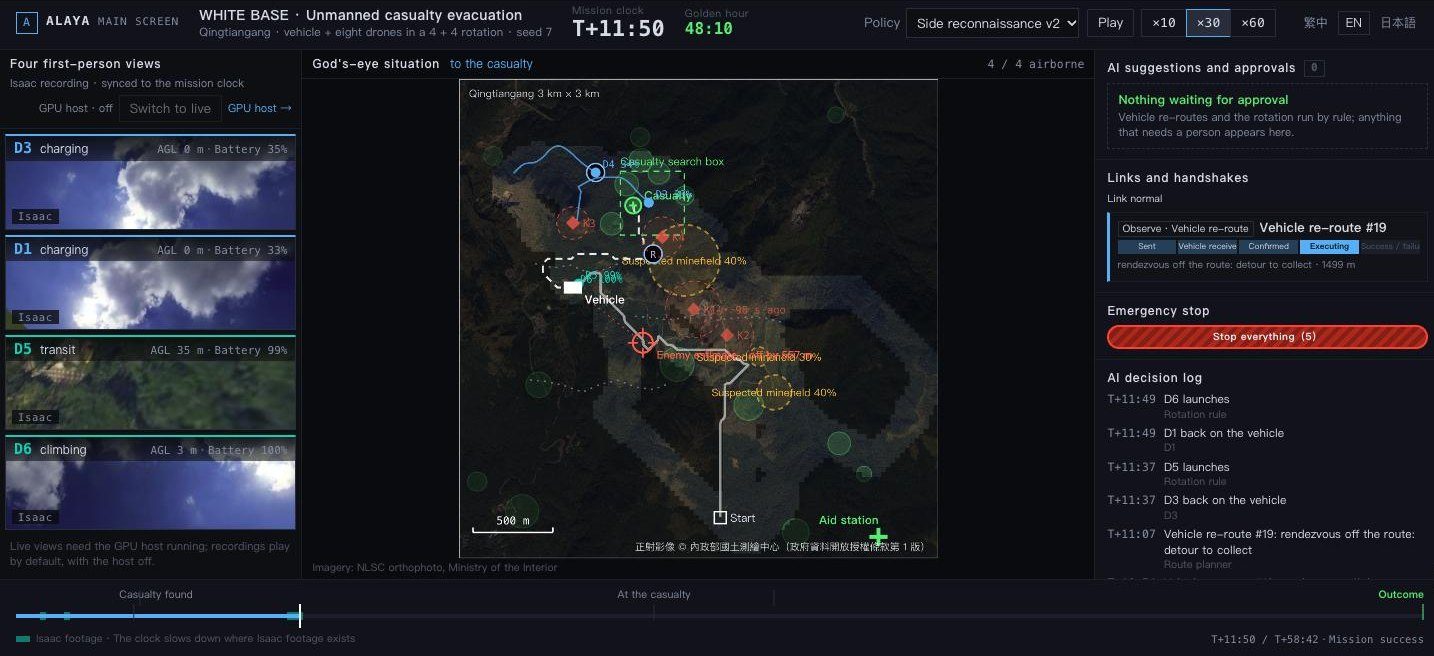
UGV mothership casualty evacuation: airborne shift handover
A ground vehicle carries eight drones forward. Four search for the casualty and watch for the enemy while four recharge on deck; low-battery drones land and fresh ones launch, keeping four airborne at all times. The right column shows each drone’s own camera.
AI finds the plays you never wrote
The commander sets the mission and the limits. The AI composes hundreds of plays on its own, tests each one on scenarios it has never seen, and lays out even the moves you hadn’t thought of. Where it can’t win, it tells you what’s missing.
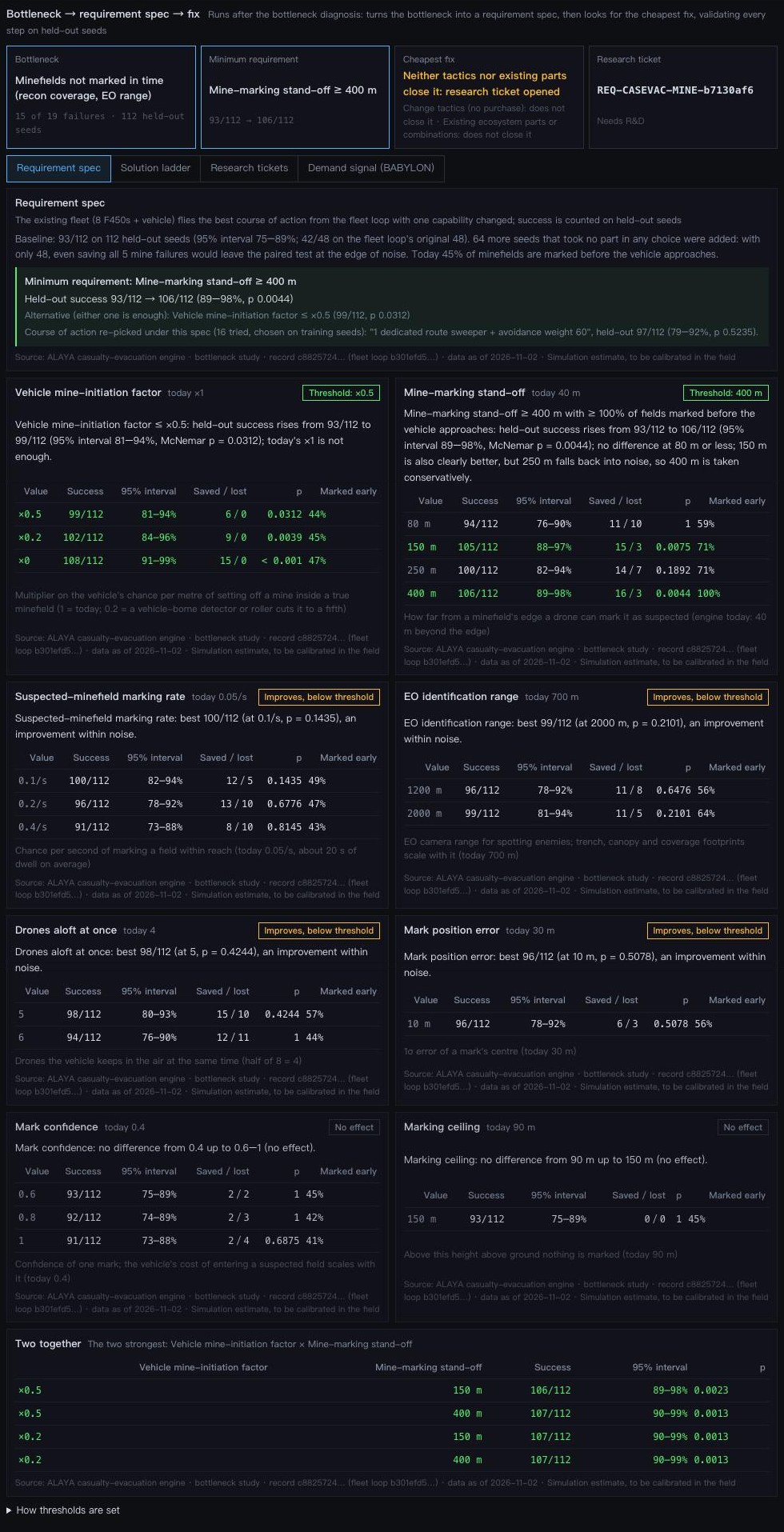
Example: the AI sends a drone to show itself where the enemy can see it, drawing their attention while the unmanned ground vehicle evacuates the casualty.
Which actions are allowed, how many aircraft can be expended and what needs approval are all set by the commander.
The AI invented a decoy play that today’s fleet can fly
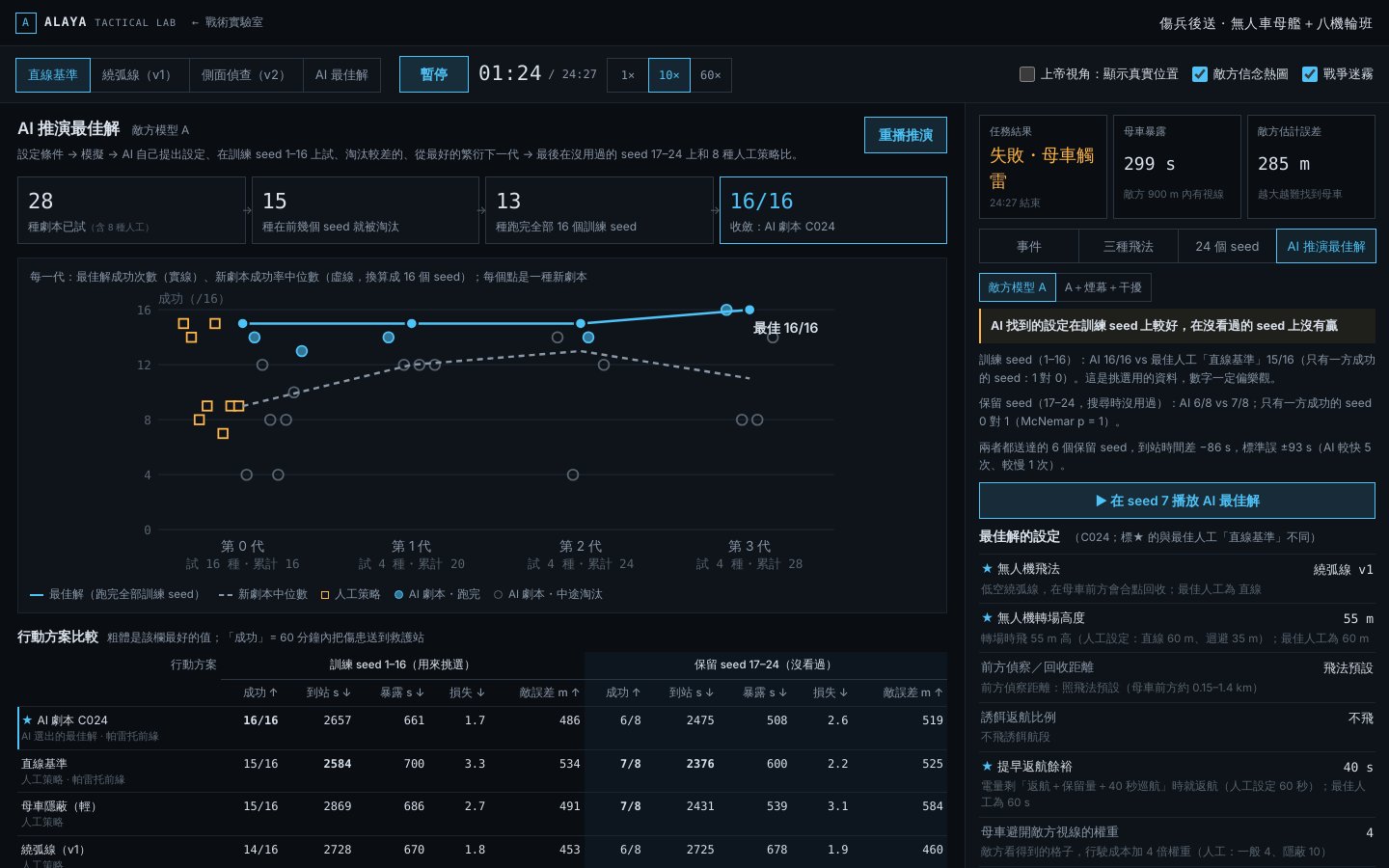
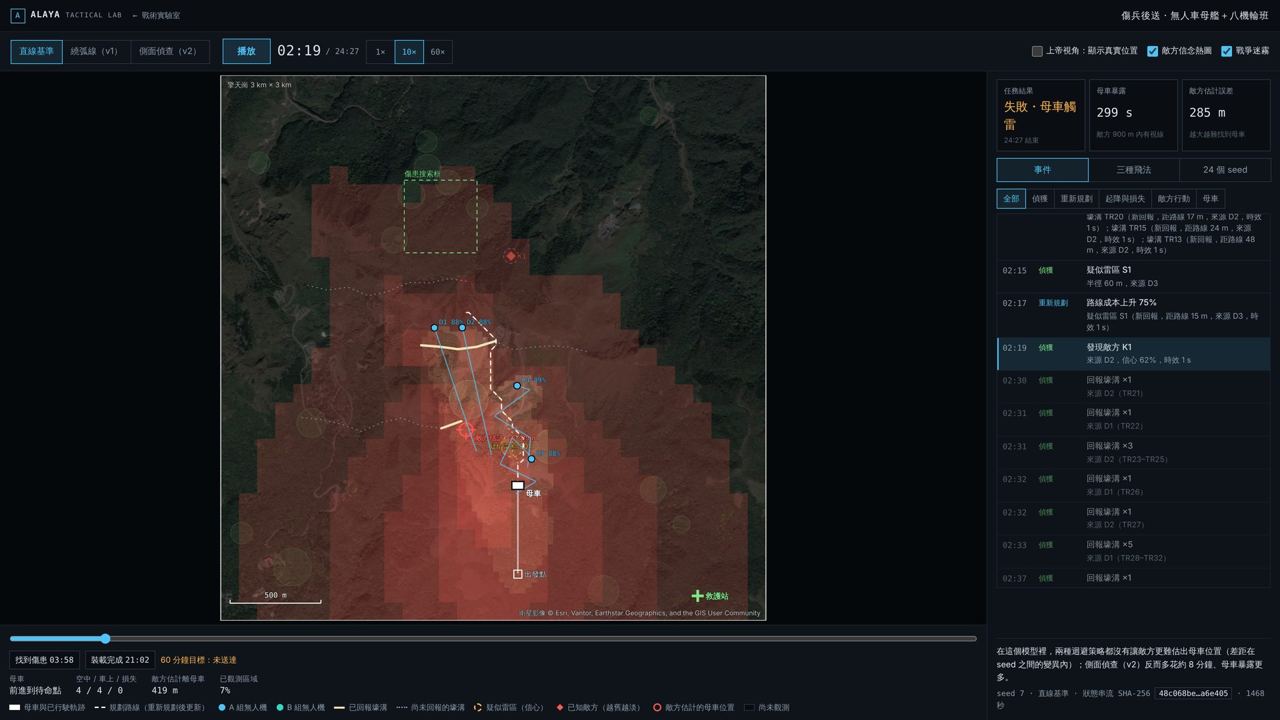
ALAYA simulates a casualty evacuation in the Qingtiangang mountains: one unmanned ground vehicle, the mothership, carrying eight drones. The red force detects and hunts the mothership, and it changes its patrol routes.
- 01Red hunts the mothershipRed detects the mothership, chases it and shifts its patrols.
- 02The AI invents a decoy playAI play search composes a play no one had written: as red closes in, one drone fakes a landing at the objective; during loading it lures red at a choke point, while the mothership dashes and switches to an alternate route.
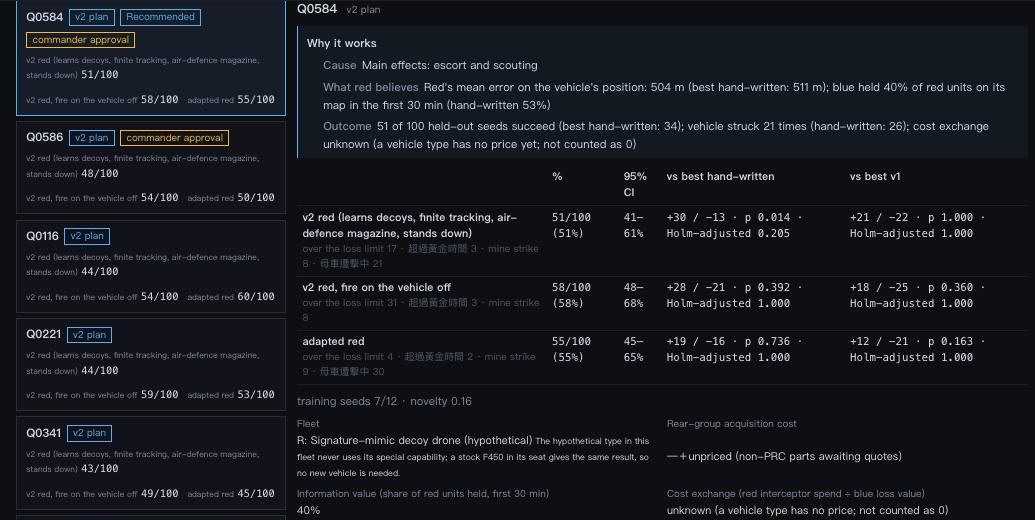
- 03Simulation: 51 vs 3451/100 vs 34/100Out of 100 held-out scenarios, the decoy play succeeds 51 times; the best hand-written play under the same conditions, 34.
- 04Runs on today’s fleetIn verification, every aircraft in the play was swapped for a stock F450, and all 100 scenarios came out exactly the same. No new equipment needed.
- 05Next idea: a signature-mimic decoyThe next idea ALAYA tests: an F450 carrying an emitter that mimics the mothership’s heat and radio signature. If it holds up, the commander turns it into a procurement spec and BABYLON sources non-PRC products.
IDEA CARD · SIGNATURE-MIMIC DECOY (TO BE TESTED)
- Payload
- ≤ 300 g · about 25 W
- Signature
- Mimics the main vehicle’s ground thermal and radio signature
- Airframe
- F450-class; can be converted from the existing fleet
- Test
- Next ALAYA run: does red take the bait, and where should the decoy sit?
- If proven
- Commander opens the procurement spec → BABYLON sources non-PRC off-the-shelf products from partners
Every step: the AI recommends, the commander approves. The system never executes on its own.
ZERO decides. ALAYA rehearses, then executes. BABYLON outfits.
The Mission Decision Support System is the core. The wargaming and readiness systems supply capability, and the approved mission package goes to each vehicle’s edge AI.
Mission Decision Support System
Decision AI, your staff officer.
When a report arrives, ZERO calls the terrain, line-of-sight, radar-horizon and ballistics engines, fights each course of action to a result, ranks the courses by success, time, exposure and losses, and hands them to a human for approval. The model is self-deployable, expert teams’ judgment plugs in as modules, and every judgment can be traced to its evidence.
- Model
- Non-PRC, clearly licensed open weights, tuned on defense doctrine, ballistics and tactics
- Deployment
- Self-hosted by the unit on Taiwan compute or its own servers, fully air-gappable
- Modules
- Expert skills plug into the Mission Decision Module Library on one contract
- Evidence
- Every judgment opens its replay and state hash
- Authority
- No mission is pushed before a human approves
Course-of-action comparison: casualty evacuation from a UGV mothership
| Criterion | COA 1Direct baseline | COA 2Heavy concealment | COA 3Light concealment Recommended | COA 4Concealment + 1 km flank scout | COA 5Concealment + 2 km flank scout | COA 62 km flank scout + decoy |
|---|---|---|---|---|---|---|
| Delivered within 60 minhigher is better | 22/24 | 16/24 | 22/24 | 12/24 | 15/24 | 14/24 |
| Mean time to aid stationminutes, lower is better | 40.3 | 43.7 | 44.0 | 50.5 | 46.1 | 46.3 |
| Mothership exposure to enemy viewseconds, lower is better | 667 | 629 | 637 | 558 | 732 | 557 |
| Drones lostaircraft, fewer is better | 3.0 | 2.5 | 2.8 | 1.8 | 1.6 | 1.3 |
| Enemy error locating the mothershipmetres, larger is safer | 681 | 736 | 697 | 782 | 865 | 815 |
Recommend COA 3, light concealment. It delivers 22/24, the same as the direct baseline, with less mothership exposure and a harder target for the enemy to locate, at a cost of 3.7 minutes on average.
Heterogeneous Unmanned Vehicle Cooperative Operations Wargaming System
Fight it in the wargame first, then hand it to the vehicles.
Drones, UGVs and USVs split the work, hand off and replan on the same real terrain against a red team that adapts. The winning plan, once approved, becomes a mission package executed by each vehicle’s edge AI.
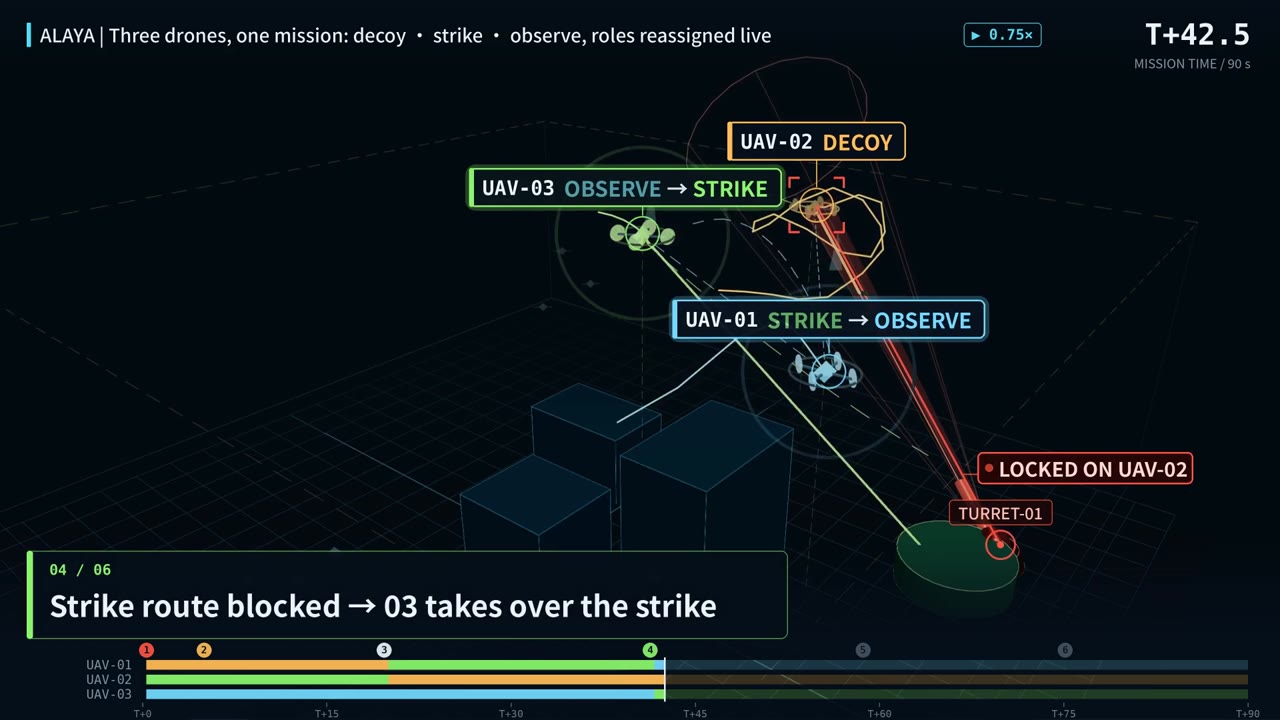
Multi-Drone Cooperative Penetration Wargaming System
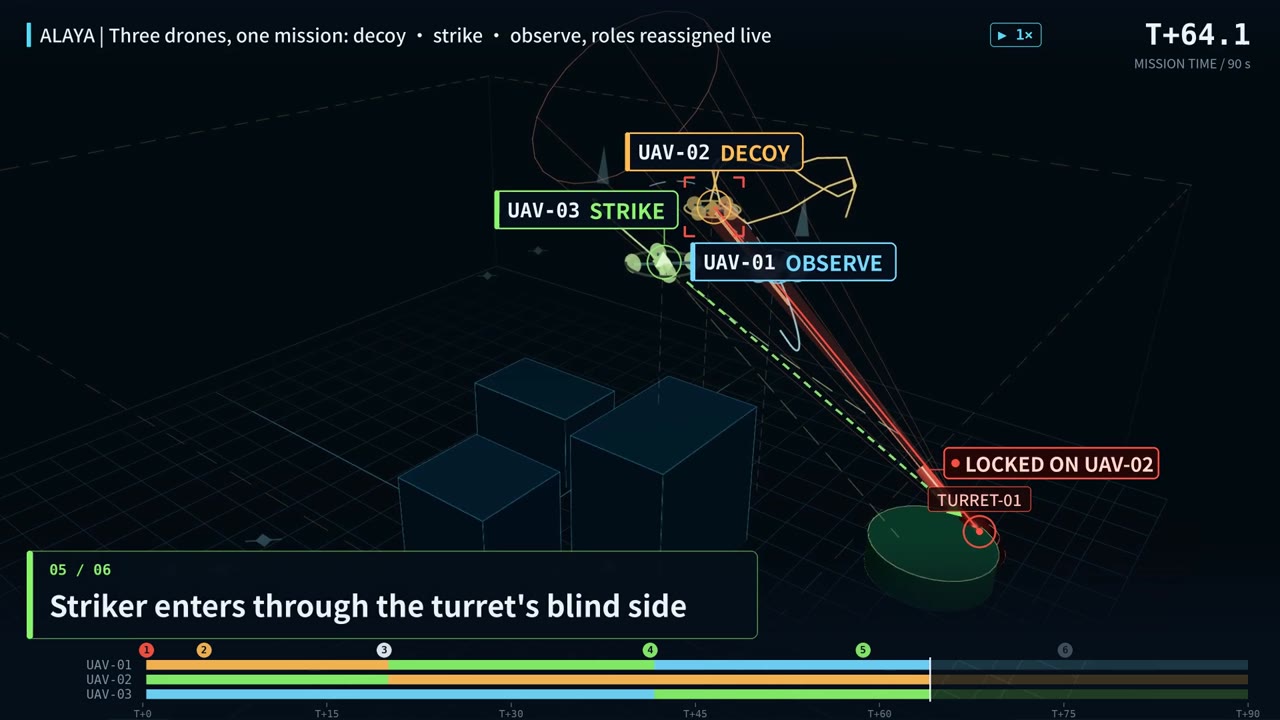
Three-drone 3D decoy approach with dynamic role reassignment. One drone closes fast to pressure a counter-drone turret and force it to turn; the observer coordinates the single attacker into the turret’s blind spot as it swings back. Whoever the turret locks, or whichever route fails, roles are reassigned on the spot.
- 1T+00Opening roles: 01 decoy, 02 attack, 03 observe; the turret locks 02
- 2T+20The turret is still locked on 02, so 01 and 02 swap roles
- 3T+4201’s attack route is blocked: 03 takes over the attack, 01 observes
- 4~T+64The striker enters through the turret’s blind side
- 5~T+75Mission complete, decision log sealed
MINOVSKYComms-Denied Multi-Drone Autonomous Cooperation System
Wingmen you can see. When the link is jammed, each drone watches its wingmen through a wide-angle camera and holds its role and formation by shared tactical rules, each covering the others’ blind spots.
- A fast interceptor closing from behind is spotted by a wingman first; with no link, a sharp turn passes the warning.
- The drone a ground shooter is aiming at manoeuvres at once and swaps roles with a wingman.
Wargame first, then deploy: ALAYA tells you the real bottleneck
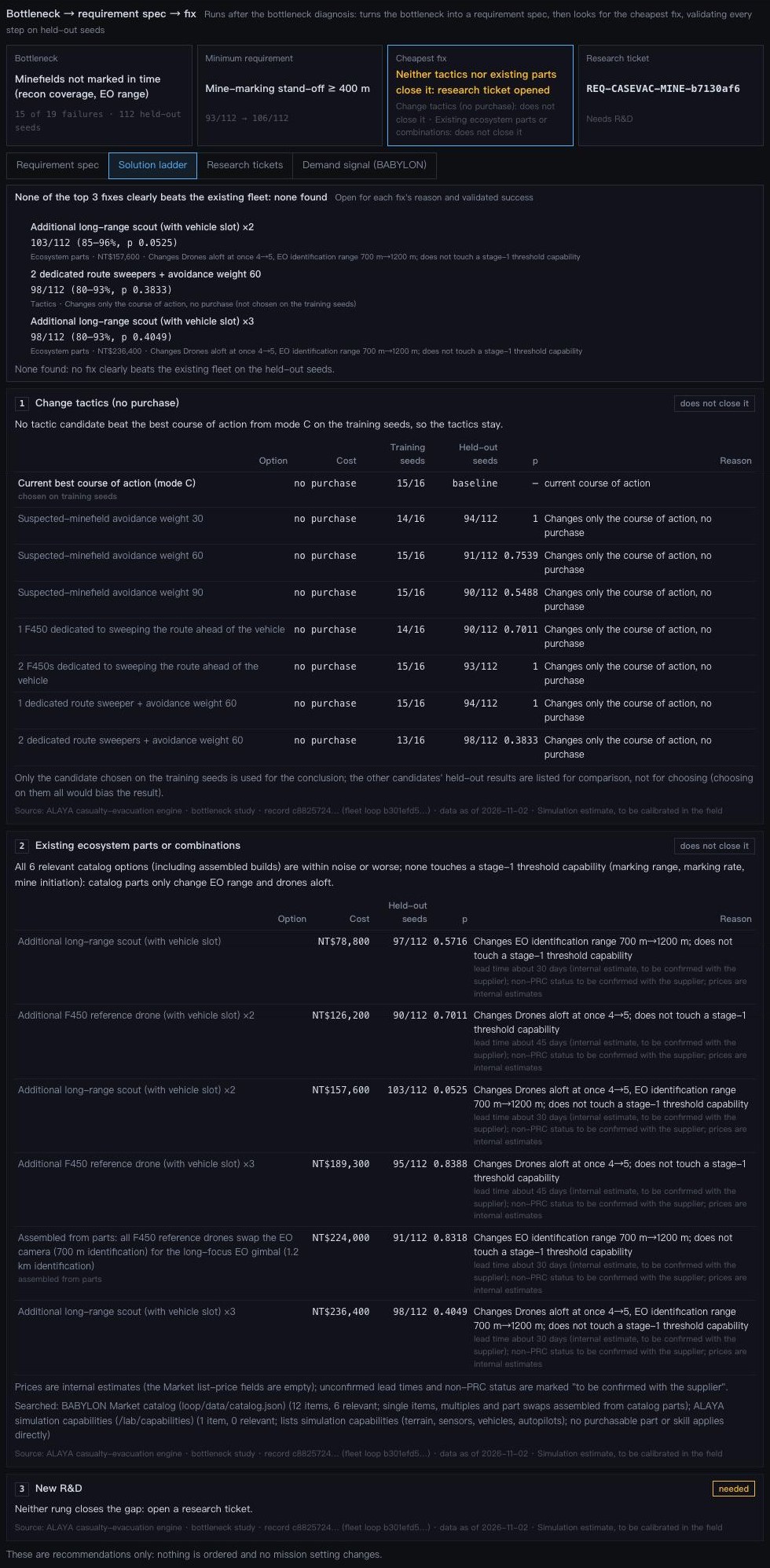
ALAYA does more than plan the mission. After the wargame it pinpoints the link where the mission actually breaks and turns it into an evidence-backed requirement spec: how much capability is enough, below which value nothing changes, and which upgrades make no difference at all. It then searches for the cheapest fix, from a change of tactics to ready-made parts and builds in the BABYLON ecosystem, validating every rung on scenarios that were never used to choose. When nothing on hand closes the gap, it opens a research ticket with the thresholds, the evidence and the expected payoff, ready for R&D and procurement.
The AI finds the plays no one scripted
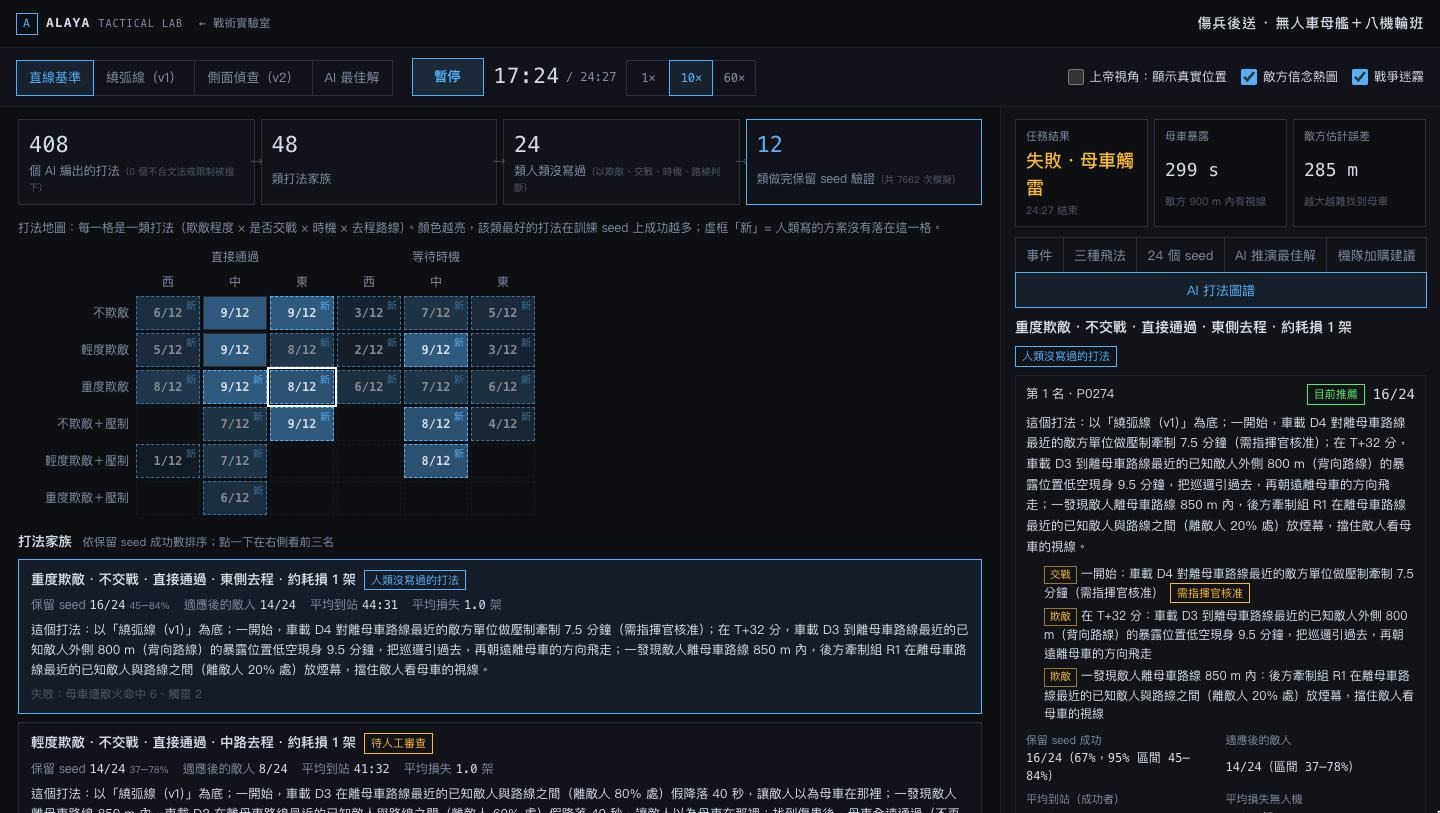
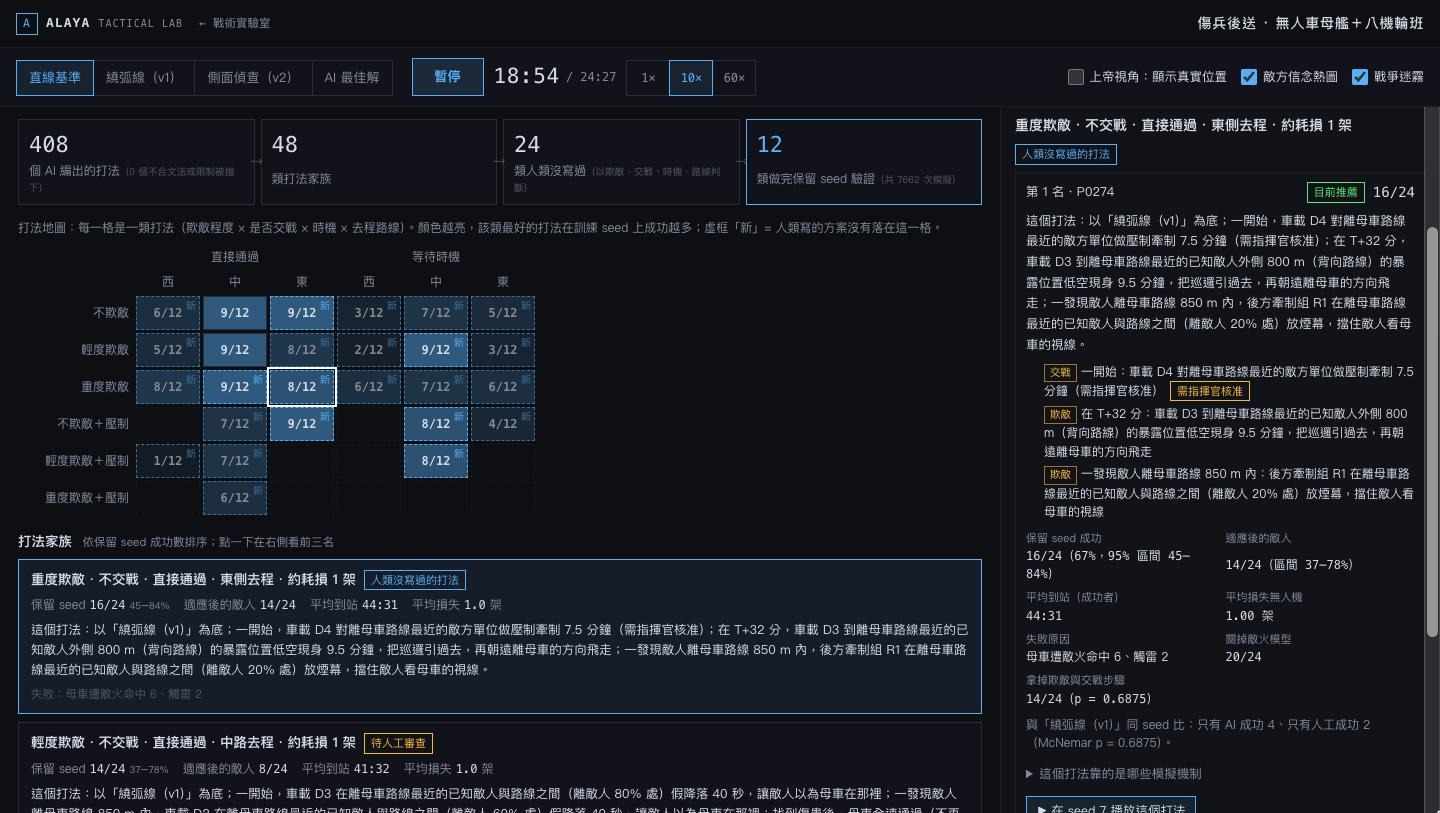
ALAYA does more than tune the tactics a human already wrote. It composes complete courses of action from building blocks—route clearance, escort, airborne relay, deliberate exposure to draw a patrol away, false landings, screening, suppression, vehicle holds and re-routes—and keeps the best of every family, so whole families of tactics no one scripted come to the surface: 24 in combat-vehicle mode and 20 in medical-marking mode. The leading plans are stress-tested against an enemy that adapts, then explained in plain language: who does what, and when. Every engagement step waits for the commander’s approval; the commander keeps authority.
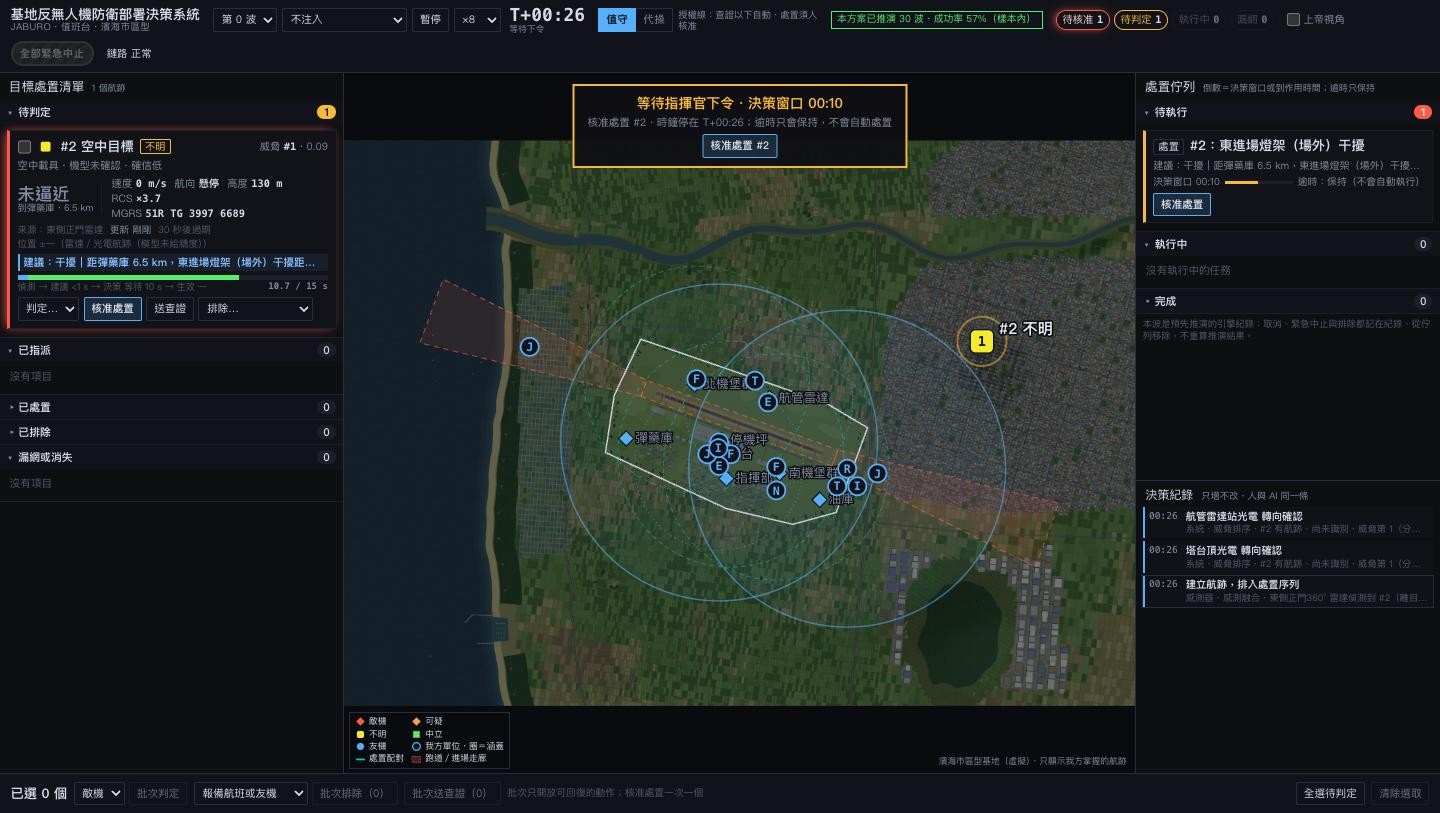
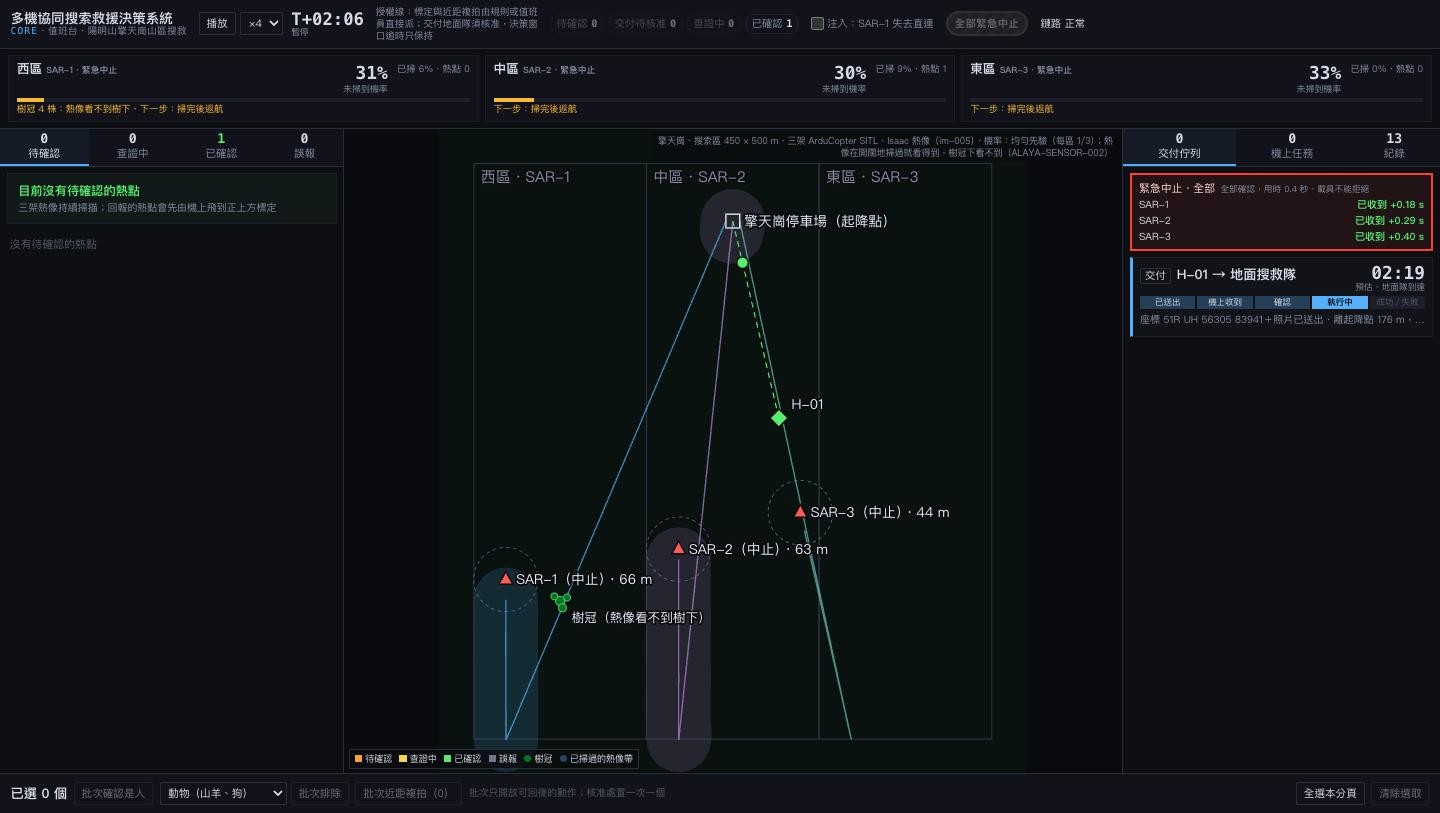
One operator, many tracks: the JABURO, MAGELLAN and CORE duty consoles
ALAYA’s three duty consoles let one operator run many tracks and contacts at once: triage lists grouped by state, an AI recommendation with a one-line reason, and the top three options side by side with their validated success rates, marked “unvalidated” where none exist yet. Every task shows its handshake from sent to received, confirmed, executing and success or failure; emergency stop runs on a channel of its own, separate from cancel, every asset acknowledges it, and a banner flags a degraded link the moment it happens. When the decision window runs out the system holds and never executes on its own, engagement waits for the commander’s approval, and every decision lands in a hash-chained log you can export for after-action review.
Unmanned Vehicle Procurement and Readiness Platform
Build the fleet for the mission.
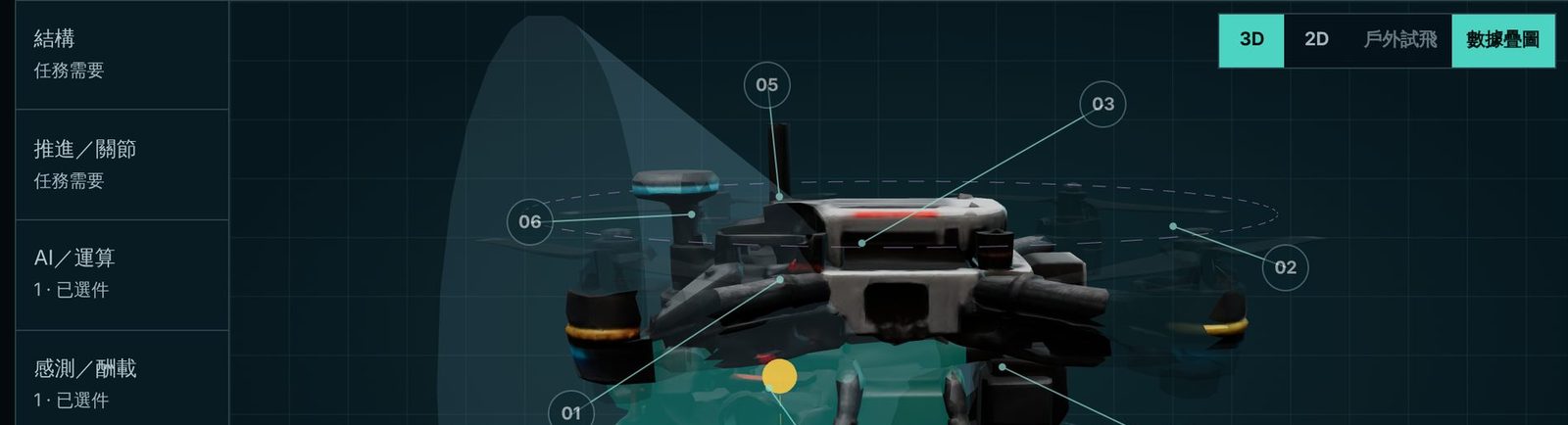
Build the fleet a mission needs from Market stock, or from modular airframes, swappable payloads and structural parts 3D-printed at a forward base. Centre of gravity, sensor cones and comms range update as you pick parts, and the configuration goes straight into an ALAYA wargame.
RXUnmanned Vehicle Configuration and Maintenance Record System
Trusted engineering data: parts, changes, capability evidence, substitutes and maintenance history for every fielded system, with access control and version tracing.
Mission Decision Module Library
One decision layer, many mission modules. Military, police and fire share the same decision layer and each plugs in its own modules. Every module follows one contract, so it can be wargamed, ranked and pushed the moment it plugs in.
- Mission inputsLocation, enemy, resources
- Simulation engineALAYA
- Pass/fail ruleSet per module
- Ranked COAsZERO
- Edge mission packageSigned and pushed
Base Counter-UAS Defense Deployment Decision System
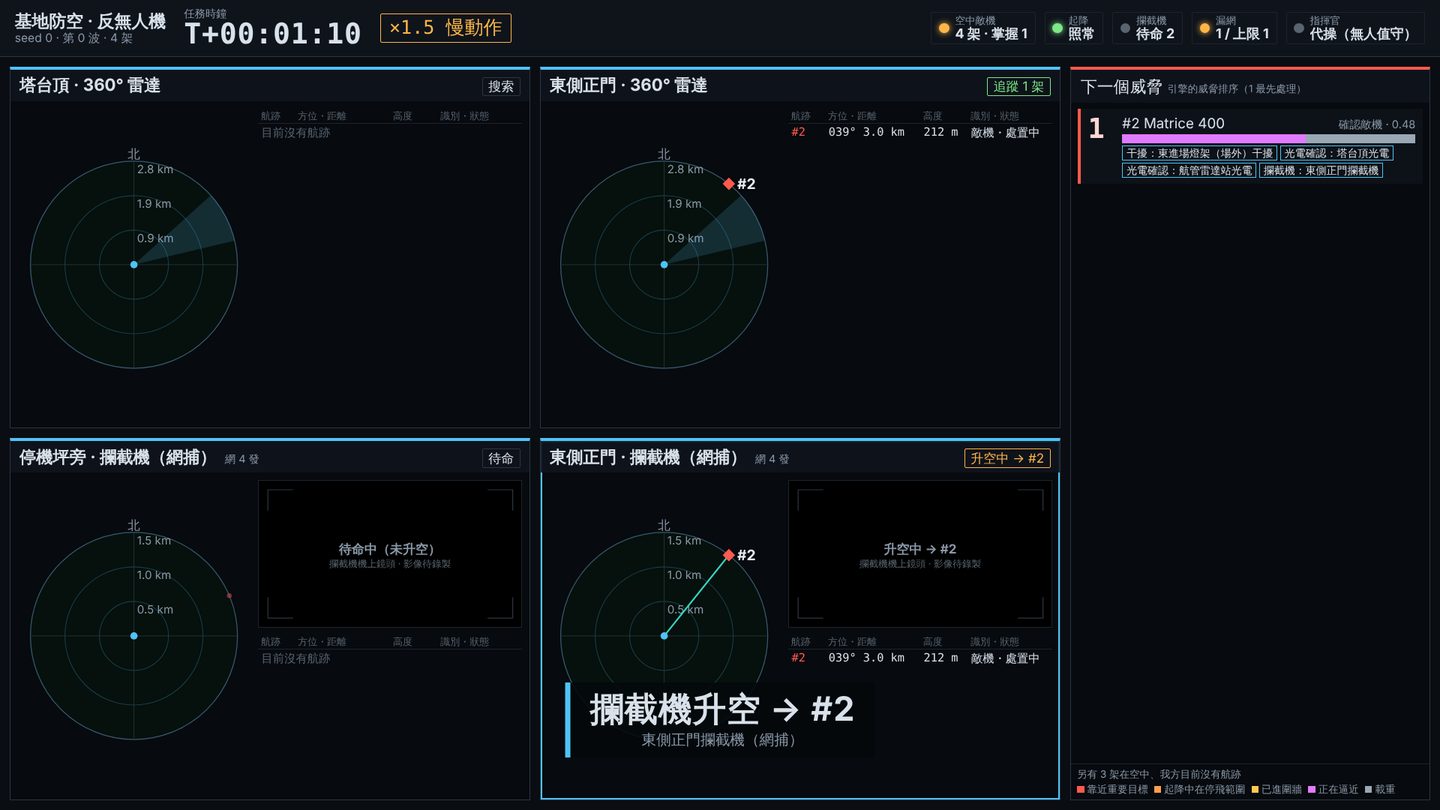
At night, several small drones close in low and quiet from different directions. The position already has radar, EO, jammers, nets, guns and interceptor drones, with only one or two people on watch. On an offline edge computer the system fuses every track, ranks the response order and recommends the best existing effector for each target with its reasons. Nothing acts until an operator confirms.
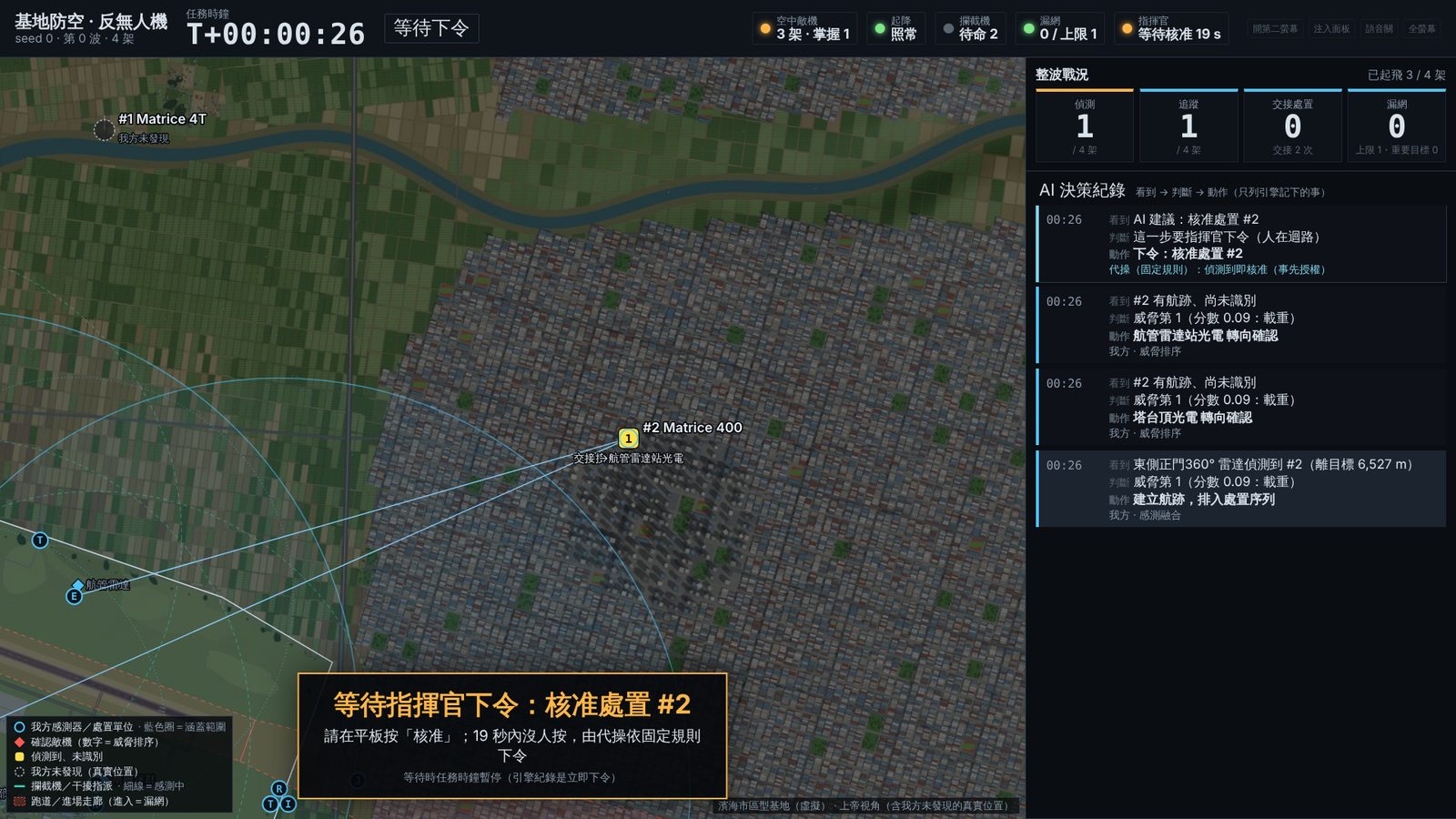
Detection to recommendation < 1 s; the rest is for the human.
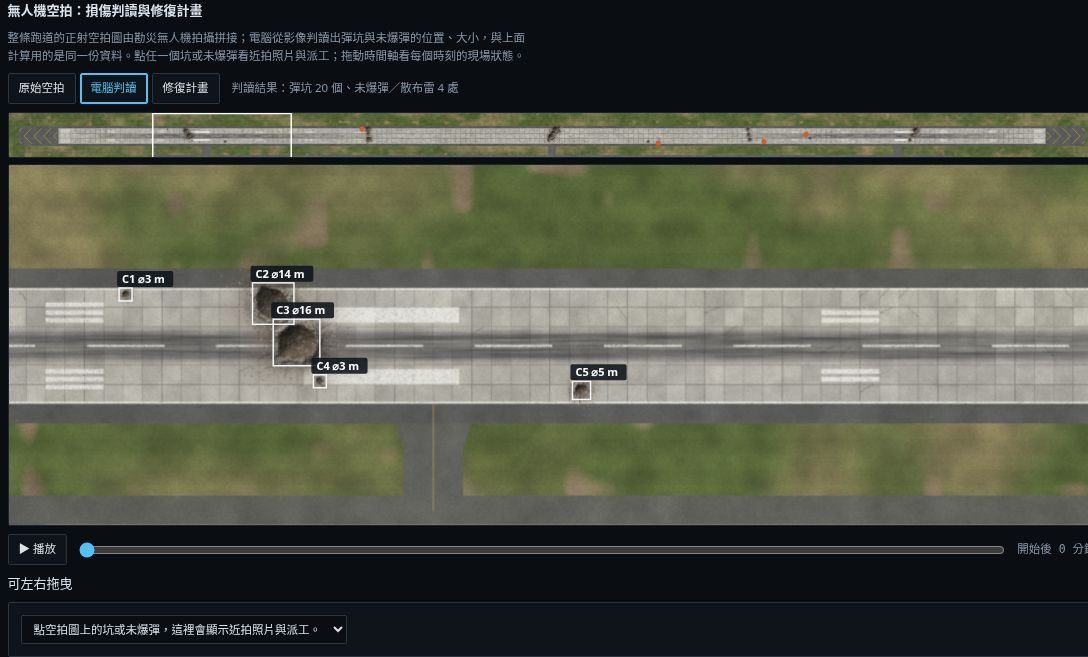
Base Damage Assessment Decision Support System
Operations research does the solving. AI turns spoken field reports and incomplete data into solvable constraints, and re-plans as soon as conditions change.
| Metric | Traditional OR + manual modelling | BALL |
|---|---|---|
| Modelling time | Model built after manual data clean-up | Spoken reports become constraints directly |
| Re-planning time | Model rebuilt when conditions change | Re-plans automatically |
| Constraint violations | Checked by hand | Checked rule by rule |
| Solution quality | Depends on the modeller | Same solver, with evidence |
All modules
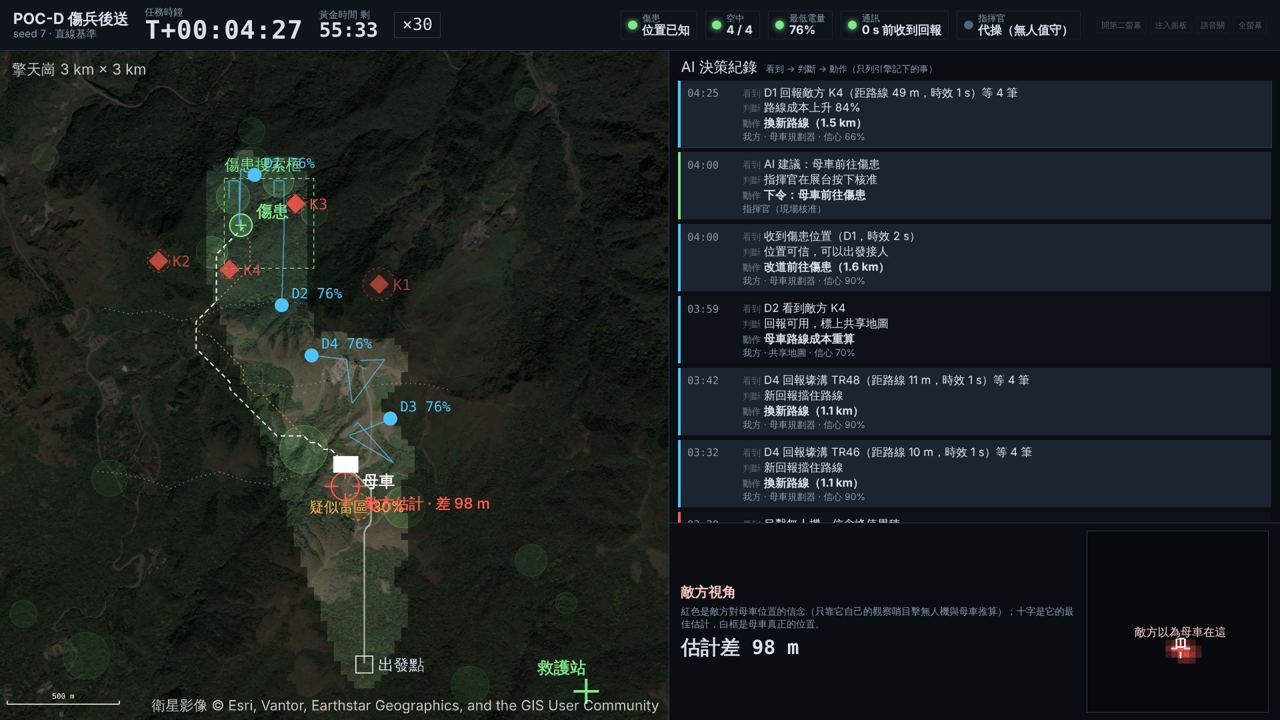 Unmanned Casualty Evacuation Decision Support SystemA UGV mothership with eight rotating drones finds the casualty and reaches the aid station.Pass/failDelivered within 60 min; a mine strike, a timeout or total comms loss is a failFUNNELLand
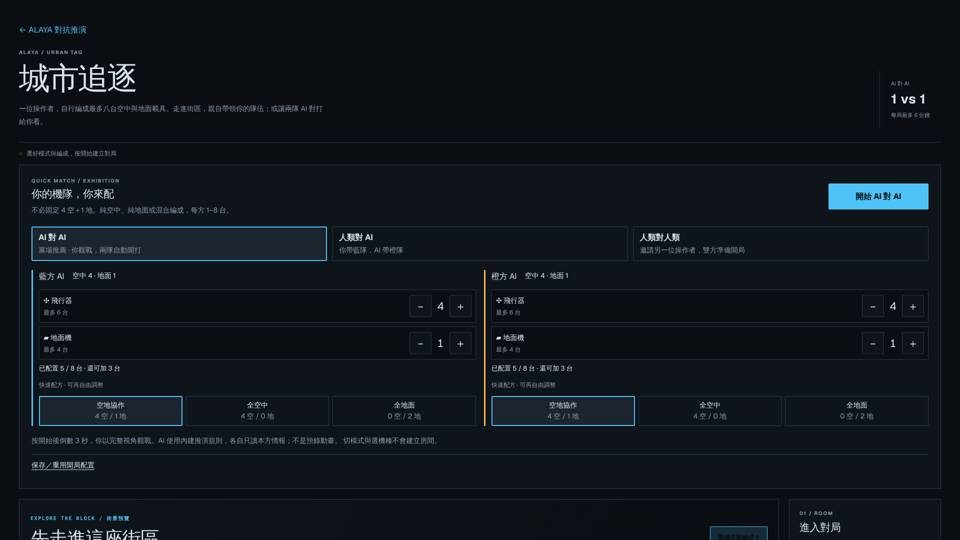 Urban Drone Tracking and Containment Decision SystemA mixed air and ground team tracks and boxes in a target through city blocks.Pass/failTarget contained and caught in timeMAGELLANSea
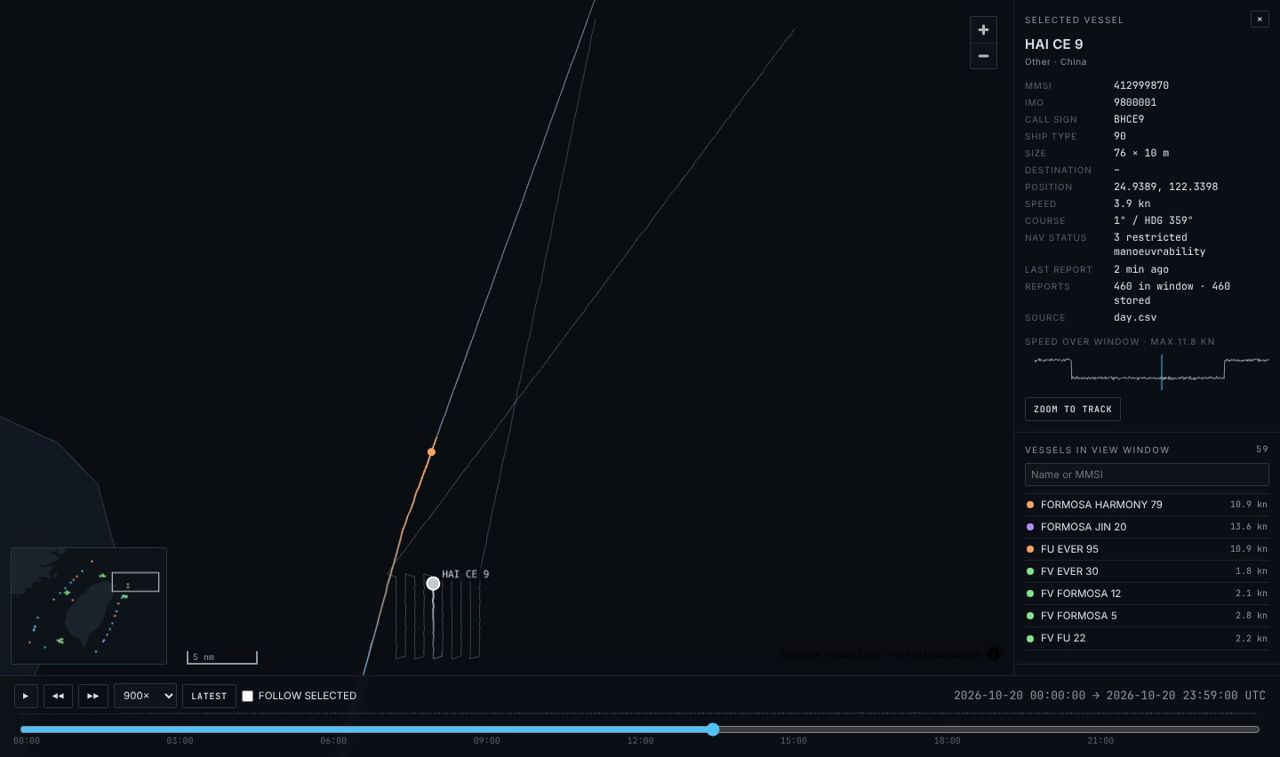 Maritime Suspicious Vessel Track Analysis SystemAIS tracks reveal seabed survey, AIS going dark and loitering.Pass/failFlagged, with reasons, before the vessel leaves the sensitive areaJET STREAMAir
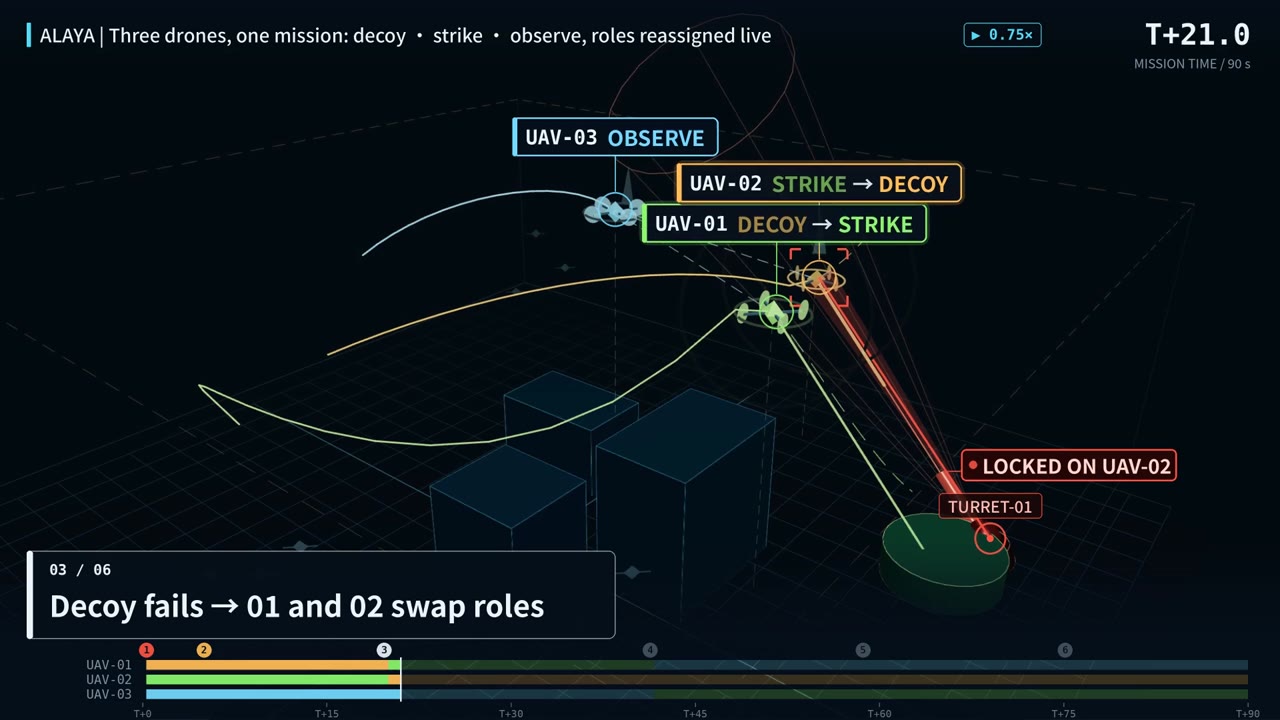 Multi-Drone Cooperative Penetration Wargaming SystemDecoy, observer and attacker reassign roles as the turret’s lock moves.Pass/failEntry completed inside the mission window, evidence chain sealedMINOVSKYAirComms-Denied Multi-Drone Autonomous Cooperation SystemWith the link down, wingmen watch each other through wide-angle cameras to keep roles and formation.Pass/failMission completed under comms loss, fleet survivesJABUROBase
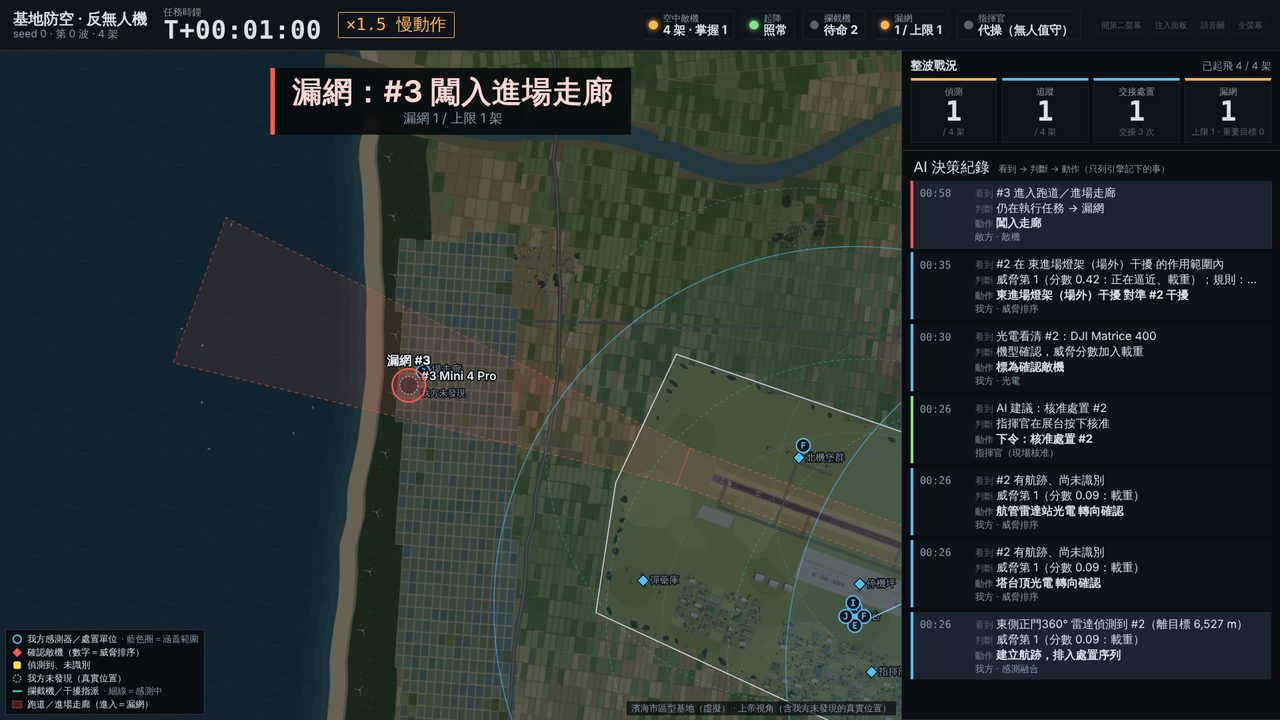 Base Counter-UAS Defense Deployment Decision SystemMulti-direction night raids; response order and best effector.Pass/failLeakers stay at or under the limitBALLBaseBase Damage Assessment Decision Support SystemDamage reports become a repair schedule that re-plans as conditions change.Pass/failShortest time to first aircraft launchMEDEADisaster
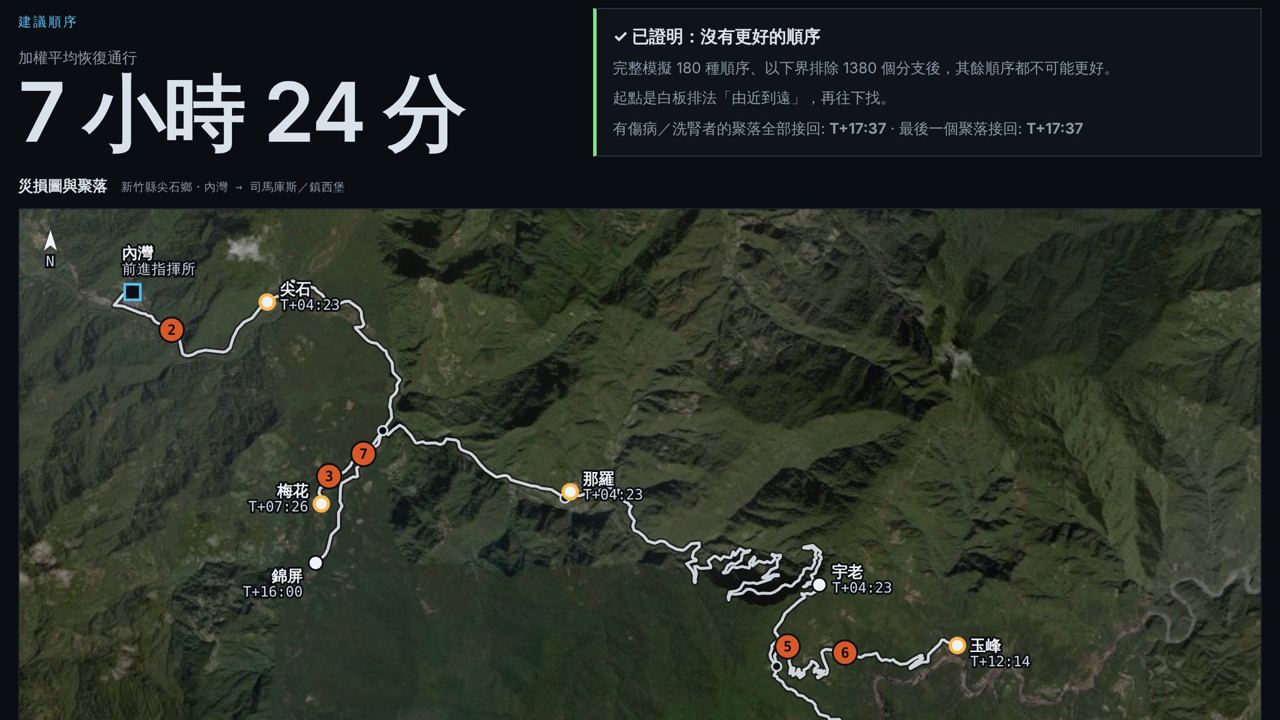 Post-Disaster Road Reopening Priority Decision SystemAfter landslides in Jianshi and Wufeng, which stretch to clear first.Pass/failLowest weighted mean restore time, with proof that no better order existsCOREDisaster
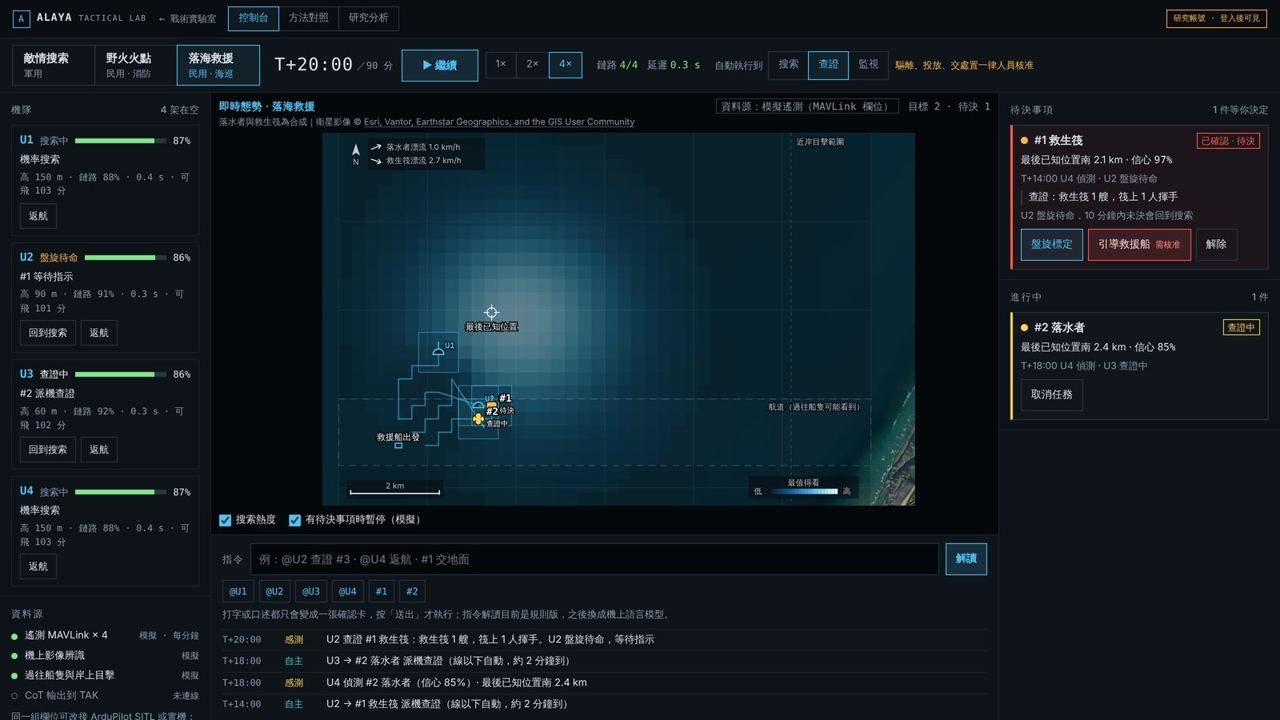 Multi-Drone Cooperative Search and Rescue Decision SystemSea, mountain and urban probability search; one find re-tasks the whole team.Pass/failSurvivor found inside the survival window
Partners and third parties build mission modules on the same contract and plug them into the decision layer through the Skill SDK. Hardware lives in the BABYLON Market; skills live in the module library.
Trusted partners. Clear interfaces.
BAOQi owns the user’s problem, defines it, designs the overall solution and leads delivery. Vehicles, equipment and specialist work come from trusted partners through defined interfaces, on a non-red supply chain throughout.

Bring us your mission.
Give us a mission problem and we send back a wargame result: the best fleet, the best plan, and a replay of every run.