

ALAYA / HETEROGENEOUS MULTI-VEHICLE COORDINATION
ALAYA
ALAYA | Formation, Kata & Mission Coordination
Project SHEEPDOG has evolved into ALAYA Wargame. Earlier research and demonstration records retain the SHEEPDOG name. Explore the current mission simulations.
Different vehicles. Shared roles. One mission.
ALAYA provides tactical decisions and mission coordination. Partner systems handle flight control, vehicle execution, and communications.
ALAYA Wargame puts heterogeneous multi-vehicle coordination at the center of mission assessment. Compare ZERO’s Formation and Kata, role transitions, mission effectiveness and fleet cost across military scenarios. Evaluate how complementary, lower-cost vehicles work as a team. The same coordination core supports different vehicle combinations and missions; search and rescue is one application.
Formation · The team’s relative arrangement and each vehicle’s role in the shared mission.
Kata · Reusable tactical coordination patterns that connect roles, cooperation, and transitions.
System roles / tactical decisions
Where BAOQi fits in the system
BAOQi decides how a heterogeneous team should divide work and respond to change. Integrated partner systems control and execute each vehicle's actions.
01 / Mission and command
Mission / command
People and existing command structures set mission objectives, commander intent, constraints and authorization.
02 / BAOQi
BAOQi — tactical decision layer
Evaluate courses of action, allocate roles and tasks, set priorities, and replan as the situation changes.
ZERO
Behavior anticipation and candidate course-of-action generation.
ALAYA
Tactical option assessment, role and task allocation, and adaptation as conditions change.
Downward: tasks, roles, priorities and constraints
Upward: status, observations and execution results
03 / Partner systems
Partner execution and control systems
Turn assigned tasks into executable actions and report status to the tactical decision layer.
- Autopilot / flight control
- Vehicle control
- Navigation
- Local collision avoidance
- Formation motion control
- Communications
04 / Vehicles and sensors
Heterogeneous vehicles and sensors
- UAVAir
- UGVGround
- USVSurface
- UUVUnderwater
- SensorsObservation
ALAYA / MISSION OUTCOMES
From individual actions to a mission completed together.
Give different platforms the roles they serve best, respond to change as a team and carry coordination through to the outcome.
Different vehicles bring different strengths. The team delivers the mission, and every result strengthens the next tactical cycle.
ALAYA / PLATFORM ASSETS
Reuse tactical knowledge in the next mission.
Capability models, mission patterns, and simulation results give the next planning cycle a shared starting point.
Cross-platform capability and mission interfaces
Bring vehicle capabilities, states and roles into one mission framework, expanding the teams that can be assembled.
Reusable coordinated missions
Retain team formations, role changes and handover patterns so new missions start from accumulated coordination experience.
Mission value and the learning loop
Feed effects, expenditure, time, reserves and future options back into decisions, building mission knowledge for the next cycle.
ONE MISSION · THREE CORE CAPABILITIES
From knowing the body to coordinated action.
Start with the mission and the mixed fleet’s capabilities. BABYLON describes the body; ZERO develops candidate kata—coordinated action patterns—and formations; ALAYA compares coordination in simulation. Self-play, review and partner-platform testing are stages of our development and validation roadmap.
Define goals and resources
Build the mission configuration
Generate tactical choices
Coordinate the whole team
↶ Assess mission value · Build strategies and experience ↶
ALAYA / MISSION TEAM
One coordination core. Multiple mission applications.
Start with mixed-vehicle roles, handovers and mission outcomes. Reconnaissance, infrastructure protection, maritime monitoring, search and rescue apply the same coordination core to different missions.
The situation changes. The whole team adapts.
The same vehicles take new roles as conditions change, keeping observations, tasks and routes aligned.
The central link drops. The mission moves on.
Carry the shared mission to the edge. Local units take over and fill gaps, then resynchronize when the link returns.
Make every resource count toward the mission.
Compare fleet configurations and coordination patterns by mission effect, fleet cost, time and reserves. Identify where complementary roles let more affordable vehicles with lower individual performance meet the team’s mission requirements.
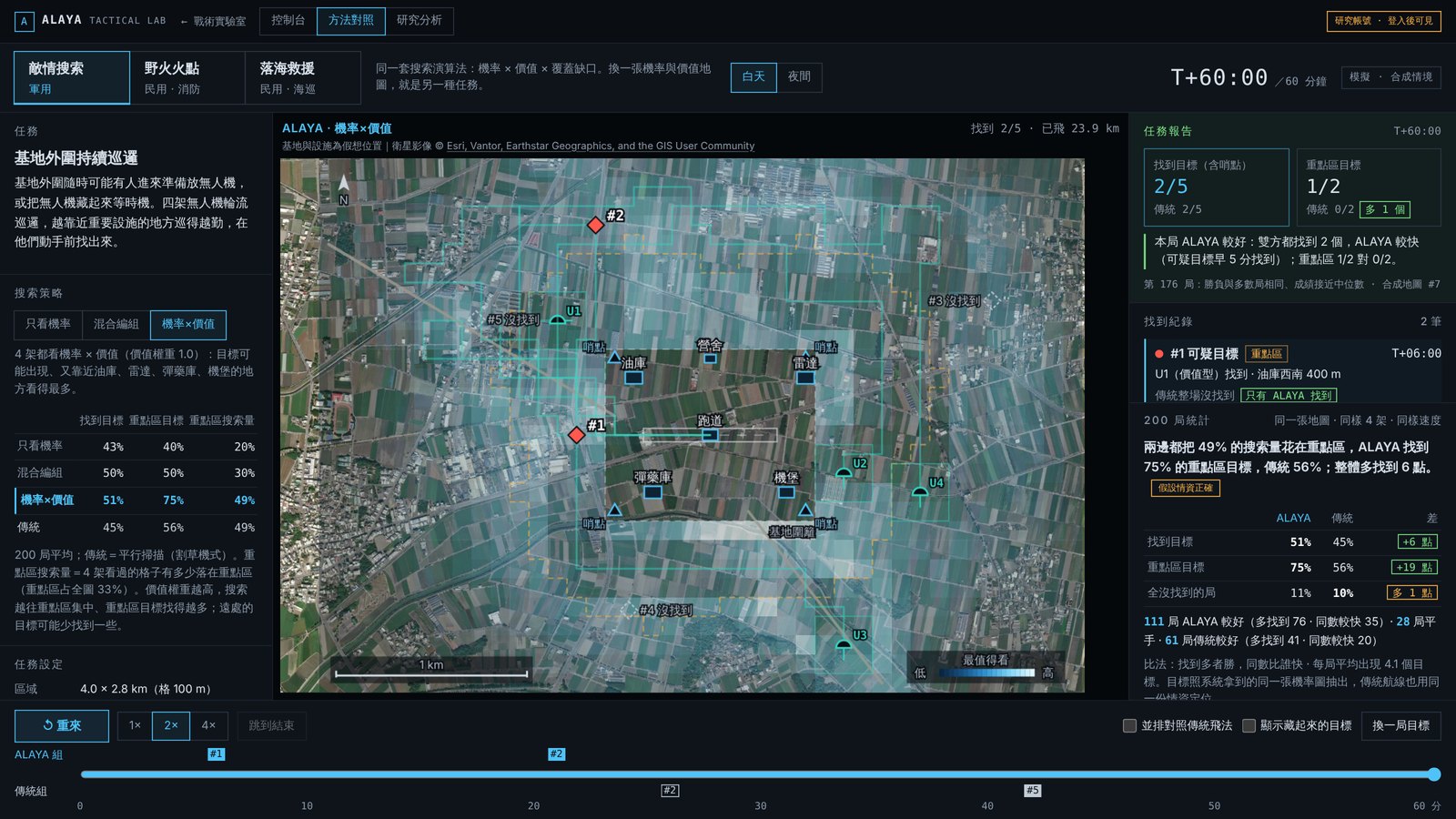
Application: weighted search vs. a conventional scan
ALAYA / MISSION LEARNING LOOP
Every result strengthens the next tactical cycle.
Assess effects, expenditure, time and reserves together. Identify the decisions that shaped the outcome, then feed the lessons into strategies, teams and resource configurations.
Put investment and outcomes together to make mission value visible.
TECHNICAL RESOURCES
Engineering & research archive.
Original English research records and engineering references. Historic names and dates remain attached to their evidence.
FAQ / responsibilities
BAOQi makes tactical decisions; partners control and execute.
- How does ALAYA connect planning and vehicle execution?
- ALAYA evaluates tactical options and allocates mission roles. Partner systems handle flight control, navigation, communications, and vehicle execution.
- How does ALAYA plan for a multi-vehicle team?
- Mission objectives, vehicle capabilities, observations, and available resources guide role allocation and coordinated plans. The simulation environment lets teams compare configurations and review the resulting decisions.
Plan the team. Test the mission. Explain the investment.
ZERO
Mission and candidate plans
BABYLON
Resources and capability configuration
ALAYA
Coordination and scenario comparison
Explore every capability
Open a capability for the full story01Different vehicles. One mission carried forward
Assign roles by capability and simulate sensing handovers, energy rotation, interrupted links and failure recovery. Compare the mission value of team coordination through Formation and Kata.
Explore the workflow ↗02Compare human and AI decisions in the same scenario
Compose air and ground teams, run AI-versus-AI or player-involved matches, and replay the roles, actions and outcomes of each session.
Explore the workflow ↗03Bring the site, equipment and resources into one planning workspace
Import site layouts and compare equipment placement, terrain visibility, resource allocation, reserves and mission delay in repeatable scenarios.
Explore the workflow ↗04Restore departures sooner. Build the budget around the outcome
Model repair machinery, clearance work, material waits, parallel crews and usable departure segments. Compare first departure, full recovery, aircraft waiting time and readiness investment.
Explore the workflow ↗05Which road opens first—and who gets out sooner?
Place machinery, crews, airlift and evacuation vehicles on a real road network. Compare plans that account for equipment arrivals, road dependencies, patient deadlines and time spent waiting.
Explore the workflow ↗06What does the next investment buy the mission?
Compare readiness levels against the same scenarios, with work orders, cost lines and resource gaps. Connect the next vehicle, repair set or budget increment to a measurable change in the plan.
Explore the workflow ↗07Connect mission simulation with autopilots and visual environments
An engineering workflow links JSBSim physics with shared timing, coordinates and state exchange across ArduPilot, PX4, Isaac Sim, Unreal Engine, ROS 2, DIS and HLA.
Explore the workflow ↗08Change the location. Rerun the question
Select a location, edit fleet routes and inspect spatial relationships through satellite maps and Cesium 3D, comparing the scene, resources and mission plan together.
Explore the workflow ↗09Make each rerun explain its differences
Connect decision logs, event timelines, AAR, source versions and hashes. Sensor CSV comparison and spatial playback turn research results into reproducible deliverables.
Explore the workflow ↗Build toward the next mission
Product roadmap01Carry simulated team roles into field integration
Expand synchronized autopilots, edge tactic cards, platform interfaces, sensor calibration and multi-vehicle trials, extending the mission evidence chain into deployment.
02Compare sensing runways as a readiness investment
The next release brings runway sensing and drone confirmation into one evaluation entry, comparing survey time, departure recovery and installation investment.
BAOQi
Bring your mission. Build the next solution.
Discuss the mission objective, available vehicles and partner systems. We can explore tactical decisions, role allocation and the integration steps needed for execution.