In mid-October 2026, Starshield terminals on Ukraine’s front line were given a speed cap of 160 km/h, without warning. Interceptor and strike drones moving faster than that lost their link. Who ordered it is still three stories: Elon Musk said Starshield is owned and controlled by the US government and that any limit on speed or usage is decided by the US military and ultimately the President; President Trump said it was neither him nor Musk; Secretary Rubio said Ukraine does not have Starshield at all. The Wall Street Journal, citing US officials, reported that Musk ordered it. Nine senators from both parties have asked the Pentagon Inspector General for an initial briefing by 1 November.
The shape of the event matters more than the name
This was not a cut-off of supply. It was a change to one parameter. The same speed-gating mechanism had been used earlier this year to stop Russian drones flying on Starlink. One switch, both directions.
You can stockpile missiles. You cannot stockpile a link, a cloud service or an intelligence feed. Money buys the goods; it does not buy the switch. And when the vendor, the White House and the State Department each tell a different story, there is no one to negotiate with. What a contract cannot fix, only architecture can.
The dangerous years are the generous ones
Taiwan’s Indigenous Defence Fighter was planned at 250 aircraft. After the F-16 and Mirage 2000 purchases were approved in 1992, the order was cut to 130, and further development stalled with it. The famous cases run the other way: Israel’s defence industry was forced into existence by the French embargo of 1967; South Korea’s self-reliance programme by US troop-withdrawal plans in the 1970s. When everything is available for purchase, nobody wants to pay to keep a domestic line alive. When you finally need it, the thing you are short of is not money but time. The countries that have held on wrote “slowly, but never stop” into the rules, not the mood: a fixed share of every budget and every procurement goes to the layer they own, whatever the ally gave that year.
Layering means choosing, not covering everything
After a week like this, the easiest conclusion is “build everything yourself”. That is a different kind of laziness, and its name is autarky. Two kinds of layer must be owned: what can be switched off remotely (software, links, data feeds) and what burns faster than it can be replaced once a war starts (munitions, the interception layer, drones). What is too expensive or too slow to own can be rented, as long as there is a degraded mode.
- Consumables: stockpiles, a domestic line, multiple sources, and stock one level down (motors, batteries, chips, fibre spools). The US can throttle your link; China can cut off your motors.
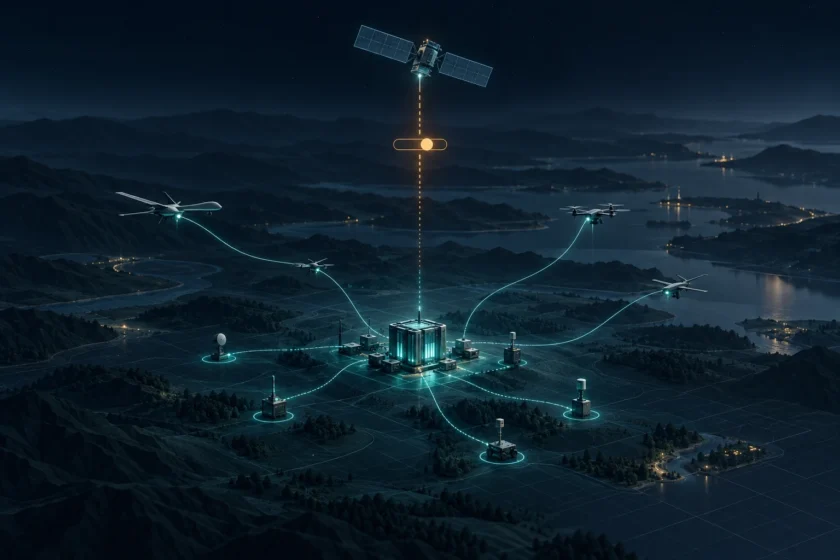
- Services: a second provider in a different jurisdiction, a ground fallback that does not depend on radio (mesh, microwave, fibre-optic drones), and finally on-board autonomy.
- Intelligence: the hardest to replace. Set the target at 60–70%: your own radar, commercial imagery contracts, non-US sources.
Then one line in every system’s requirements: with the primary link dead, which 70% of the mission can it still do? A backup that has never been unplugged in a drill is not a backup.
What this means for a decision layer
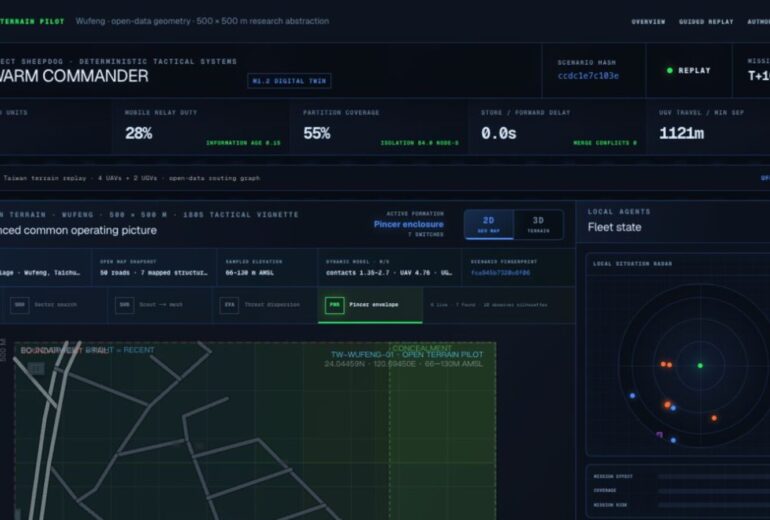
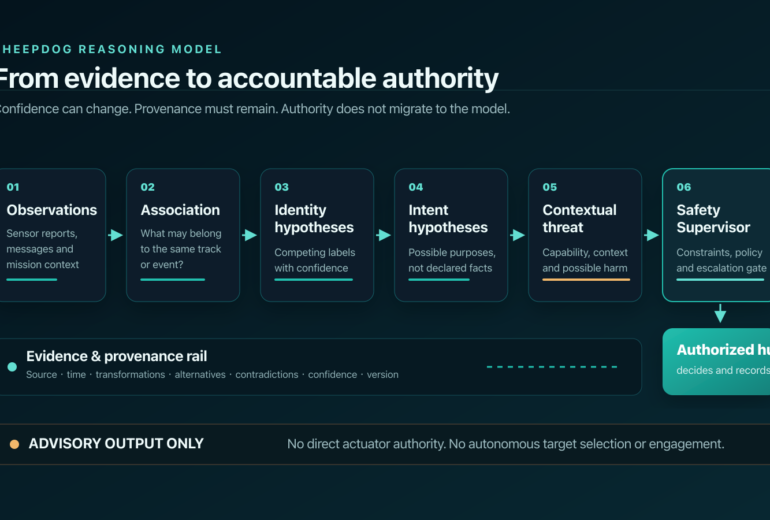
The lesson is not “the United States is unreliable”. The question is whether your system has a version that does not require anyone to be reliable. That is the design brief behind ZERO, ALAYA and BABYLON: they run inside the unit’s perimeter, on policy set by the operating authority, and “link throttled to 160 km/h” is exactly the kind of parameter a simulation should expose. Run the mission once under that condition, see which tasks survive, and only then decide which layer gets the money.
Research boundary: ALAYA is a research system; the results behind this are from simulation, advisory output with authority retained by the human. Sources: The Wall Street Journal, 20 Oct 2026; statements by Musk, Trump and Rubio, 14–18 Oct 2026; letter of nine US senators to the DoD Inspector General, 15 Oct 2026; Central News Agency, 14 Jan 2000, and Australian Aviation, 1993, on the IDF order cut from 250 to 130.