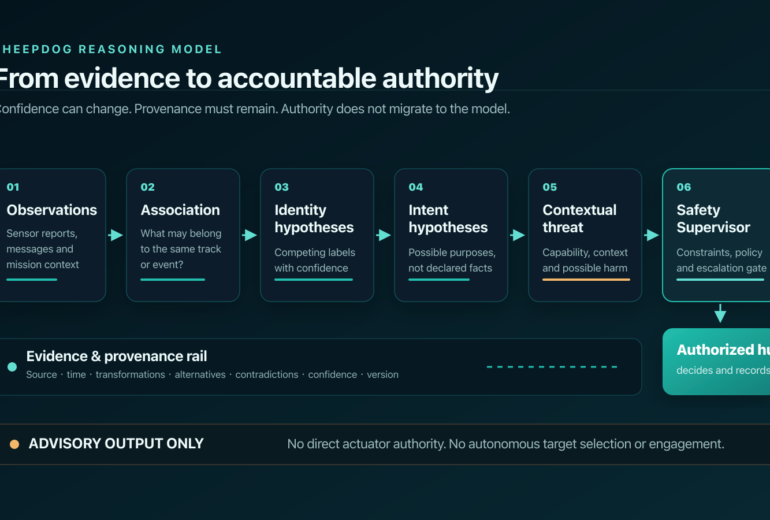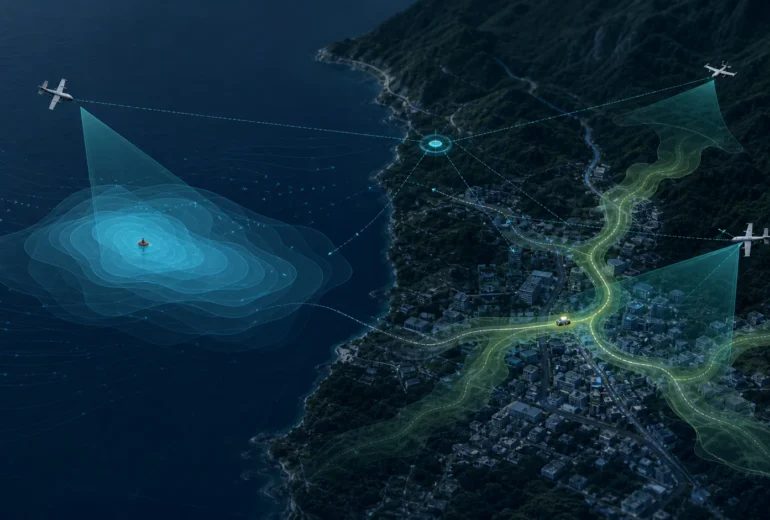
Most swarm demonstrations begin after the hardest question has already been answered: Where is the target?
That shortcut produces clean choreography, but it hides the operational problem. A real autonomous team begins with an incomplete picture. Individual vehicles see fragments, communications may be intermittent, contacts may move, and the team must decide where to look before it can decide what to do next.
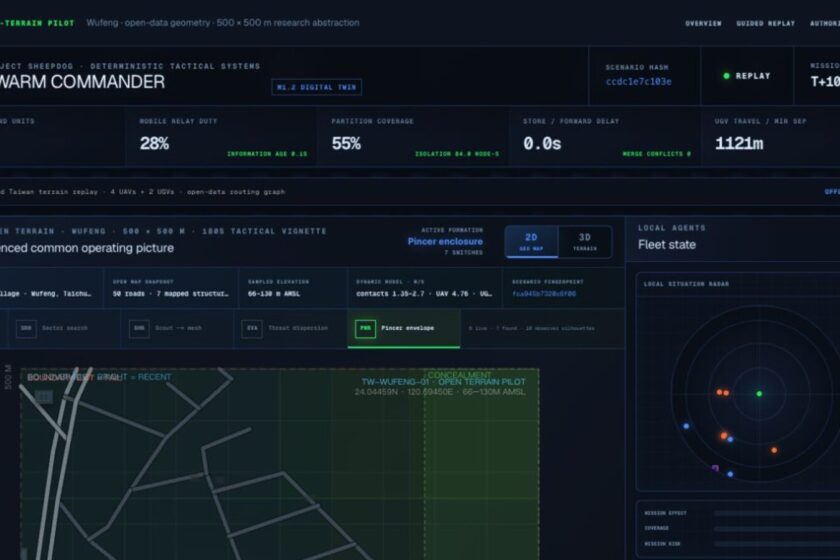
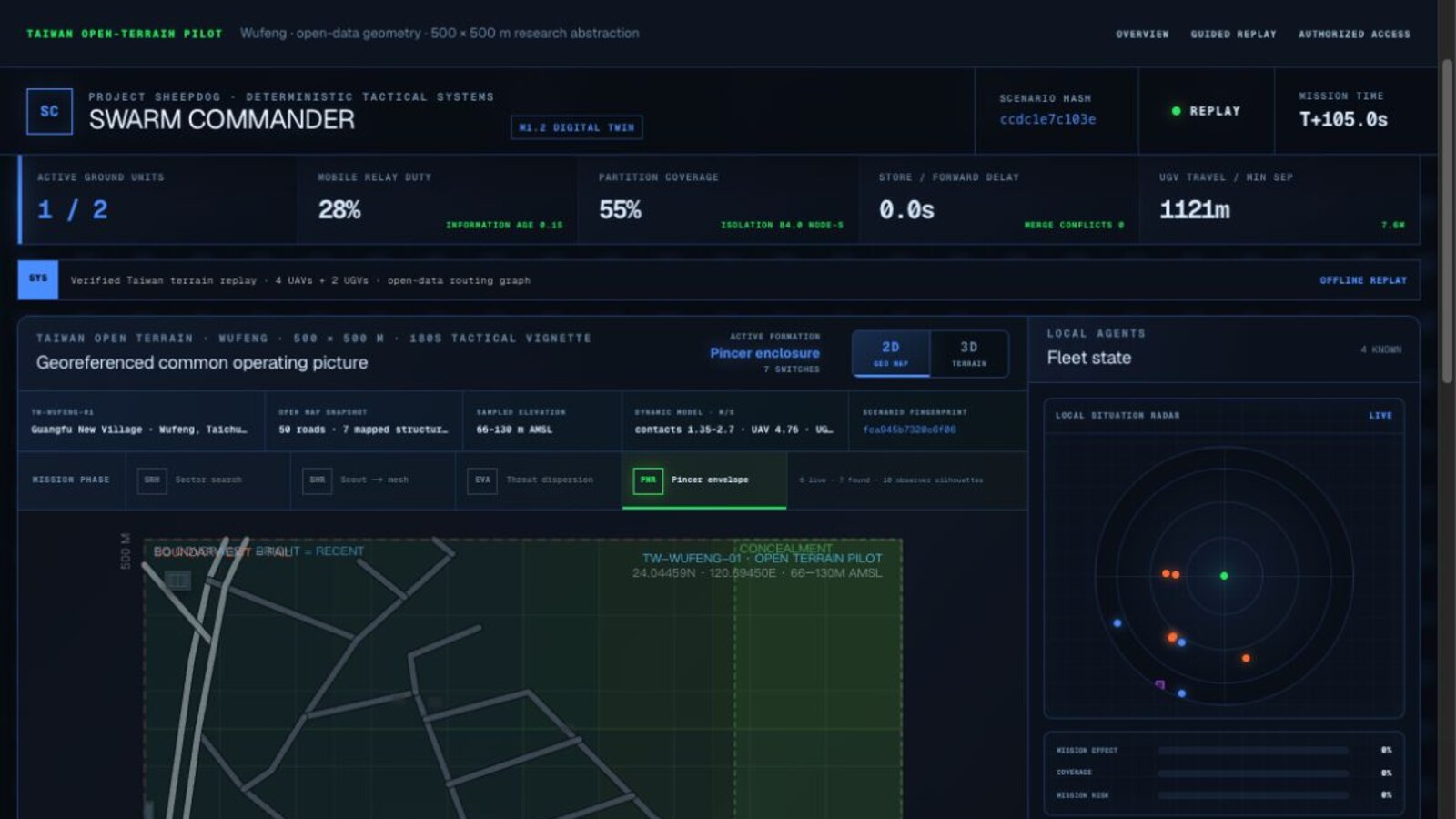
SHEEPDOG’s Taiwan open-terrain pilot starts from that uncertainty. The public replay begins from incomplete observations and shows how heterogeneous agents search, observe, share and reallocate as a common operational picture develops.
The hidden assumption in many swarm demos
When every vehicle is given a complete target list at mission start, the demonstration is primarily testing motion planning. Search becomes theatre: the system appears coordinated because the information problem has already been solved off-screen.
We test a stricter starting condition. A vehicle may know its own task, teammates and search boundary, but a contact becomes actionable only after an observation enters the shared picture. Unknown ground contacts remain visually subdued; detected and fused tracks become visible to the team. That transition—from unknown to observed to shared—is part of the mission, not a preloaded assumption.
A public five-step loop
- Search. Agents spread across bounded sectors instead of flying toward pre-known coordinates.
- Observe. Local sensor views produce partial, synthetic observations with limited geometry.
- Fuse. A central vision-fusion layer turns compatible observations into common tracks.
- Share. Track updates move across the team while the system records information age and link state.
- Reallocate. Search, observation, relay and intercept roles change as the shared picture changes.
This loop is intentionally platform-agnostic. The pilot combines UAVs and UGVs, while the underlying product thesis extends to surface vessels, fixed sensors and high-altitude relay nodes through the same capability-aware orchestration layer.
A useful swarm is not one that knows everything. It is one that can build, share and preserve a usable picture while conditions change.
Moving contacts make coverage a decision problem
Coverage percentage alone is not enough. Repeatedly scanning empty terrain can inflate activity without improving knowledge. A moving contact also makes yesterday’s observation less valuable with every passing second.
The SHEEPDOG research direction therefore treats search as a continuing allocation problem: balance unexplored space, aging tracks, observation quality, vehicle availability, terrain constraints and communications resilience. The public replay shows the resulting behaviors—sector search, scout-to-mesh sharing, threat dispersion and a pincer envelope—without publishing the private scoring logic, thresholds or route-generation methods that produce them.
What the public build proves
| Visible public proof | Retained in the private laboratory |
|---|---|
| Non-omniscient mission start and sector search | Search scoring functions and path-generation logic |
| Synthetic multi-view observations and shared tracks | Detection thresholds, fusion rules and model parameters |
| Role changes, dispersion and pincer state transitions | Assignment costs, policy weights and scenario controls |
| Terrain-aware 2D and 3D research visualization | Raw traces, evaluation harnesses and customer scenarios |
Watch the Taiwan open-terrain pilot · Request a private SHEEPDOG briefing