The most important idea behind Shield AI’s X-BAT is not its silhouette. It is the combination of runway independence, distributed basing, multi-mission reach, and autonomous teaming.
Shield AI describes X-BAT as an AI-piloted VTOL fighter jet with a wingspan of 39 feet, a maximum range above 2,000 nautical miles, and a ceiling above 50,000 feet. It is designed to launch and recover from ships, remote islands, or austere forward bases, and to operate in teams under Hivemind autonomy—including in GPS- and communications-degraded environments.
That is a large, fighter-class aircraft program. This comparison concerns architecture and constraints; SKY MECH is an independent, smaller research program with a different maturity and mission scope.
The comparison is about constraints
| System thesis | X-BAT | SKY MECH concept |
|---|---|---|
| Primary constraint removed | Dependence on conventional runways | Energy and time spent climbing from the ground |
| Deployment model | Ship, remote island, or austere forward base | Altitude-prepositioned carrier and relay node |
| Platform class | Large fighter-class autonomous aircraft | Small, low-cost, non-weaponized scout and relay research system |
| Energy logic | Self-powered long-range flight | Use altitude as a stored energy and observation resource |
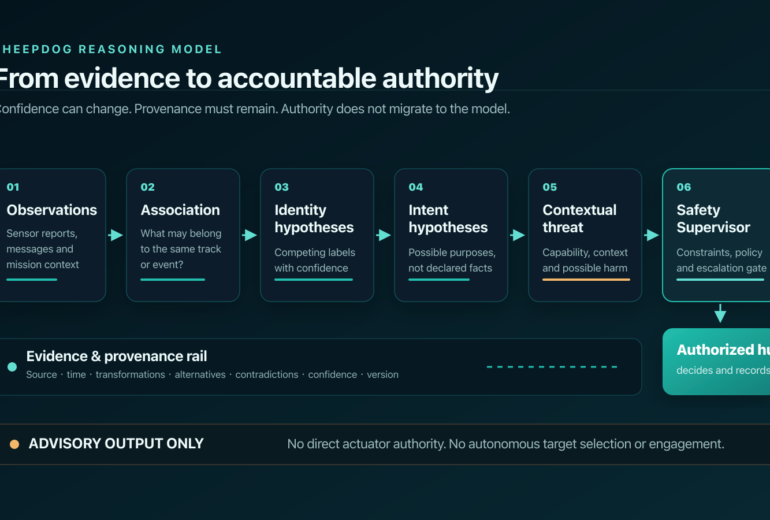
| Autonomy layer | Hivemind | SHEEPDOG |
X-BAT removes the runway. SKY MECH removes the climb. SHEEPDOG decides what moves next.
Altitude as a pre-positioned resource
If a small unmanned aircraft is expected to begin its useful work at altitude, requiring every vehicle to climb from the ground consumes energy, time, and launch capacity before the mission begins.
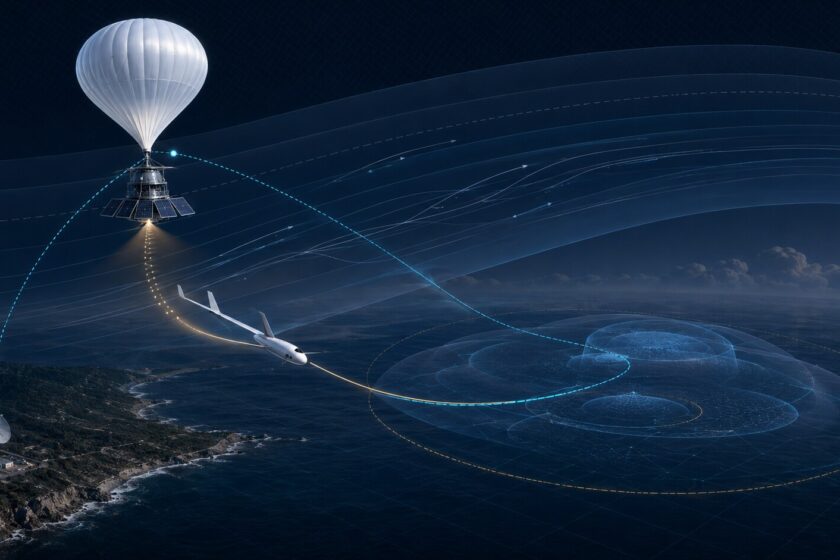
SKY MECH explores a different architecture: a low-cost aerial carrier holds sensing, communications, energy, and releasable observation assets at altitude. Small unarmed scouts can then begin with stored gravitational potential energy and use energy-aware glide paths while the carrier remains available as a relay and observation node.
The current SKY MECH P0 package is a tethered, non-weaponized engineering research platform with explicit fabrication and validation gates. Roadmap work covers free-floating operation, broader-area deployment, lifting performance, environmental testing, and field integration.
The carrier is not the core abstraction
A balloon is one possible carrier, not the entire product definition. The software problem is to represent any airborne resource node in a common way:
- position, altitude, drift, and available release windows;
- remaining energy and charging conditions;
- sensors, relay capacity, and link health;
- available scouts or payload modules;
- weather, airspace, and safety constraints;
- mission value, replacement burden, and fallback options.
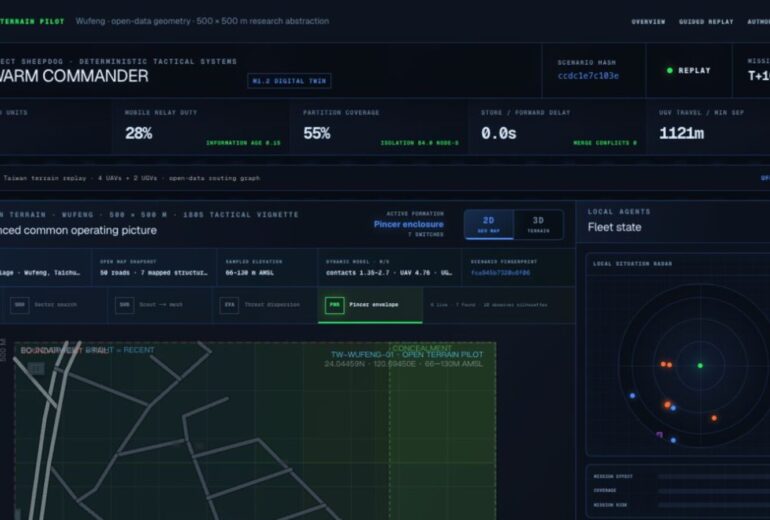
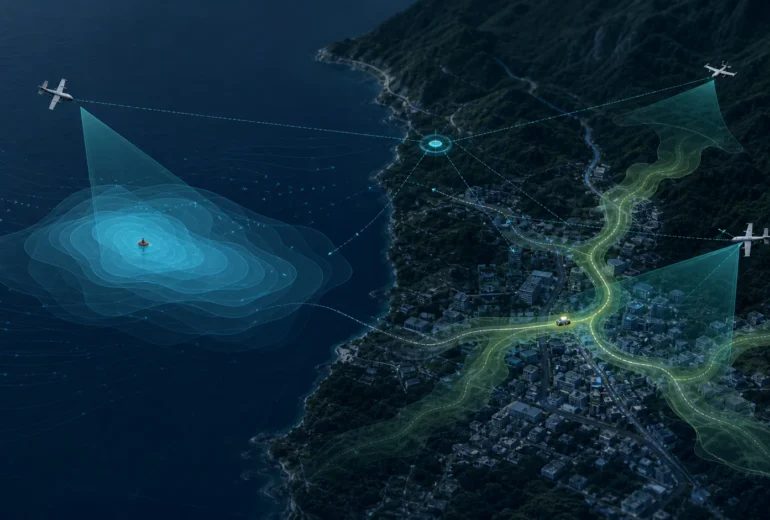
Once these properties are expressed as a Capability Passport, SHEEPDOG can compare an airborne node with UAVs, USVs, UGVs, fixed sensors, and third-party platforms inside the same simulation and mission-planning environment.
The company architecture matters more than one aircraft
Shield AI’s structure is instructive: aircraft, platform-agnostic autonomy, and simulation reinforce one another. The company states that Hivemind has been deployed across more than 30 platforms.
Baoqi’s corresponding thesis is intentionally narrower and earlier:
SKY MECH and partner platforms → SHEEPDOG tactical AI → Taiwan-specific simulation and tactical learning → bounded edge execution.
The objective is to develop a low-cost, infrastructure-aware architecture in which height, energy, sensing, communications, and heterogeneous vehicles become software-addressable mission resources.
Source note: Shield AI is referenced for public comparative analysis; Baoqi and SKY MECH are independent programs.
Sources: Shield AI, X-BAT official product page; Shield AI, Hivemind platform integration and autonomous teaming.
Inspect the SKY MECH / SKY MESH engineering release · Explore Project SHEEPDOG