

Research context
Research library
Preserved research and engineering material, organized by its source page.
Historical wording and artifacts retain their original context. The current SHEEPDOG entry target is one operator and three aircraft. Archived simulations, drawings and concepts do not establish physical control or field validation.
HOME · Archived research and engineering
Historical research and engineering material. Each program retains its stated validation stage.
Mission autonomy · sensor to decision to action
One mission brain. A closed, reviewable loop.
SHEEPDOG keeps Sense → Understand → Decide → Assign → Act → Assess connected, while the five decision views below make intent, opposition, operator load, system behavior, and deployment constraints replayable before any platform is placed at risk.
→
→
→
→
Actual product · English interface
One simulator stack. Two operational views.
Runtime captures · not concept art
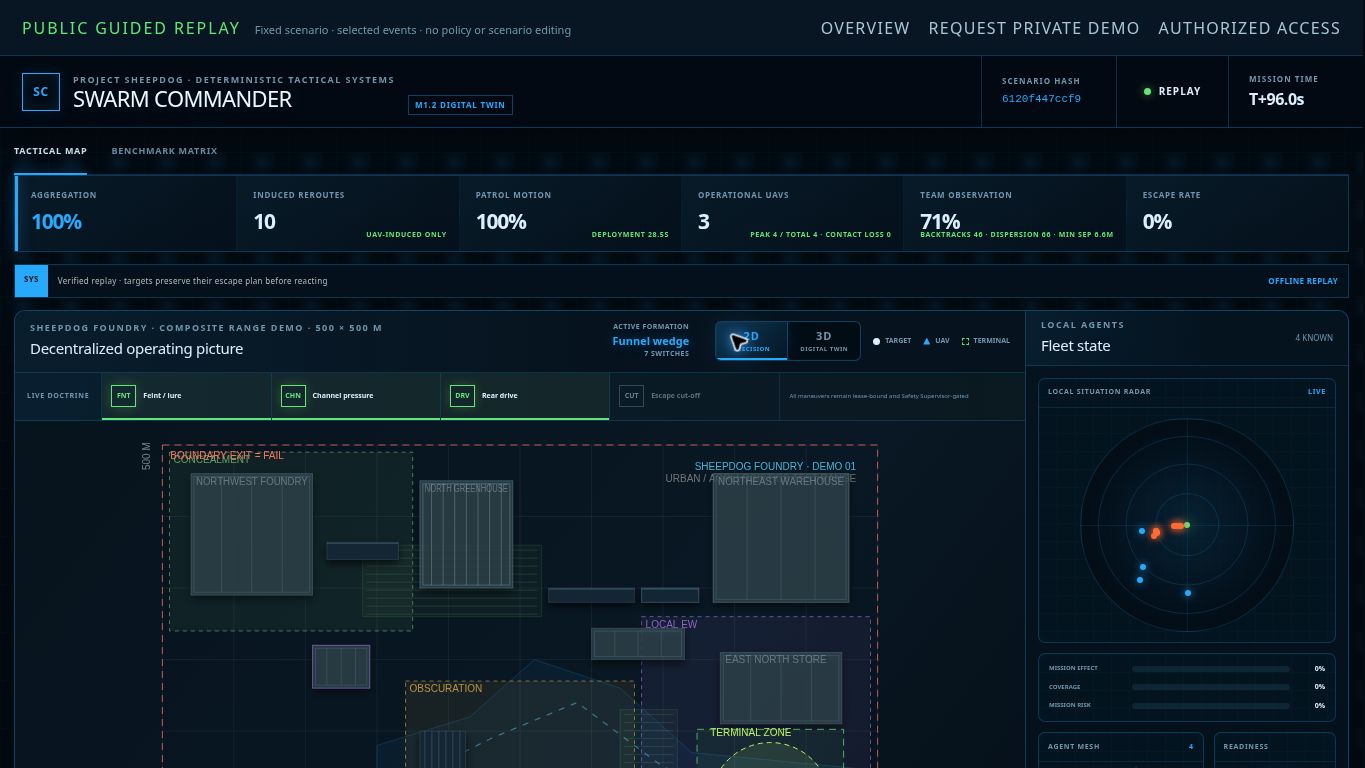
Planar command view
Exact paths, zones, KPIs, fleet state and deterministic replay evidence in one operator screen.
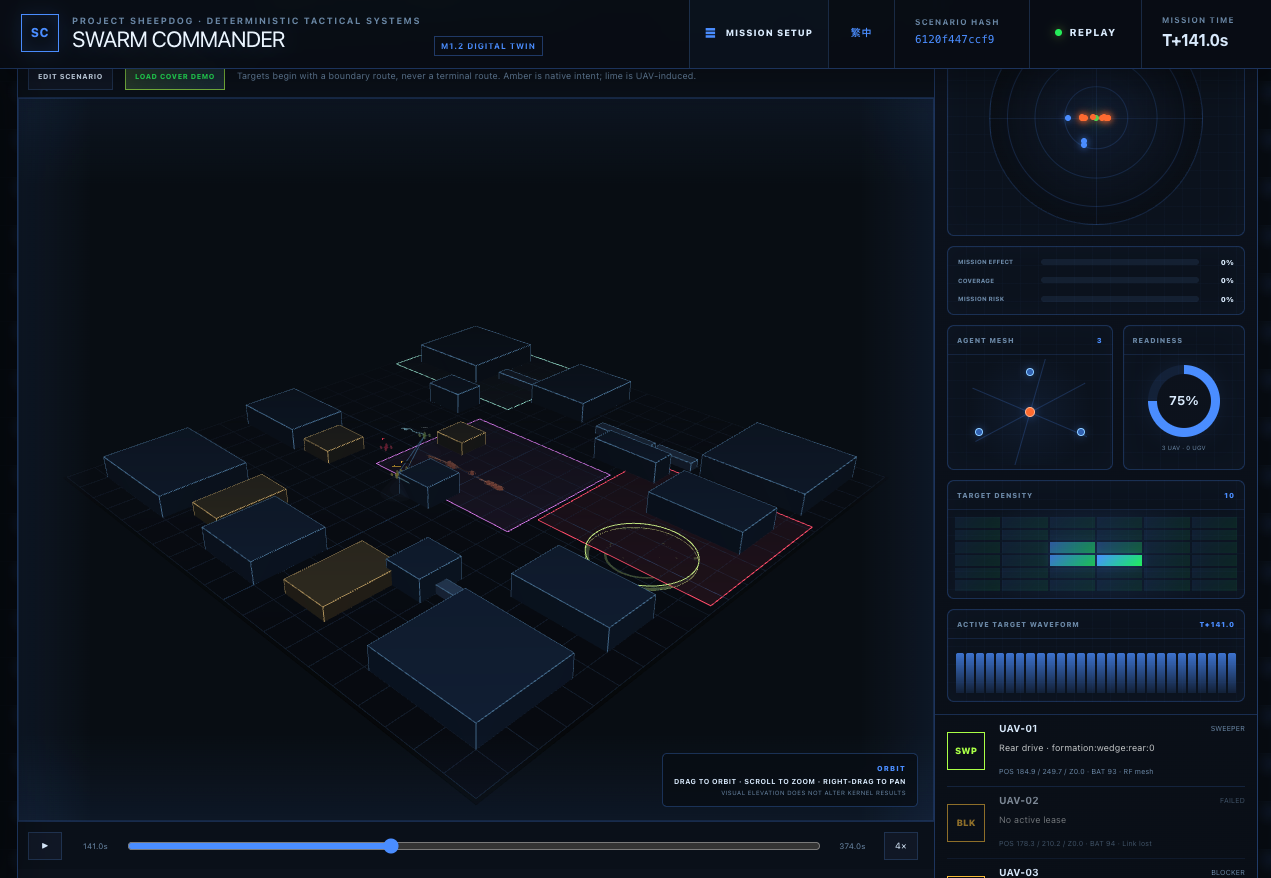
Spatial mission view
Altitude, terrain, buildings, line-of-sight context and asset separation rendered from the live simulation state.
Both views come from the working SHEEPDOG simulator and support repeatable mission replay—use 2D for precision analysis and 3D for spatial understanding.
Tactical pattern library
What SHEEPDOG trains—not just what it controls.
Large models propose candidate patterns. Deterministic simulation challenges them across terrain, communications, energy and changing mission conditions before any bounded behavior reaches the edge.
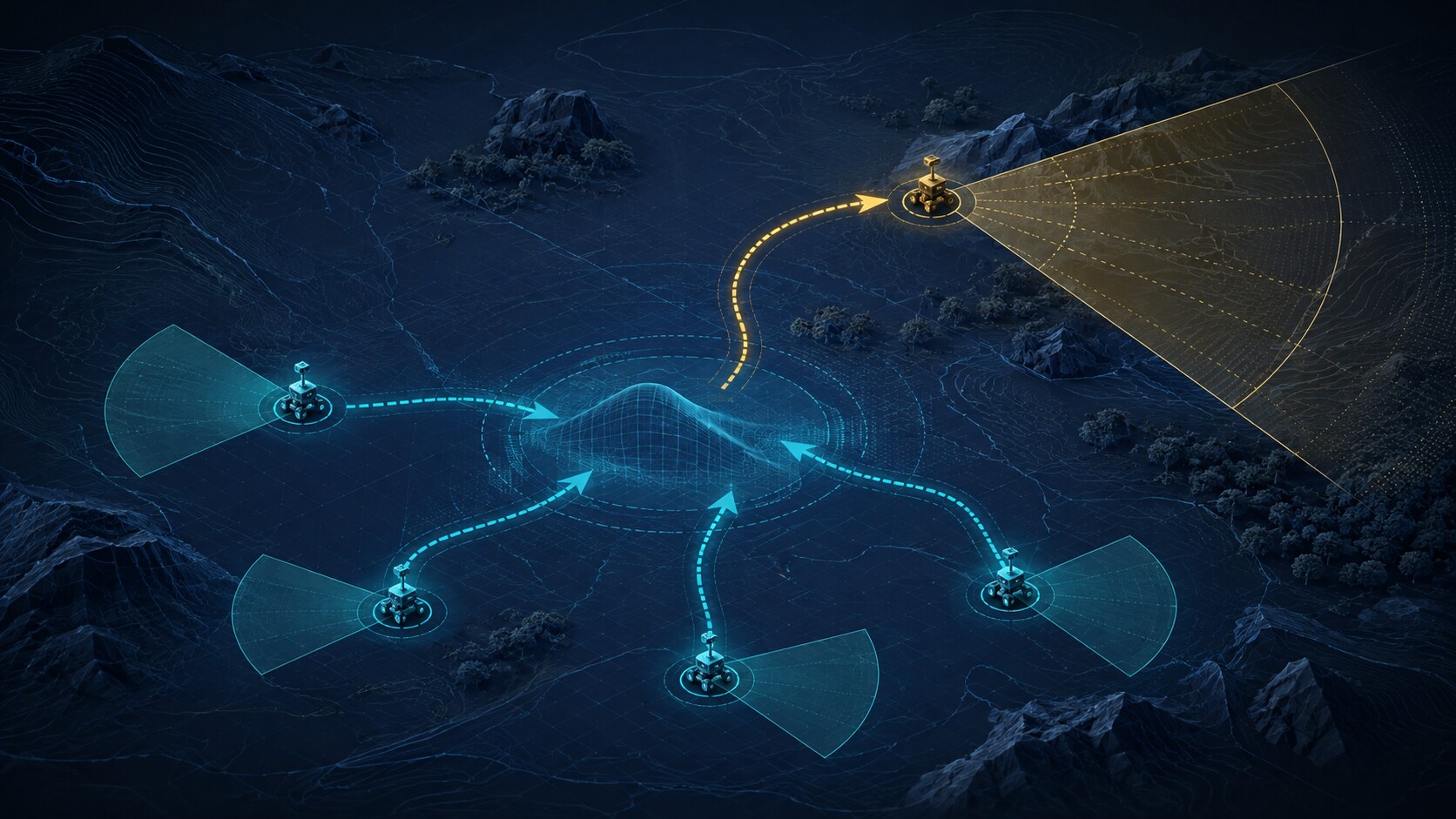
Shift attention. Reassign the mission.
A forward element draws commitment while the rest of the team preserves coverage, changes roles or completes the primary objective.
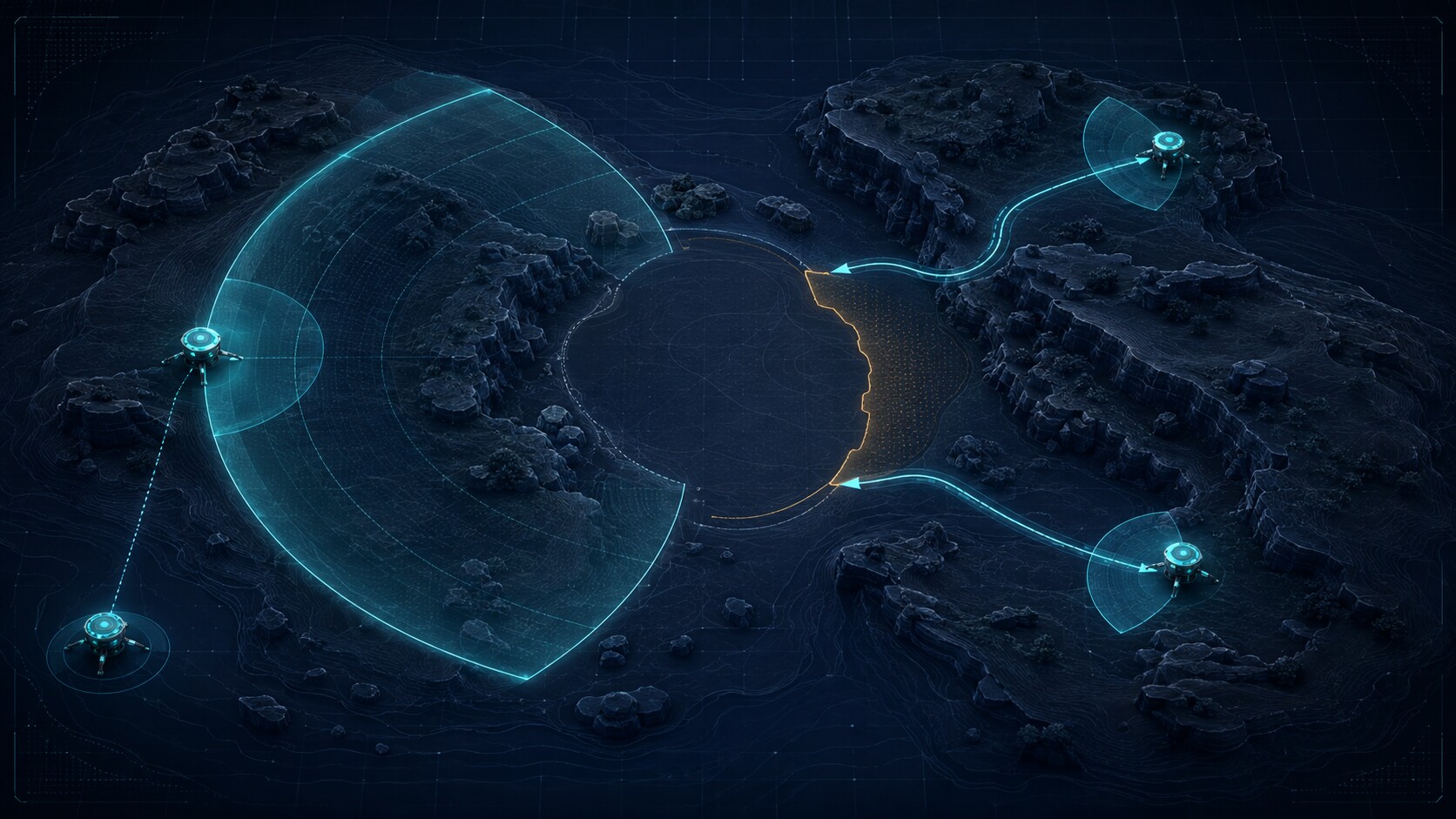
Shape the space. Close the gap.
One element maintains containment while other agents occupy alternate routes, close a coverage gap and preserve fallback capacity.
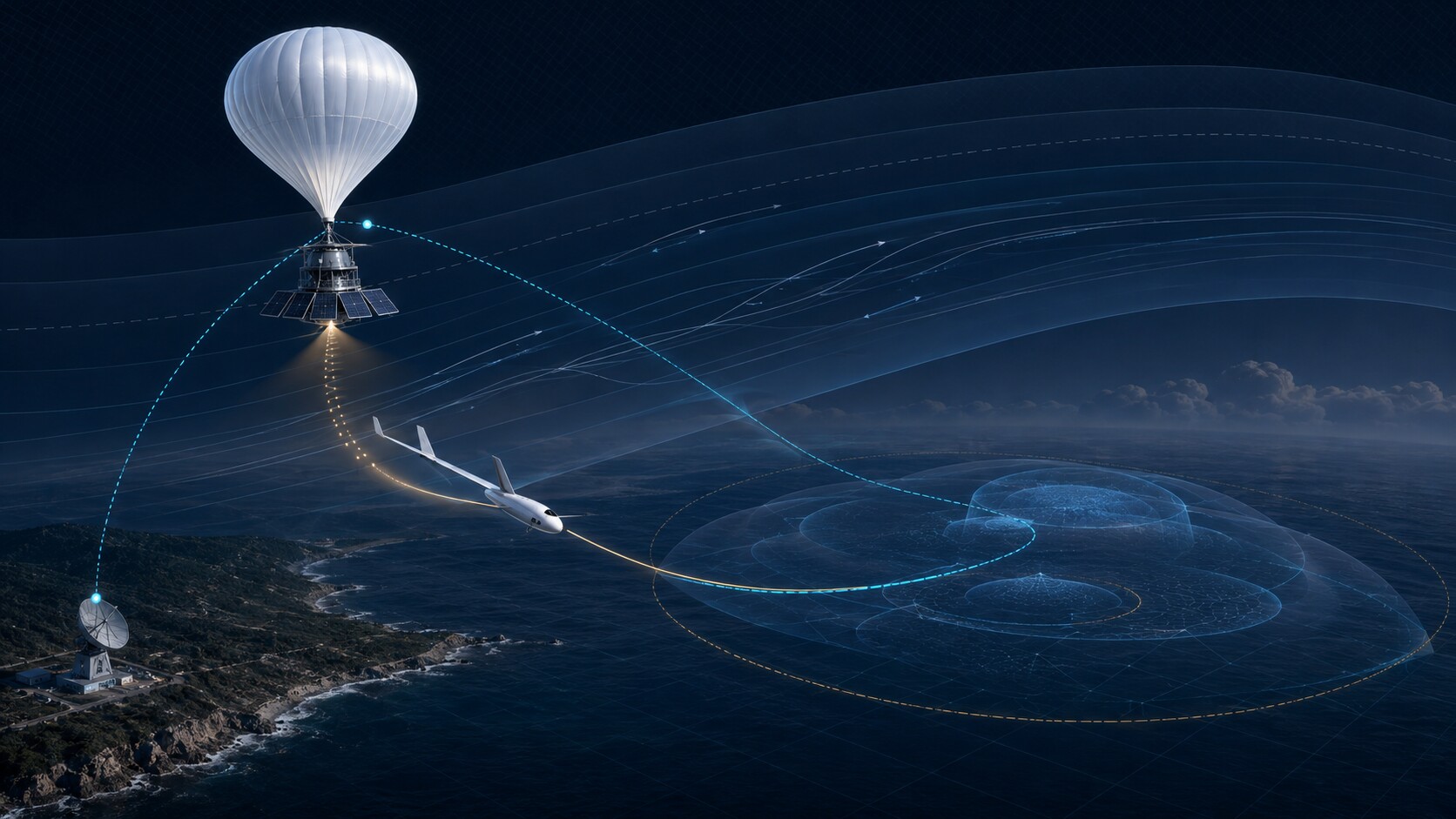
Use altitude as an energy budget.
A high-altitude relay releases a non-weaponized scout into gravity-assisted glide while simulation evaluates curved routing, link continuity and stability.
System map · one intelligence layer
Different machines. One mission model.
SHEEPDOG tests how heterogeneous platforms should coordinate, what each should preserve and when a human must intervene.
Partner platforms retain flight-control authority. SHEEPDOG supplies tested mission logic, bounded recommendations and decision evidence.
Governed AI value · human authority retained
Keep human authority. Give the machine the synchronization burden.
People retain GO / NO-GO, pause and return authority. AI continuously reconciles roles, coverage, wind, communications, separation, cost and the evidence trail across multiple vehicles.
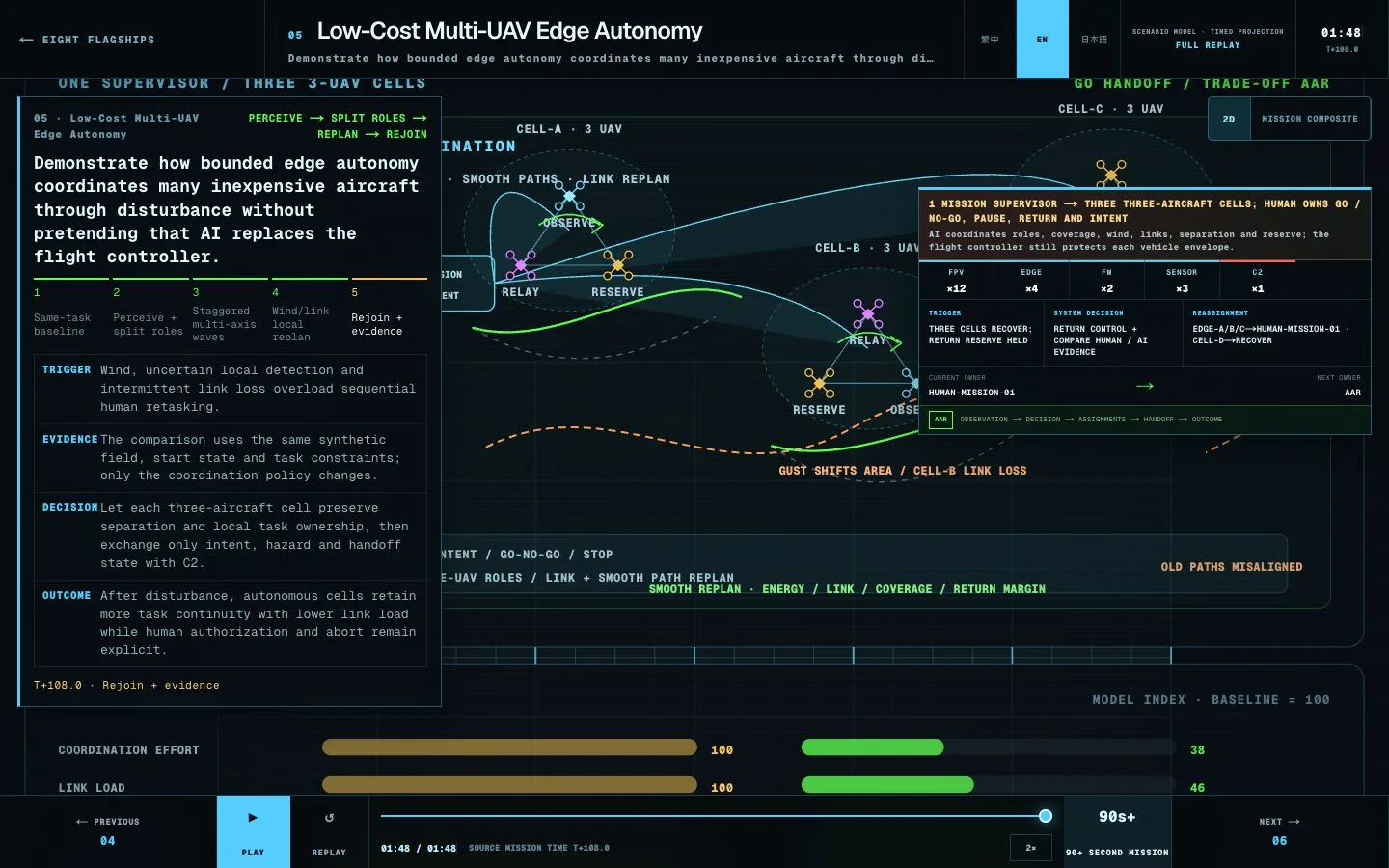
Humans decide intent. AI keeps every vehicle synchronized.
One mission supervisor gives GO / NO-GO while edge autonomy continuously reconciles role, coverage, wind, link health, separation and return reserve across multiple teams.
A named reviewer checks every proposal and can amend, reject or hear an appeal. Policy and model promotion requires holdout evaluation and regression checks. AI never auto-awards pay or merit, and never promotes a model or version by itself.
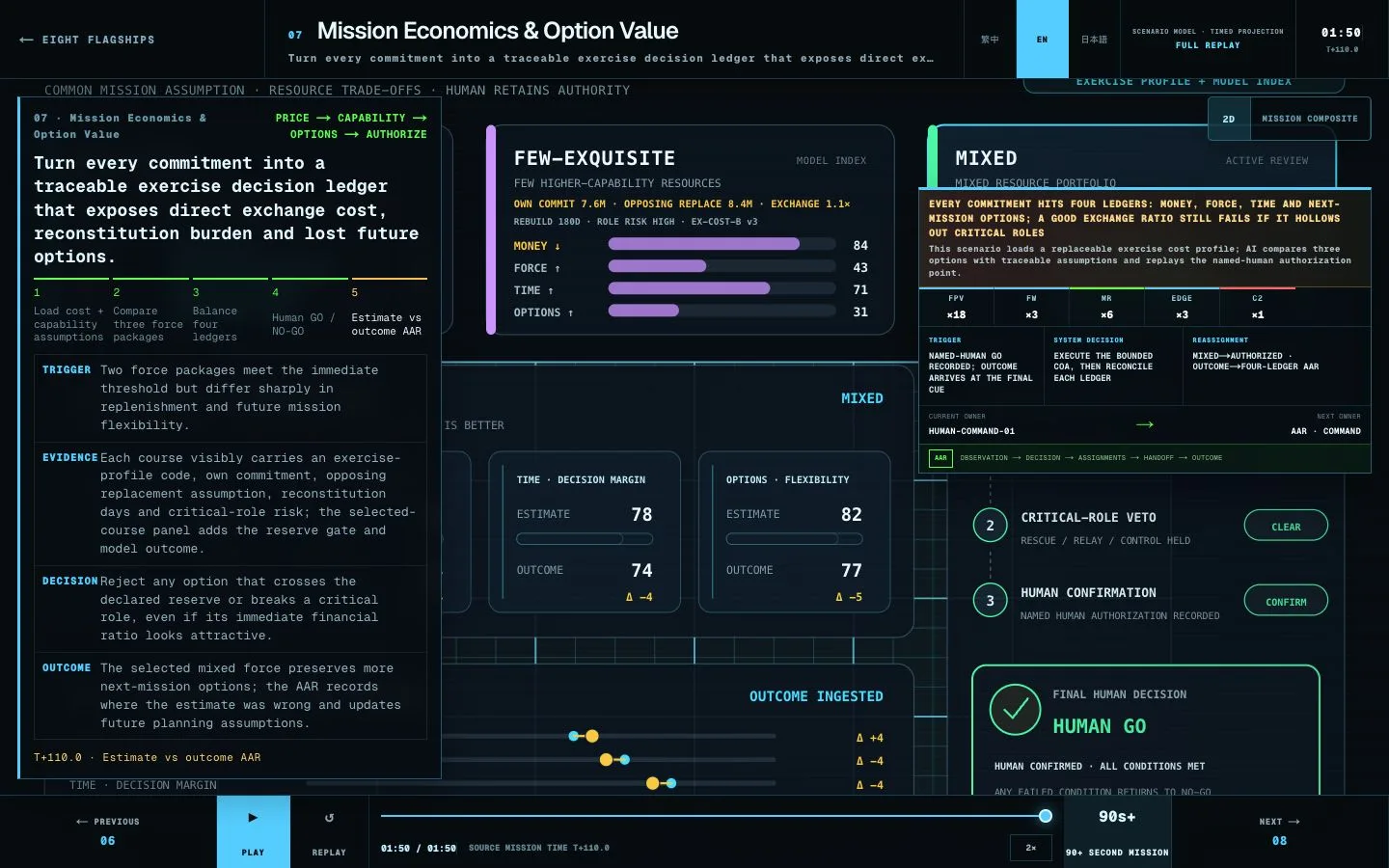
Account for this win and the force that remains for the next mission.
Money, force, rebuild time and future options are shown separately, exposing plans that look inexpensive but consume scarce roles, reserves or the ability to abort and re-task.
A named reviewer checks every proposal and can amend, reject or hear an appeal. Policy and model promotion requires holdout evaluation and regression checks. AI never auto-awards pay or merit, and never promotes a model or version by itself.
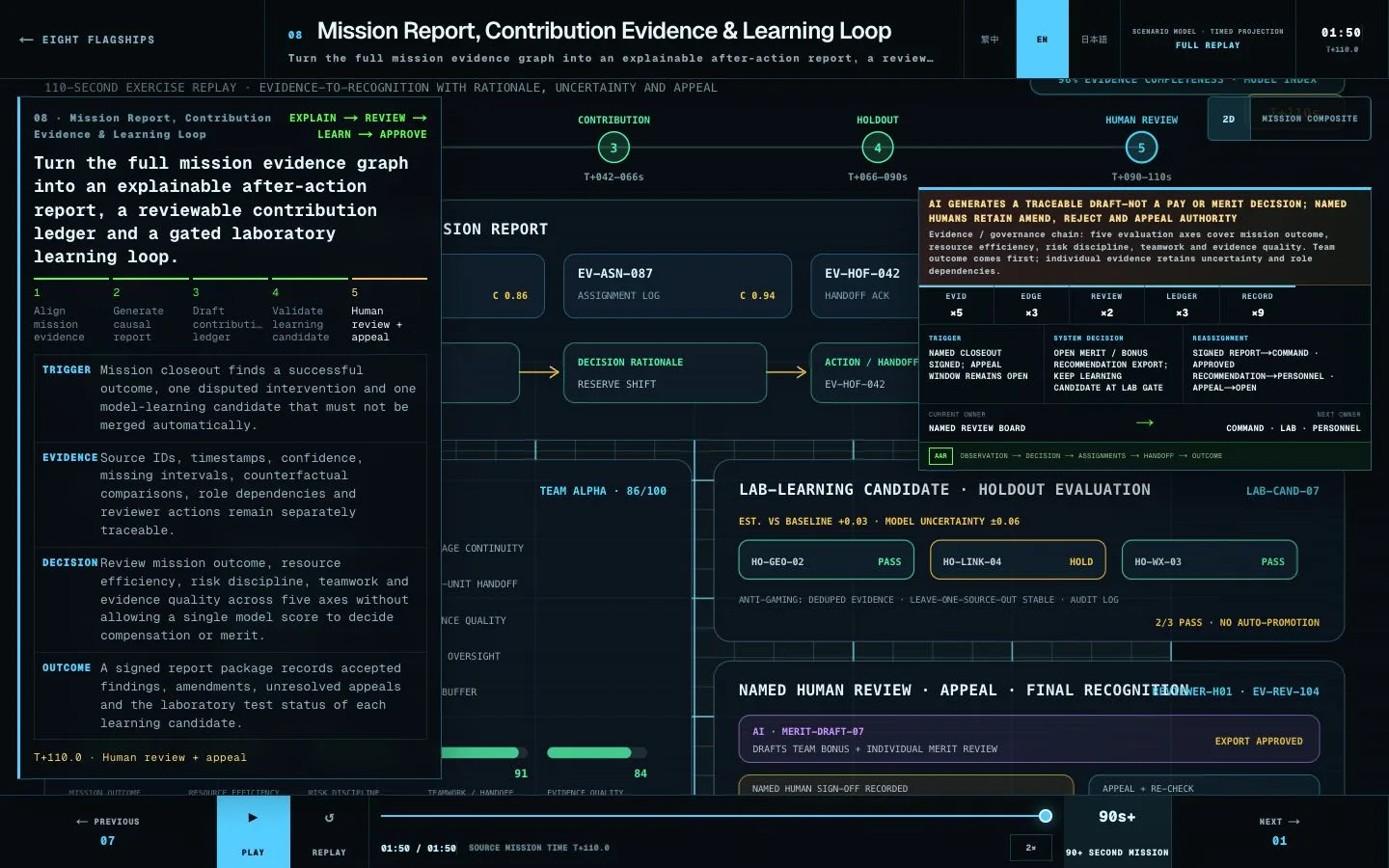
Turn every decision into reviewable, appealable evidence.
Observations, decisions, re-tasking, handoffs and outcomes are aligned into one causal record. Team-first contribution drafts and learning candidates remain behind a laboratory governance gate.
A named reviewer checks every proposal and can amend, reject or hear an appeal. Policy and model promotion requires holdout evaluation and regression checks. AI never auto-awards pay or merit, and never promotes a model or version by itself.
Research insights · deterministic synthetic studies
See the coordination problem before reading it.
Three visual studies make handoff, uncertainty and maritime belief directly inspectable.
Keep Moving, Keep the Track
Transfer sensing only after dual-FOV overlap, bank-limited turn feasibility and obstacle clearance agree.
The Center Moves with Uncertainty
Stage where information need remains highest while preserving a minimum reserve and avoiding oscillation.
Coast the Belief, Not Hidden Truth
Current and wind propagate visible probability branches until reacquisition—or an honest LOST state.
Evidence, not slides
Evidence at every maturity gate.
Working software, reproducible research and engineering releases remain visibly separated.
In the Field / Updates ·
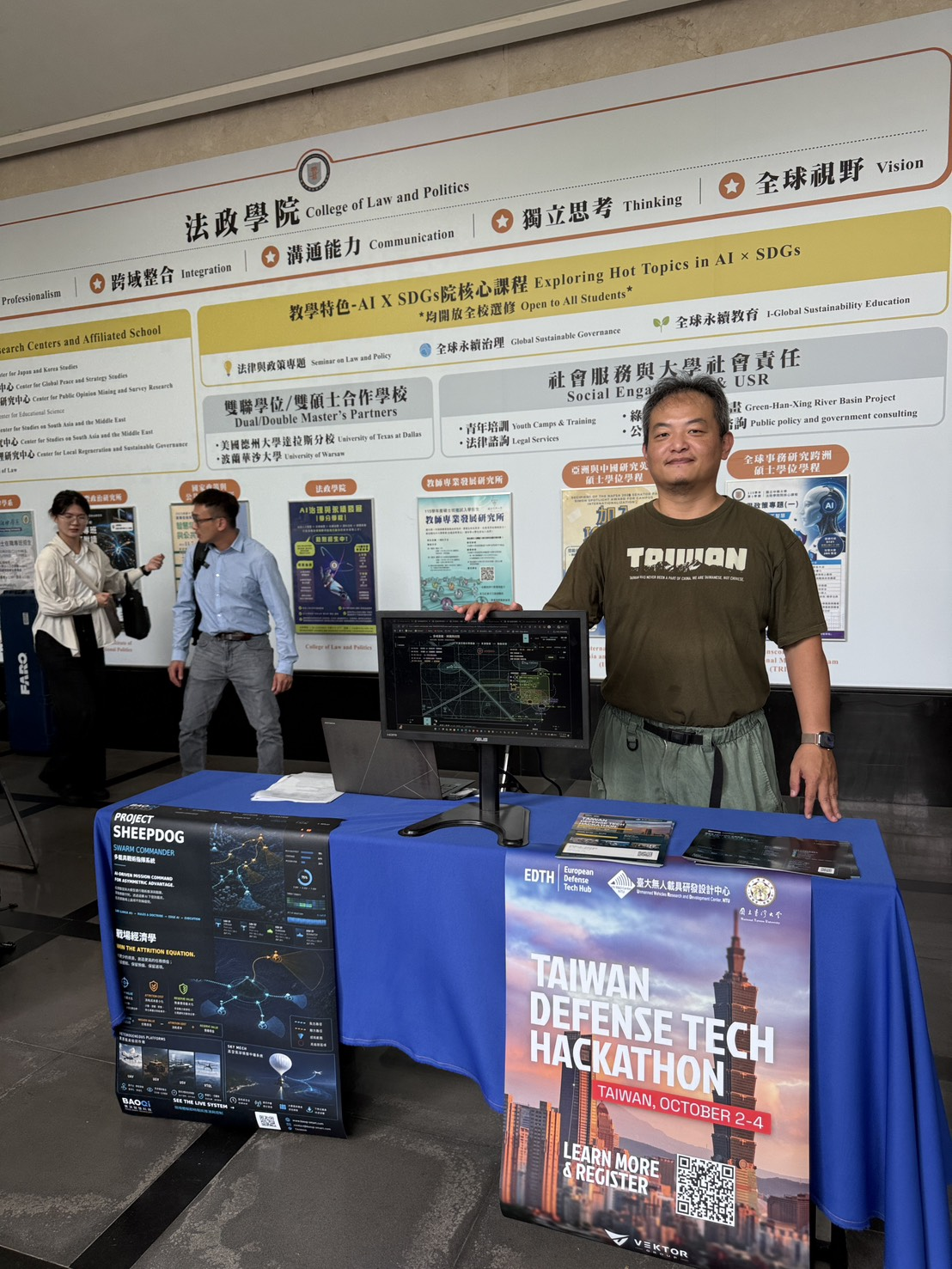
SHEEPDOG at the Taiwan Unmanned Systems Strategy Forum
Baoqi Smart demonstrated its mission intelligence platform at National Chung Hsing University in Taichung.
Collaboration ecosystem
Built with partners who move ideas into the field.
Baoqi Smart works across defense innovation and system integration—connecting mission intelligence to organizations that can help validate, integrate and deploy.

Hardware · research · integration
Run your platform through SHEEPDOG.
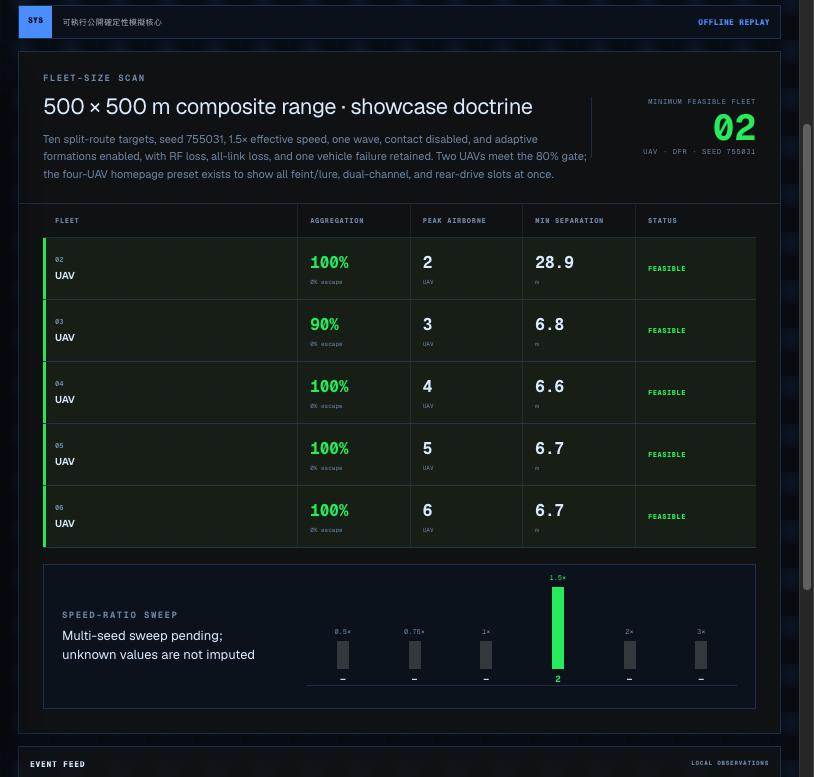
Bring a mission, operating constraints and a capability profile. We will turn them into a repeatable scenario, a minimum-feasible fleet question and measurable evidence.
SHEEPDOG · Archived research and engineering
Historical research and engineering material. Each program retains its stated validation stage.
Initial Tactical Application: One Operator + Three UAVs
One operator. Three affordable aircraft. One bounded tactical team.
Our initial product target is one operator supervising three affordable, replaceable aircraft through a portable control interface, with measurable role assignment, operator load, degraded-link recovery, and replayable decision evidence.
The three-aircraft team is the initial demonstration objective. Software, SIL, HIL and platform integration require separate validation before a physical integration pilot.
Initial validation gate
Product demo
See the mission brain make—and explain—a decision.
Watch the two-minute product walkthrough, then open a fixed, curated replay with selected events and benchmark results. Scenario controls, raw logs, policy search, and the full tactical laboratory remain available only through authorized access.
Product demo · 2:00 · English narration and subtitles.
Red–Blue AI Foundry
Milestone 01: from deterministic policy search to bounded edge evaluation.
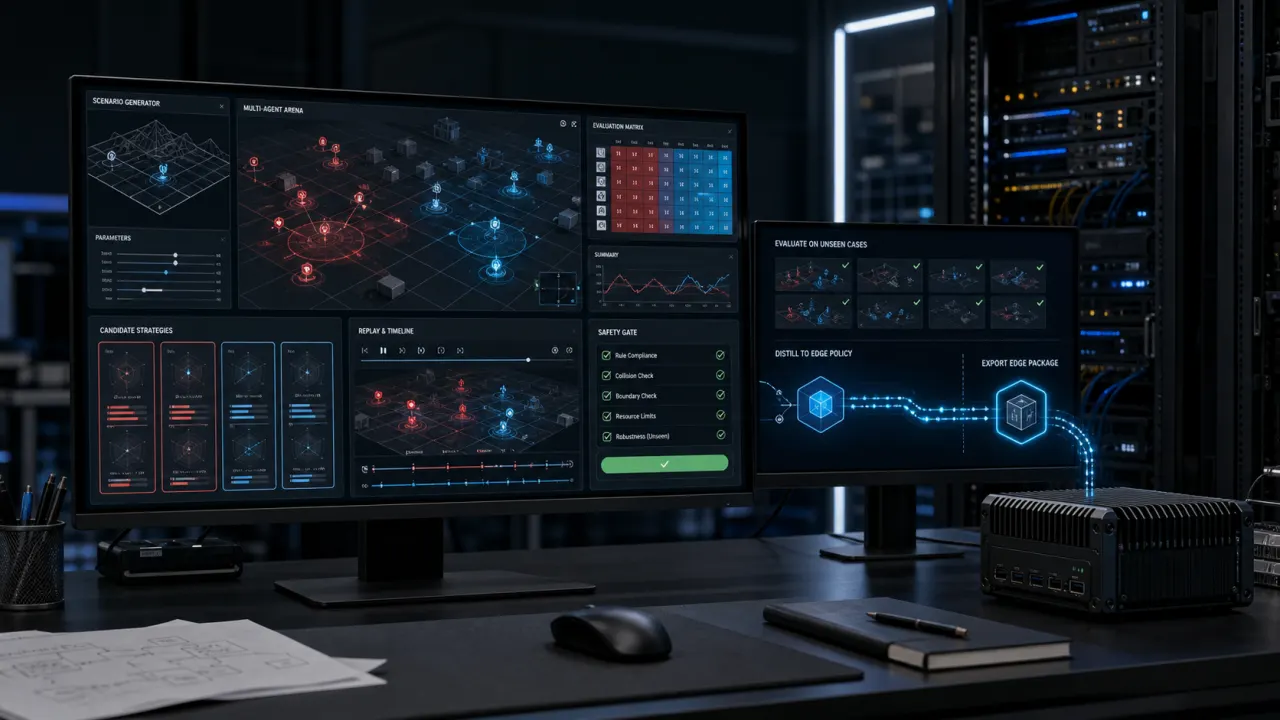
Large models and multiple agents explore Red–Blue scenarios in controlled simulation. SHEEPDOG ranks and retests candidates under matched seeds, unseen holdouts, safety gates, and tactical-economics constraints before a bounded policy can move toward the edge.
Large-model scenarios and candidate patterns.
Matched Red–Blue synthetic trials.
Minimum feasible fleet and Pareto ranking.
Unseen seeds, replay, and safety gates.
Compact edge policy under human authority.
See what each side actually knows
Separate ground truth from every agent’s world.
The evaluator can inspect full scenario truth while BLUE and RED agents act only on the tracks, sensors, messages, and confidence available to them. Detection, handoff, deception resistance, and recovery become measurable—not theatrical.
Red–Blue agent control
Separate agents control each side. Hidden units remain visible to the evaluator while BLUE detection efficiency is scored against the same ground truth.
Per-vehicle sensor views
Inspect what each UAV or autonomous platform sees: field of view, live feed, track confidence, link state, assigned role, and handoff history.
Natural-language scenarios
Confirm an address and terrain, then describe BLUE and RED initial conditions and objectives separately. Side-specific APIs allow external AI models to join the same evidence protocol.
Order of Battle composer
Import vendor capability data; compose both BLUE and RED with their own UAVs, UGVs, human ground units, mobile C2 node, quantities, protected assets, mission dependencies, and configured lost-C2 fallback.
From simulation story to reusable doctrine
Record both sides. Extract the pattern. Reproduce the evidence.
Two synchronized chronicles preserve what BLUE and RED observed, which responses they considered, what they chose, why they chose it, what happened, and how they adapted. The complete story remains linked to deterministic replay instead of becoming an untraceable summary.
- Observed track confidence falling near FOV boundary
- Decided initiate overlapping handoff and preserve reserve
- Result custody retained; recovery recorded
- Observed BLUE sensor geometry and response delay
- Decided change route and test the coverage seam
- Result counter-response and outcome recorded
Dual decision history
Observation, options, action, rationale, outcome, and adaptation for each side.
Reproducible tactics
Trigger, assumptions, sequence, counterexample, confidence, and replay references.
Machine-readable guidance
Compress reviewed patterns into WHEN / IF / THEN / UNLESS rules for edge-policy distillation.
Export the whole story
Package scenario identity, both logs, replay, patterns, doctrine, metrics, and provenance.
Mission mechanisms
Keep moving. Keep the track. Preserve the reserve.
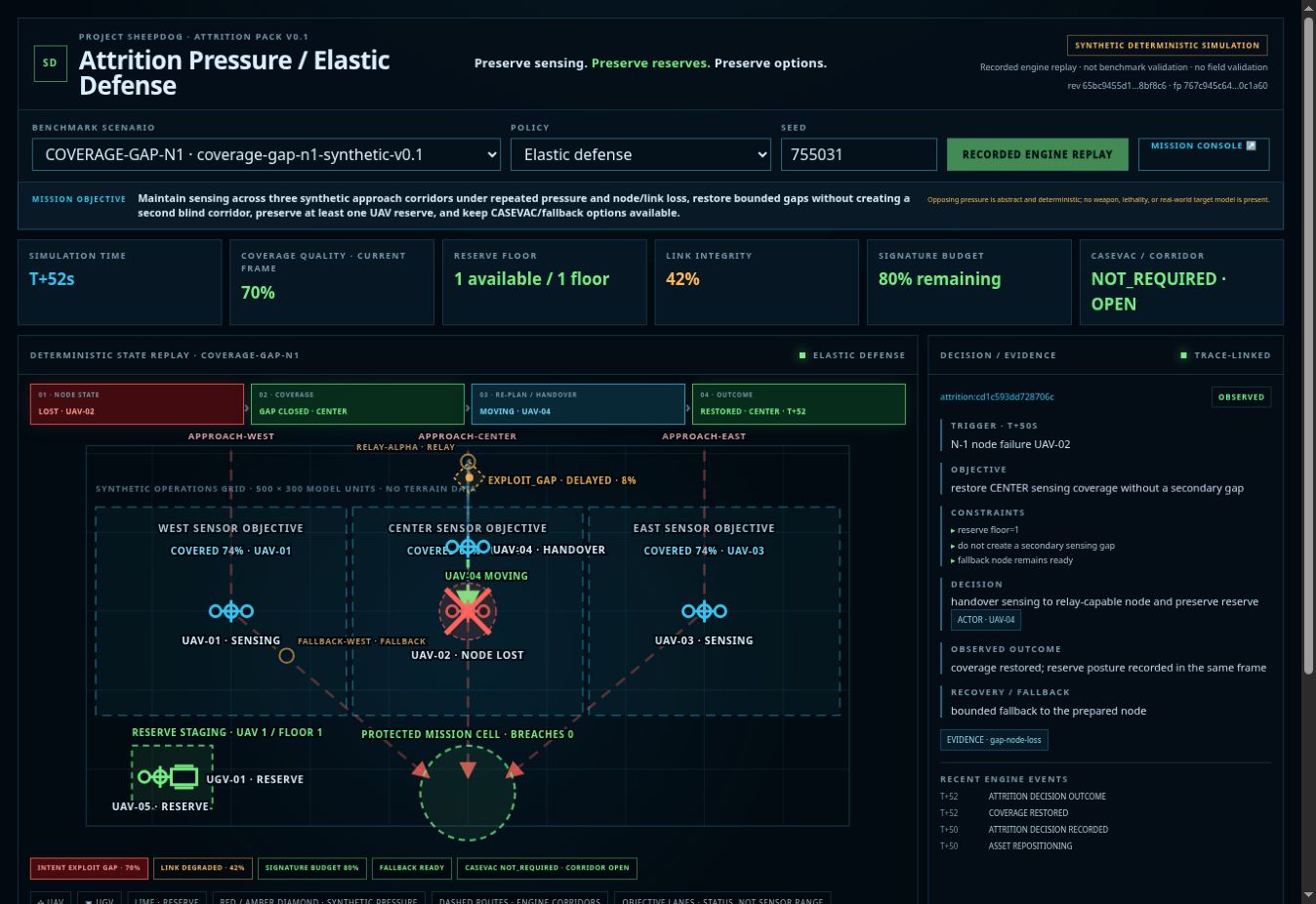
SHEEPDOG evaluates continuous reconnaissance, second-view confirmation, overlapping field-of-view handoff, probabilistic reacquisition, capability-aware assignment, dynamic re-tasking, reserve positioning, degraded links, and loss recovery within the same replayable mission state. Decision Logs and AAR preserve why assignments changed and what happened next.
Fly through the track
Transfer custody before the target leaves the current sensor footprint.
Coast through uncertainty
Maintain a probability distribution when a ground or maritime track disappears.
Move the center
Reposition uncommitted assets as the searched area and risk field change.
Coverage Gap N-1
Test whether the mission can continue after a vehicle or link is lost.
Respect the airframe
Curved routes include fixed-wing turn time, energy, obstacles, and link continuity.
Gate every re-plan
SafetySupervisor and authorized human roles bound recommendations and recovery.
Build status
A complete mission-intelligence stack—above approved vehicle control.
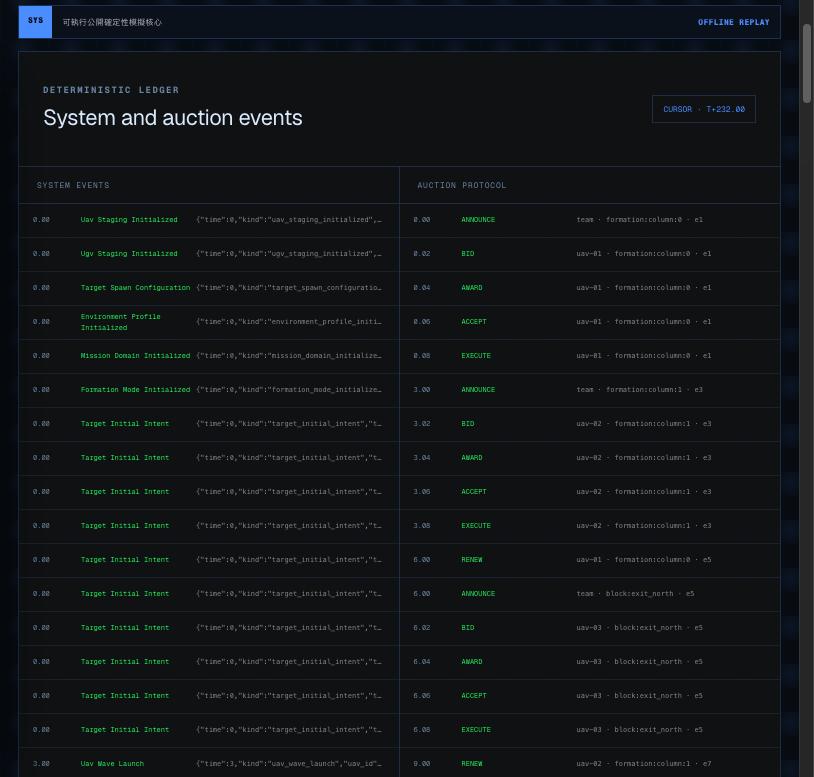
Through ROS2, MAVLink, and vendor SDK adapters, sensors and vehicles expose capability, telemetry, health, and control boundaries to a mission layer above approved vehicle control. Current software combines Red–Blue agents, observer truth, capability passports, capability-aware assignment, task leases, probabilistic tracking, second-view confirmation, dynamic reserve positioning, degraded-link recovery, SafetySupervisor gates, Decision Logs, deterministic replay, AAR, and structured decision evidence.
Platform integration partnership
Bring your airframe. We will bring the mission layer.
Baoqi Smart is actively seeking trusted UAV manufacturers and system integrators—especially non-PRC supply-chain partners in Taiwan and allied markets—to provide programmable multirotor, fixed-wing, or VTOL platforms for SHEEPDOG integration and joint validation.
Our starting tactical application is one operator coordinating a three-aircraft team through a portable control interface. Broader cooperative search and heterogeneous missions are later expansion directions, with platform integration validated separately. We welcome joint demos, funded R&D, adapter development, and international collaboration.
Mission workshop
Bring us a mission, not a shopping list.
We turn operating constraints into testable scenarios, integration contracts, minimum-feasible fleet questions, and measurable evidence.
PLATFORMS · Archived research and engineering
Historical research and engineering material. Each program retains its stated validation stage.
Capability passport
Every asset joins through the same questions.
What can it do?
Mission roles, sensors, payload class, mobility, and control boundary.
What constrains it?
Endurance, weather, airspace, terrain, communications, and safety.
What changed?
Health, battery, link, position, confidence, inventory, and latency.
What is it worth now?
Time-to-task, energy, replacement cost, reserve value, and future options.
SHEEPDOG
The mission and evidence layer.
Mission graphs, capability-aware assignment, bounded role leases, degraded-link rules, reserve rotation, deterministic replay, and Tactical Digital Twin Core primitives are implemented in the current research software.
Red–Blue AI Foundry
From large-model competition to a compact edge policy.
The lab uses large models and multiple Red–Blue agents to explore scenario variations and coordination patterns. SHEEPDOG then replays, ranks, safety-gates, and distills the surviving behavior into a bounded policy capsule designed for fast, offline edge decisions—not a large model issuing raw vehicle control.
Propose scenarios and candidate patterns.
Stress Red and Blue across matched trials.
Rank feasible, non-dominated candidates.
Holdout replay and safety gates.
Compact policy capsule for the edge.
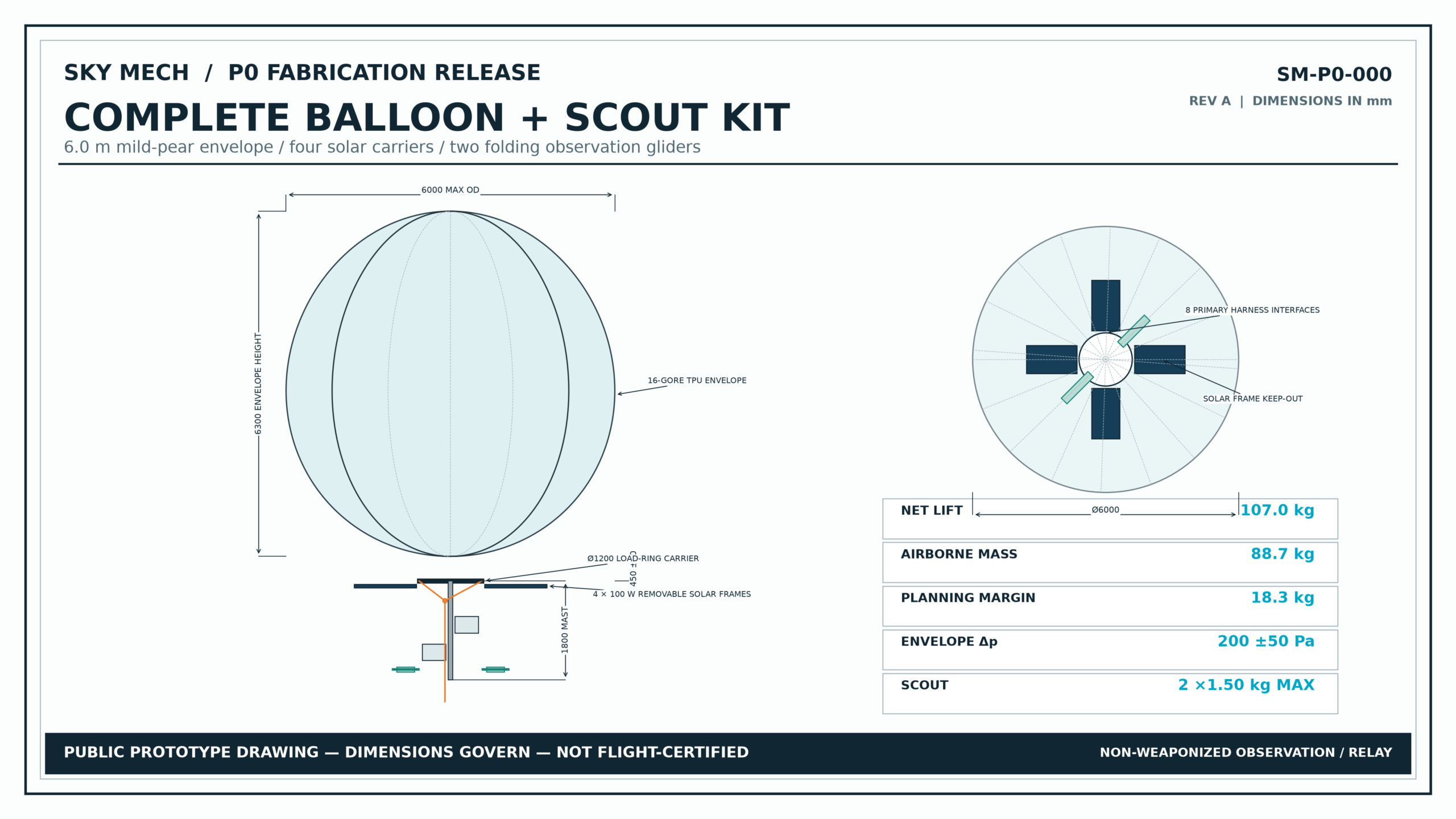
SKY MECH / SKY MESH
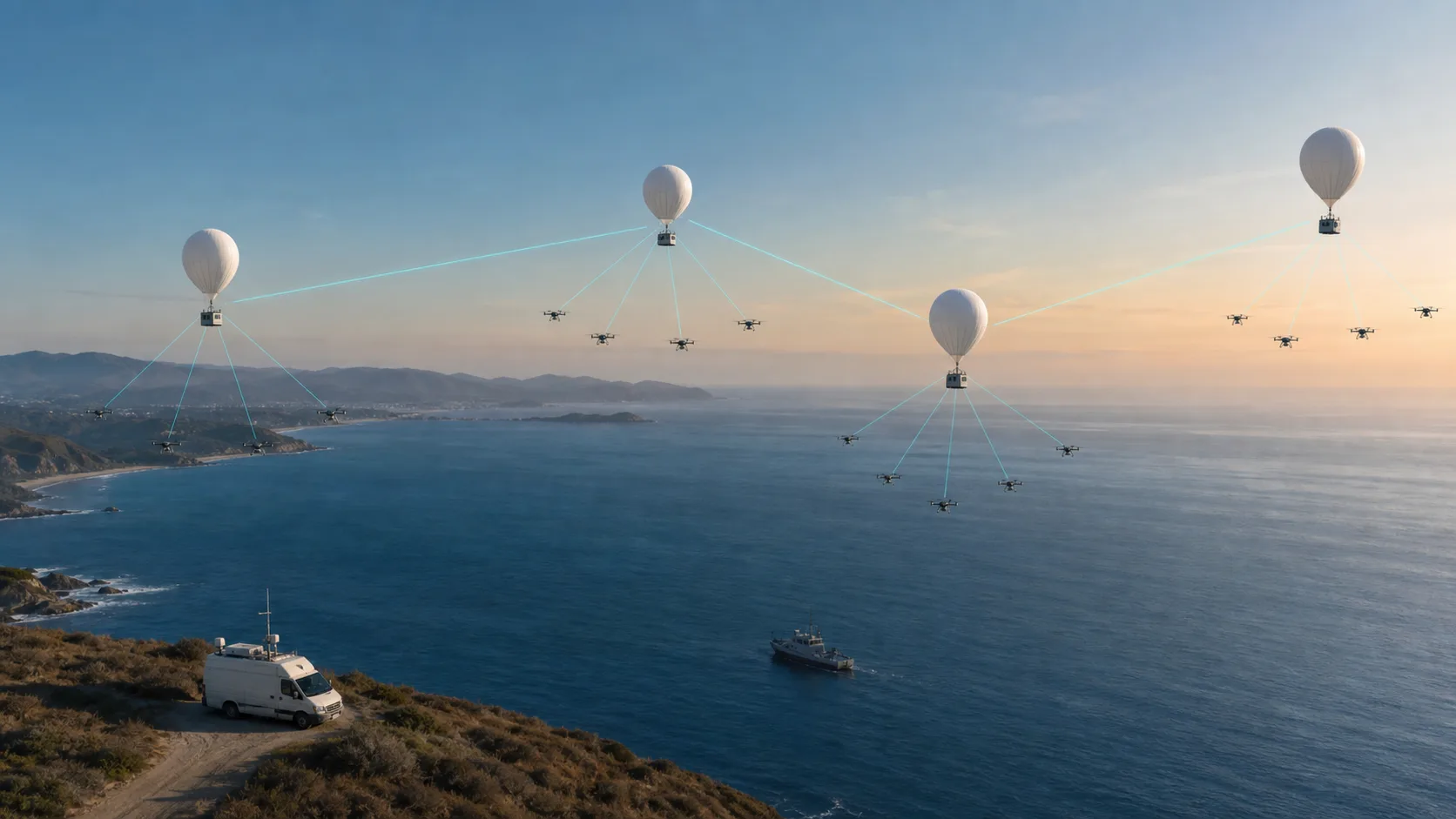
SKY MECH has a supplier-reviewable P0 CAD and fabrication package prepared for manufacturing, flight test, and validation. SKY MESH extends the architecture to coordinated multi-node operations.
UAV
Rapid reach, three-dimensional routing, aerial sensing, mapping, classification, relay, and mission response.
USV
Persistent surface presence, maritime sensing, confirmation, relay, patrol, and rescue handoff.
Jumping Spider
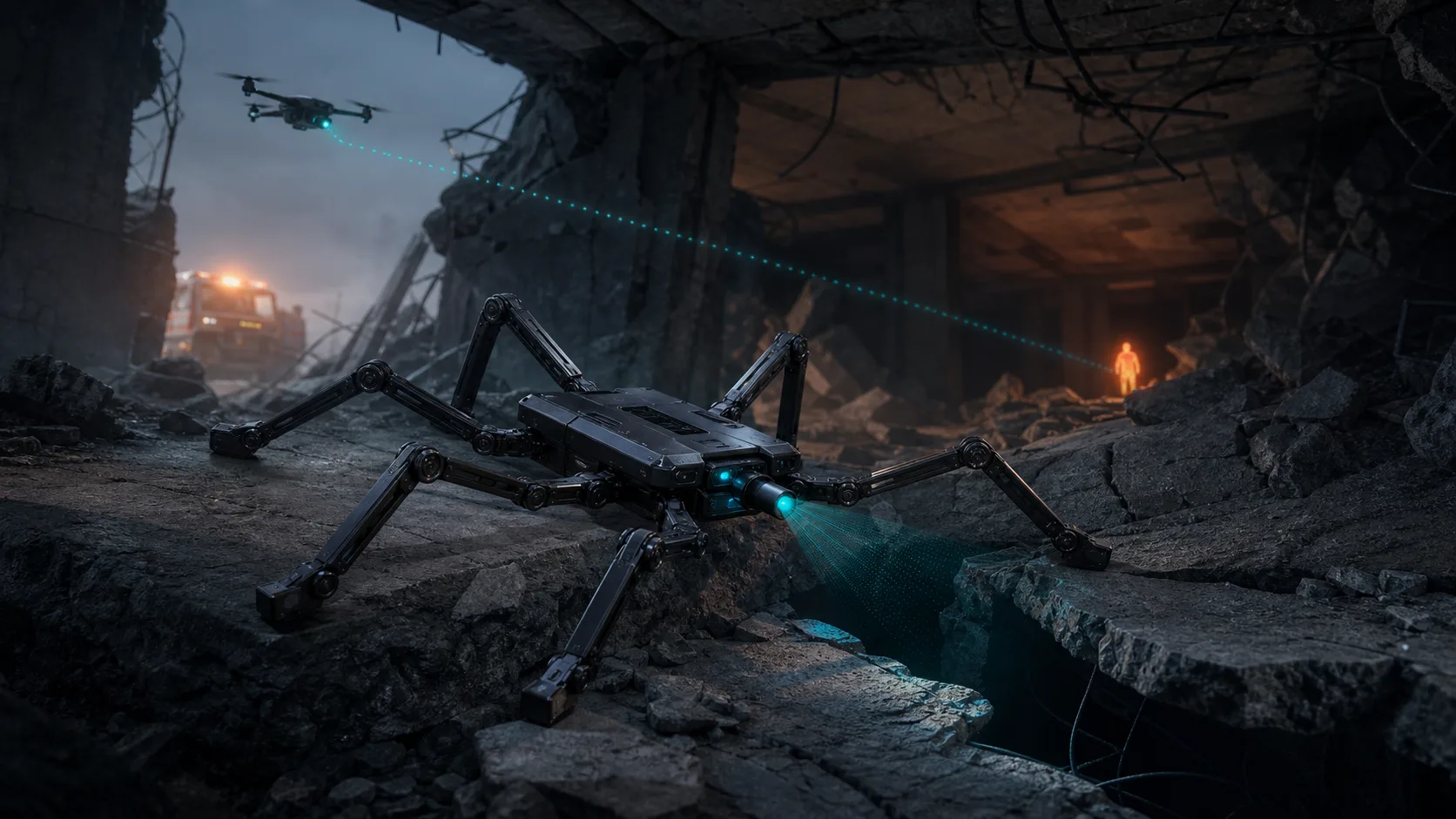
Low-profile access, gap crossing, interior and underground search, close inspection, hazard confirmation, and temporary sensing.
Jumping Spider · show the work
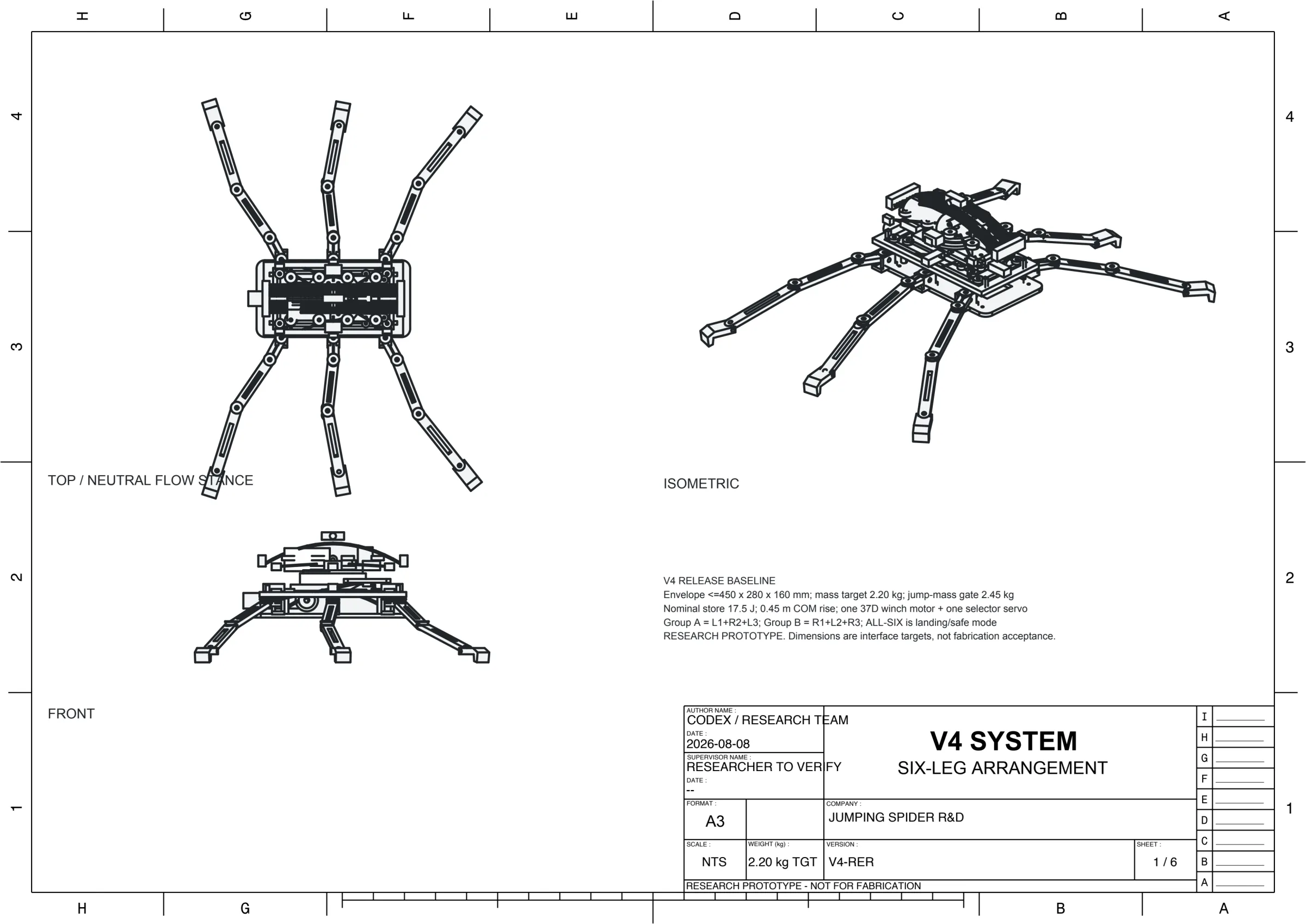
A hardware program with drawings, interfaces, and validation gates.
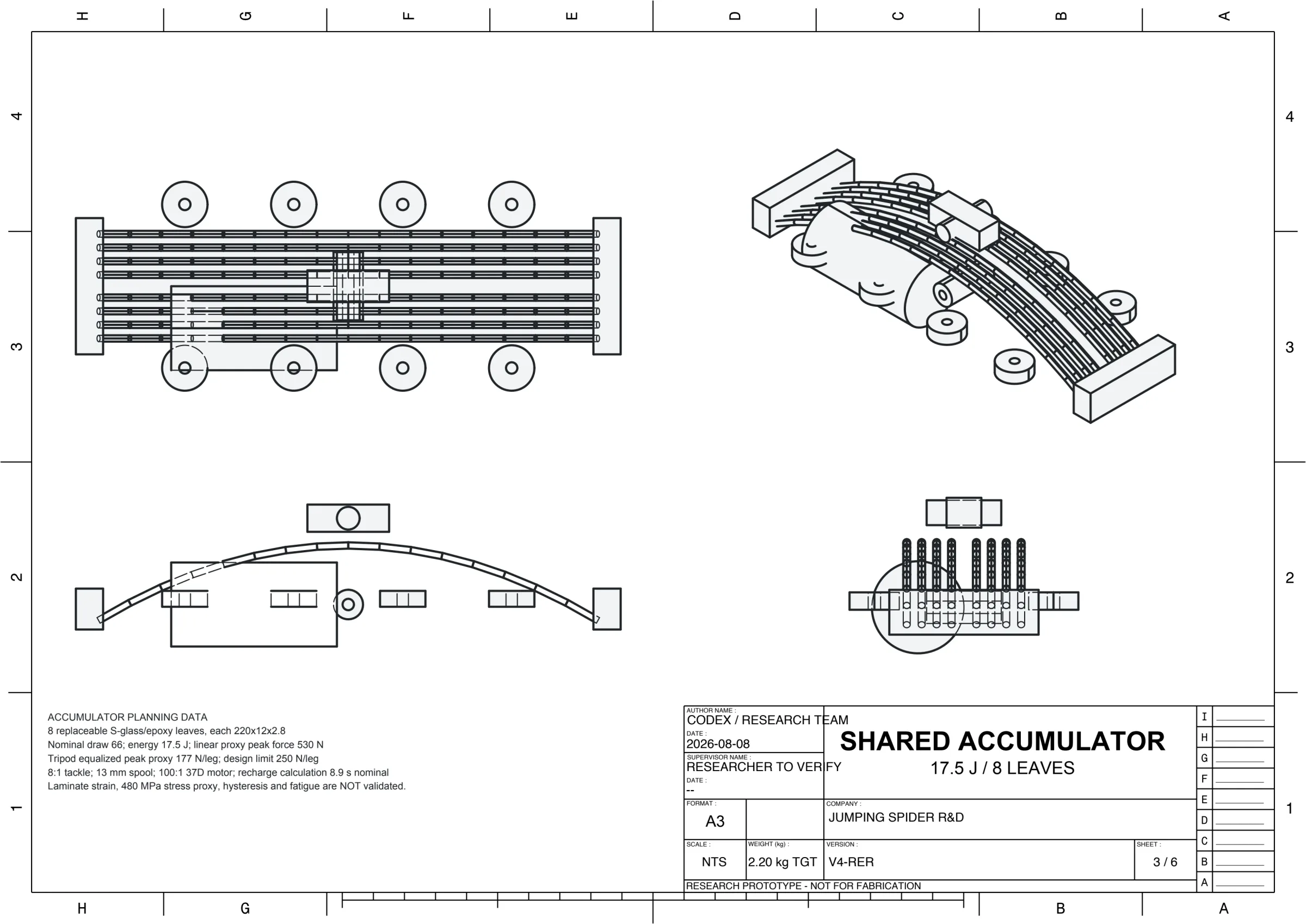
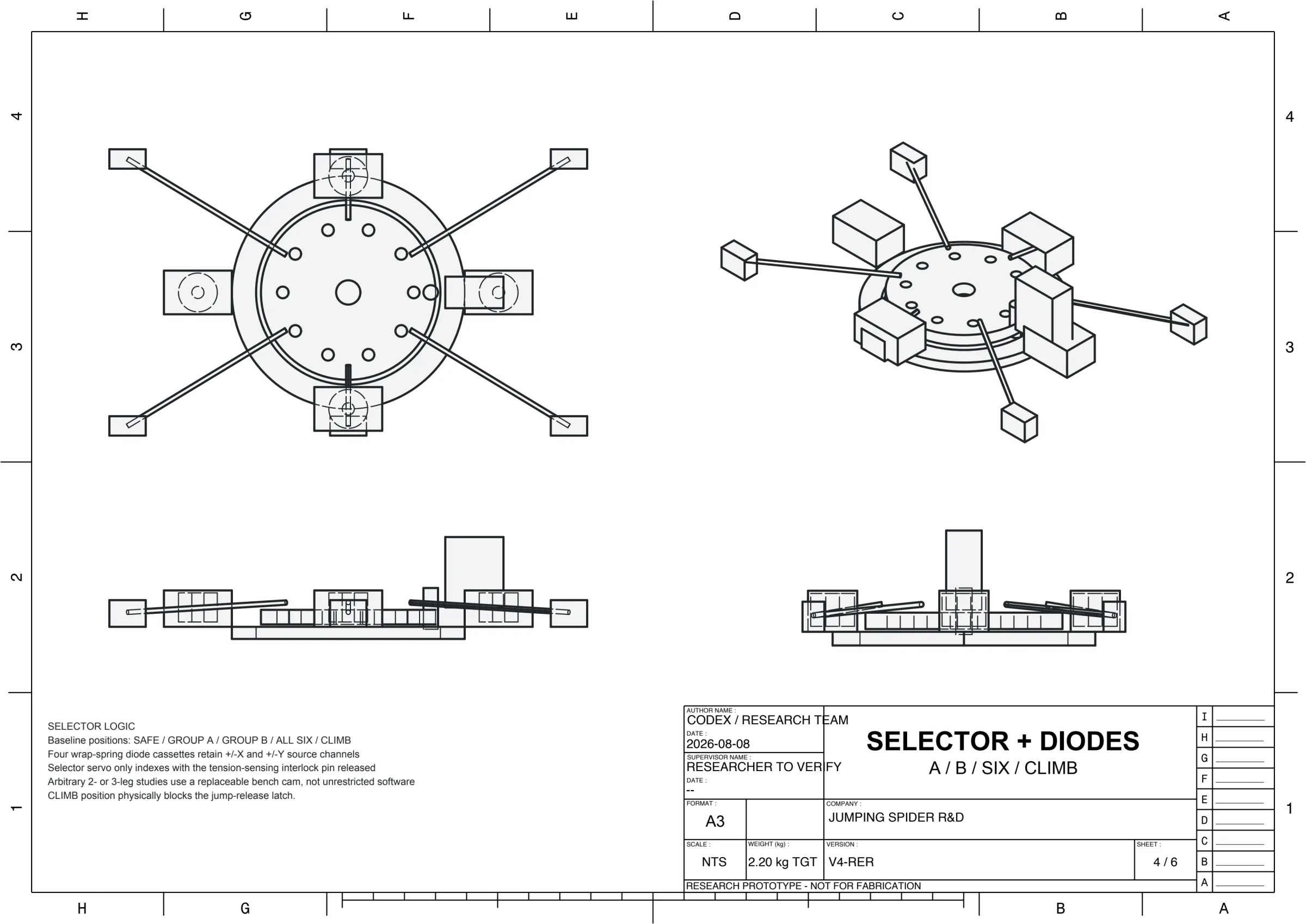
V4 is a research engineering release, not a production design. Material characterization, nonlinear FEA, tolerance stack, fabrication approval, guarded proof testing, calibration, and inventor acceptance remain required.
Integration
Expose the capability. Keep control where it belongs.
SHEEPDOG keeps the Sense → Understand → Decide → Assign → Act → Assess loop and its evidence coherent across platforms. Flight, motion, actuation, and low-level safety remain with each vehicle and its approved control stack.
COMPANY · Archived research and engineering
Historical research and engineering material. Each program retains its stated validation stage.
Why Baoqi Smart
The mission brain is the system.
Founder Wenteng Chang’s background spans semiconductors, networking, computer-vision products, product management, company building, and Taiwan’s hardware ecosystem. Across those fields, the recurring constraint is not one more machine—it is turning fragmented sensing into a shared mission picture, deciding which asset should act, dynamically re-tasking as reality changes, and preserving an explainable Decision Log and AAR.
Build sequence
Build the brain. Distill the reflex. Integrate the limbs.
Deterministic simulator
Capability-aware assignment, role leases, failure injection, safety gates, replay, and audit evidence.
Red–Blue AI Foundry
Generate, compete, select, verify, and distill robust scenario-specific policy candidates.
Edge integration
Autopilot integration, SIL, HIL, edge hardware, degraded links, and closed-field validation.
Heterogeneous demonstrator
Unify approved air, sea, and ground assets through capability passports and bounded role leases.
Evidence before claims
Different programs, clearly different maturity.
SHEEPDOG
Executable simulator, benchmark, deterministic replay, and operator evidence.
Jumping Spider V4
System layout, STEP, TechDraw, BOM, and staged validation gates.
SKY MESH
Illustrative modeled concept only—not flight or deployment evidence. Distributed-node economics and mission models remain future validation work.
Mission workshop
Bring us a mission, not a shopping list.
We turn constraints into testable scenarios, minimum-feasible fleet questions, and measurable evidence.
USE-CASES · Archived research and engineering
Historical research and engineering material. Each program retains its stated validation stage.
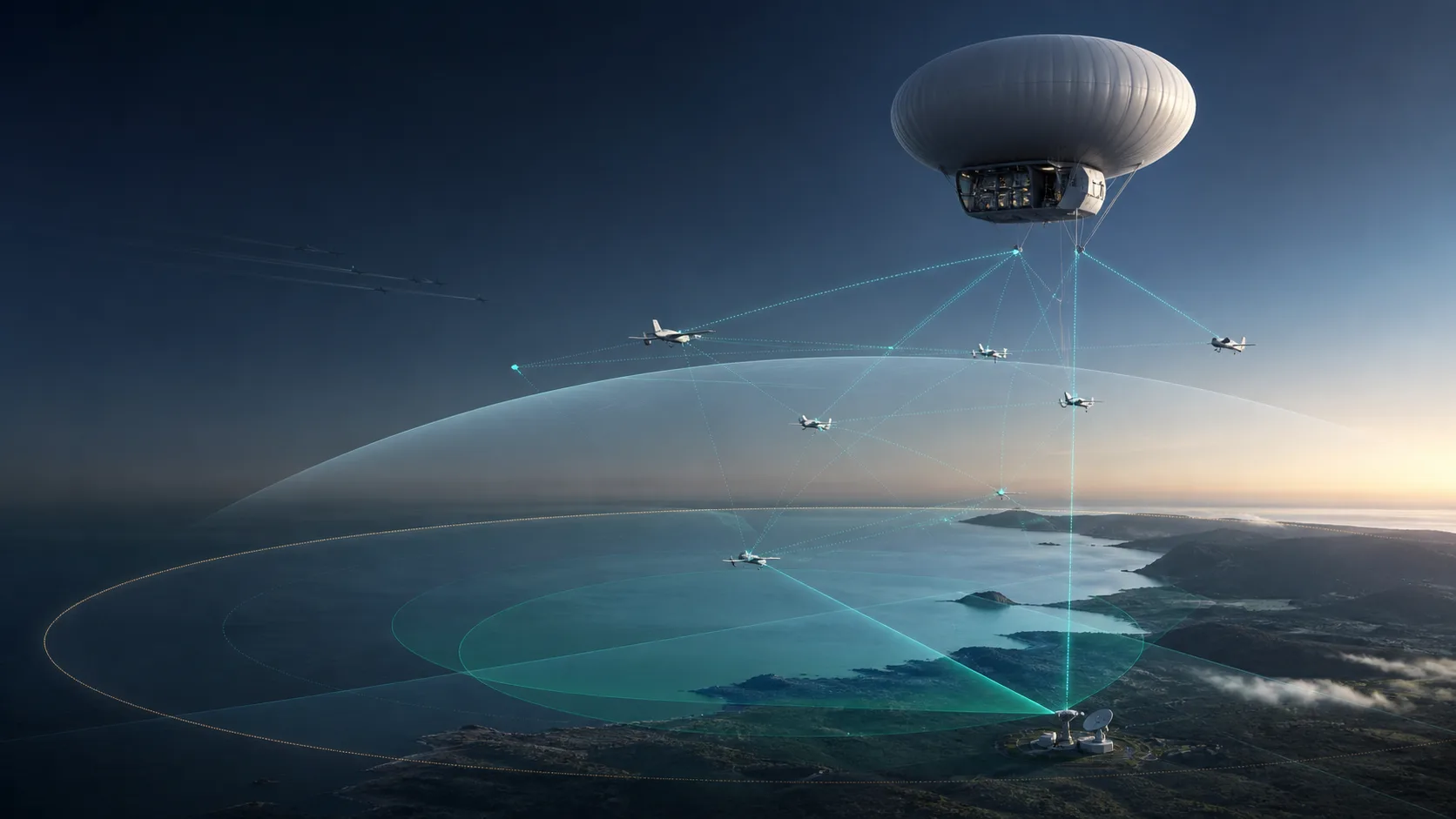
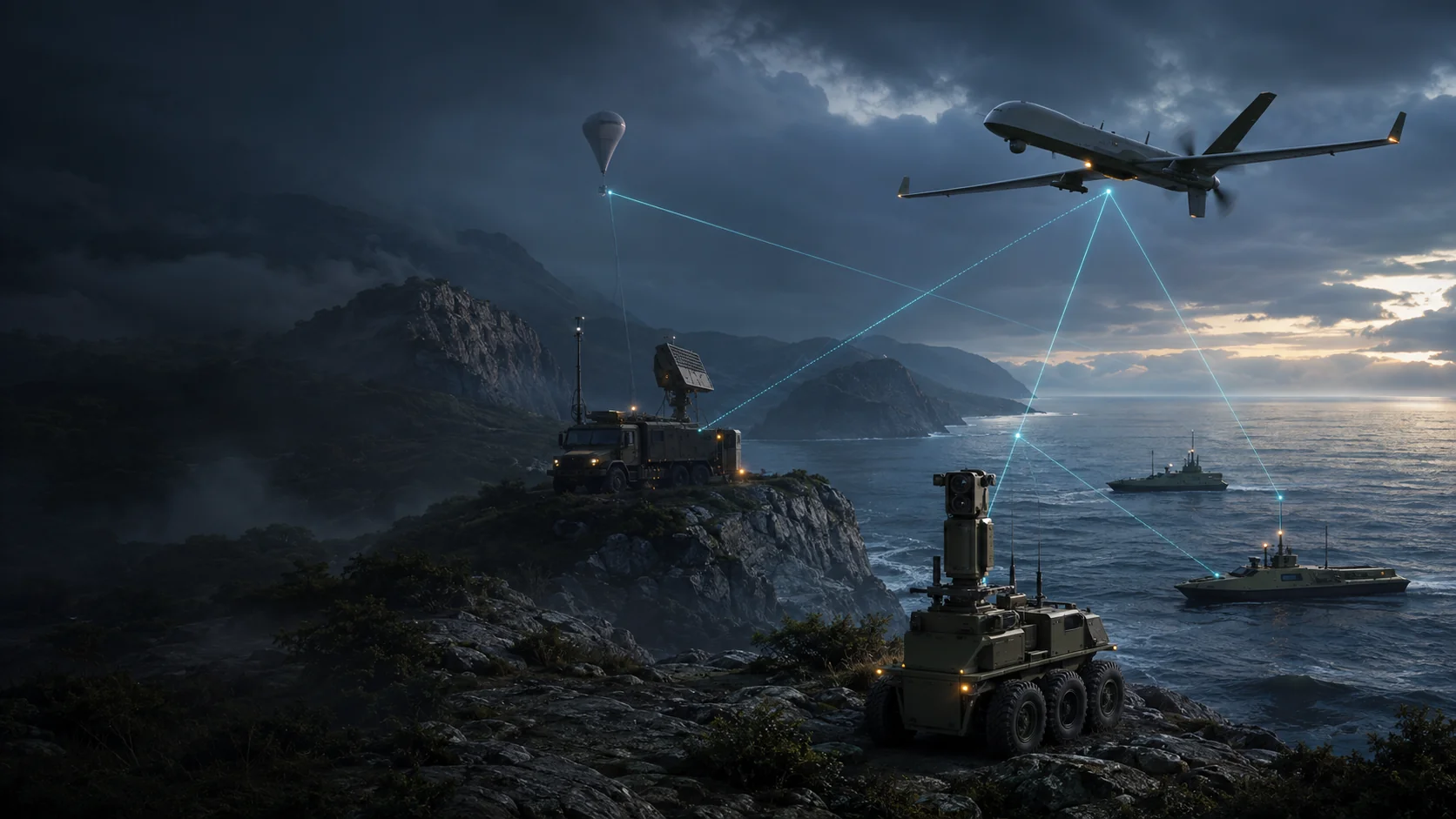
Layered airspace defense
Assign the right layer without spending every reserve.
Pre-position sensing and communications, classify the mission state, assign bounded roles, and recover when a node or link is lost.
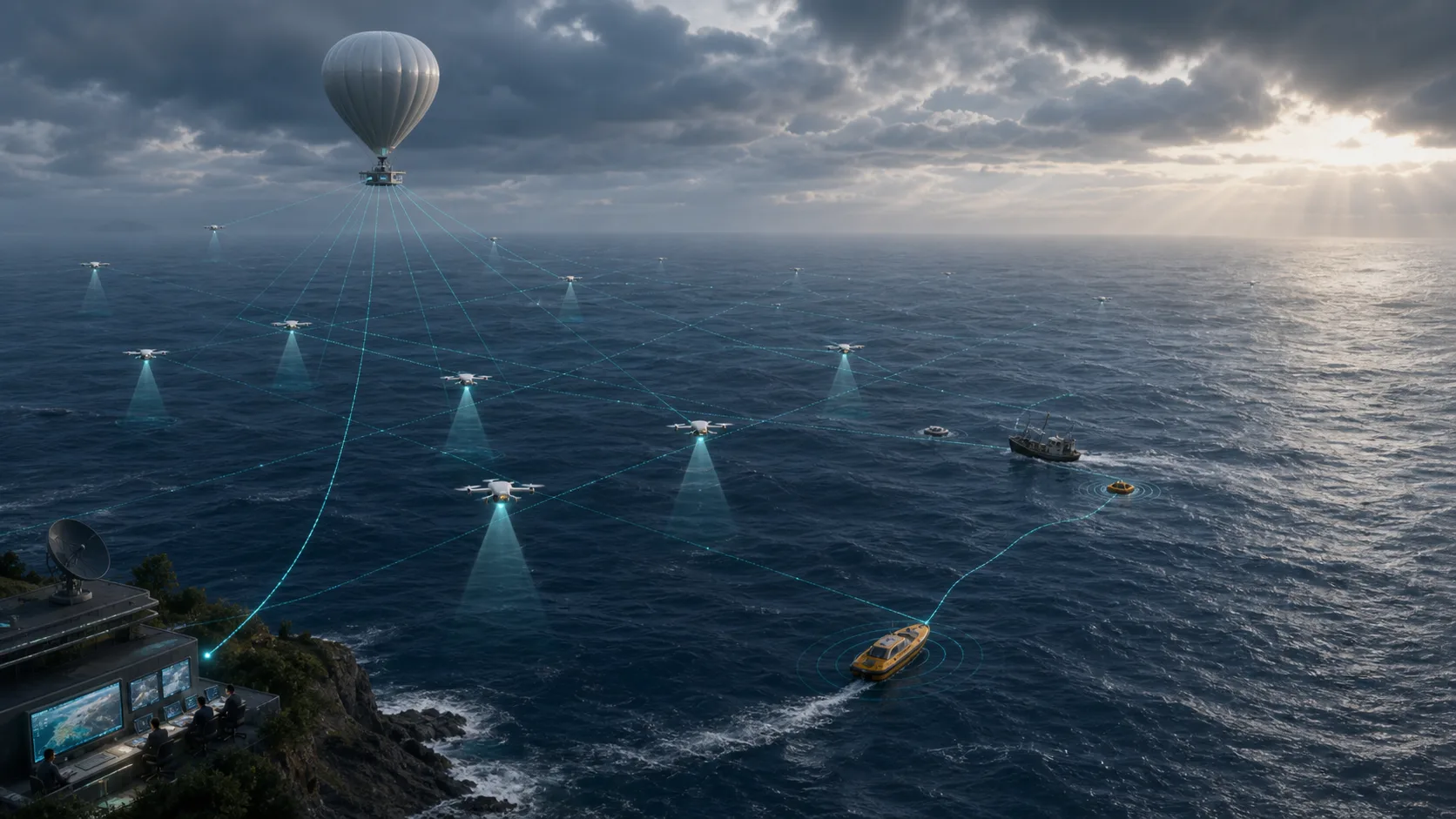
Maritime search and rescue
Turn a wide search area into coordinated evidence.
SKY MECH establishes the frame, UAVs divide the area into overlapping cells, detections are fused, and confirmed coordinates are handed to a USV or rescue team.
Urban search and rescue
Send the right sensor into the space the operator cannot enter.
UAVs map the exterior. A low-profile six-legged robot enters voids and unstable interiors, returning thermal, visual, location, communications, and health evidence.
Sensing and relay
Keep the mission picture alive when the network degrades.
Communications, sensing, and positioning are mission roles. When one SKY MECH or relay weakens, another balloon, UAV, USV, or ground node can preserve the most valuable part of the mission picture.
Scenario workshop
What is the minimum fleet that still meets your gate?
Bring the mission objective, constraints, and failure cases. We will turn them into a deterministic scenario and measurable evidence.
ZH · Archived research and engineering
歷史研究與工程資料;各項計畫依原文標示的驗證階段解讀。
任務模型 · 從意圖到 Edge
一個任務,五個相互連結的決策。
在任何載具進入風險環境之前,SHEEPDOG 先把作戰意圖轉換成可看見、可重播、可檢驗的決策鏈。
→
→
→
→
實際產品 · 英文操作介面
同一套模擬器,兩種任務視角。
實際執行畫面
平面指揮視角
在同一個操作畫面中檢視精確航線、區域、KPI、機隊狀態與確定性重播證據。
空間任務視角
從即時模擬狀態呈現高度、地形、建物、視線條件與載具間距。
兩種視角都來自可運作的 SHEEPDOG 模擬器,並支援可重現的任務重播:2D 用於精密分析,3D 用於理解空間關係。
戰術模式資料庫
SHEEPDOG 訓練的是戰術,不只是控制載具。
大型模型提出候選戰術;確定性模擬再從地形、通訊、能量與任務變化等面向反覆挑戰,選出能進入 Edge 驗證的受控行為。
轉移注意力,重新分配任務。
前方單元吸引對手投入,其餘團隊維持覆蓋、調整角色或完成主要目標。
塑造任務空間,關閉覆蓋缺口。
一個單元持續圍控,其他載具占據替代路線、補齊覆蓋缺口並保留復原能力。
把高度當成可運用的能量預算。
高空中繼節點釋放觀測滑翔載具,利用重力輔助飛行,同時評估曲線航路、鏈路連續性與穩定度。
稀缺感知任務編組 · 異質機隊
戰爭不會等待理想機隊到齊。
真正可用的,往往是不同廠牌、感測器、續航、鏈路與可信度的剩餘資產。SHEEPDOG 先識別每一架載具能做什麼,再依任務價值、成功機率、耗損風險與戰時替代成本進行編組、保留與重派。
面向戰時稀缺與異質機隊的無人載具任務編組:使用當下存在的能力、保留無法快速取代的資產,並讓每一次重新分派都可以被解釋。
AI 的剛性價值 · 可治理的協同優勢
不是把飛手換掉,而是把人類難以同步的協同變成可治理能力。
人在任務層保留 GO/NO-GO、暫停與返航權;AI 同時處理多機角色、覆蓋、鏈路、風場、避碰、成本與證據閉環。
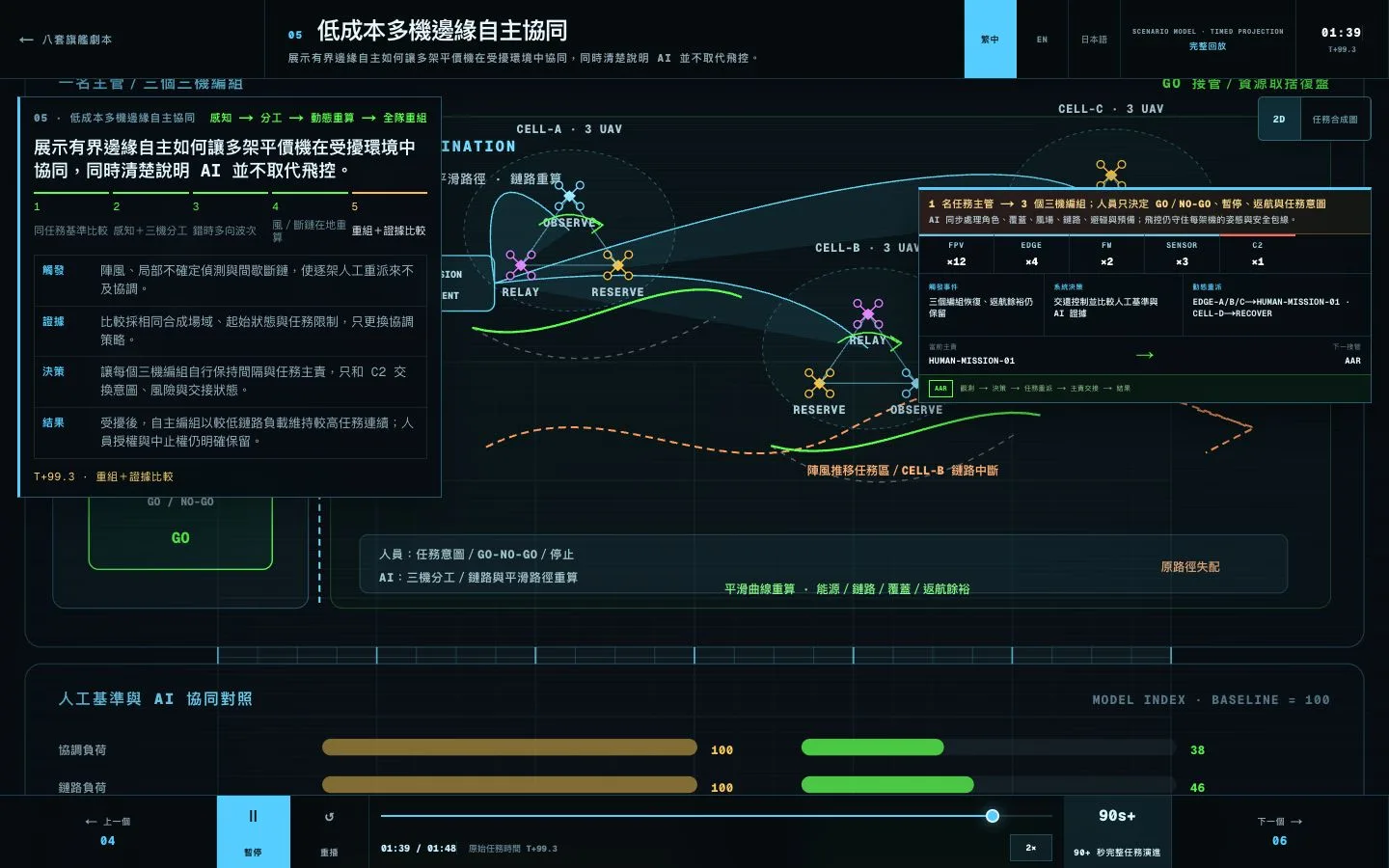
AI 同時重算,人員只決定任務意圖。
一名任務主管下達 GO/NO-GO;Edge AI 同步調整角色、覆蓋、風場、鏈路、間隔與返航餘裕,完成多名飛手很難即時協調的分工。
每次建議都由具名人員複核,並可修正、退回或申訴;新策略須通過留出驗證與回歸檢查。AI 不自動核發獎金或戰功,也不自動升版。
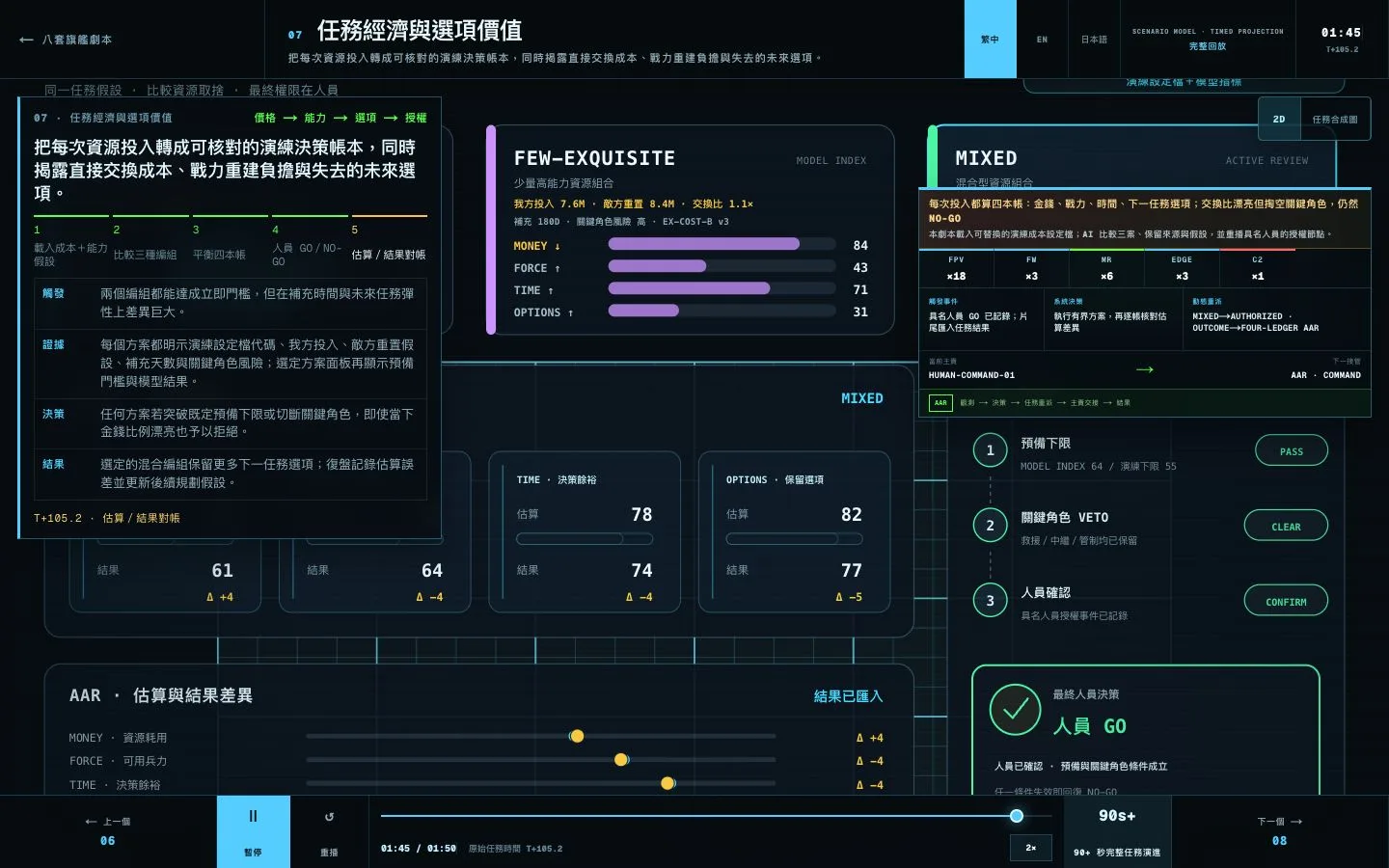
打完仗還要能打下一場。
同時核算金錢、戰力、重建時間與下一任務選項,辨識看似便宜卻掏空關鍵角色的方案,保留預備與中止選項後再交人員授權。
成本與方案建議須由具名人員複核,並保留修正、退回與申訴;規則更新先經留出驗證與回歸檢查。AI 不自動核發獎金或戰功,也不自動升版。
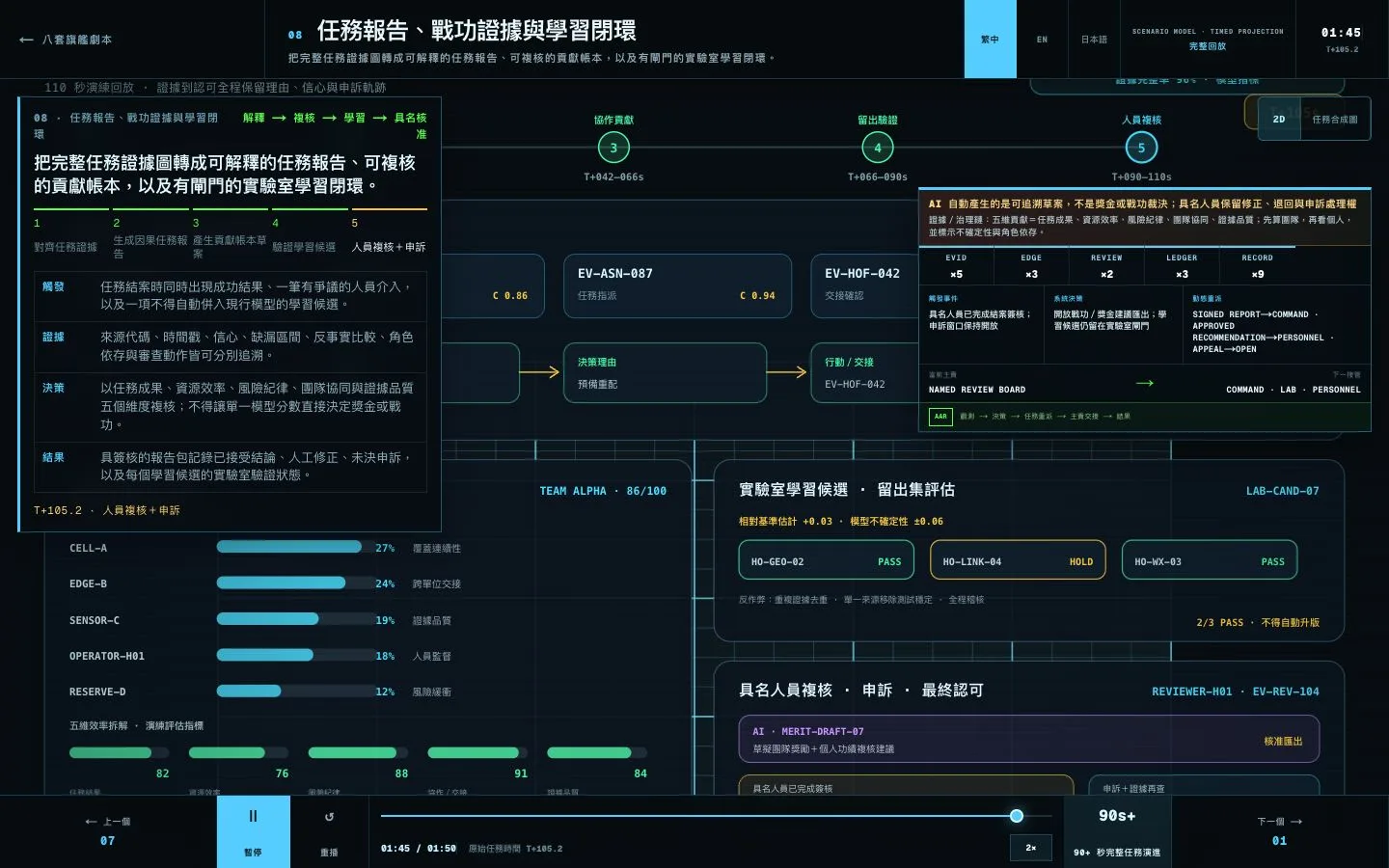
把每次決策變成可檢討、可申訴、可進化的證據。
自動對齊觀測、決策、重派、交接與結果,產生團隊優先的五維貢獻草案,並把學習候選隔離在實驗室治理閘門。
報告與貢獻草案由具名人員複核,並可修正、退回或申訴;學習候選須通過留出驗證與回歸檢查。AI 不自動核發獎金或戰功,也不自動升版。
可執行證據
每一個成熟度關卡都有對應證據。
可運作軟體、可重現研究與工程釋出,以清楚的成熟度層級分別呈現。
EDTH TAIWAN 2026 · 協辦夥伴
寶淇智慧擔任 EDTH Taiwan 協辦與臺灣企業合作窗口。
本活動由 European Defense Tech Hub 與國立臺灣大學無人載具研發設計中心共同主辦,將於 2026 年 10 月 2–4 日在臺北舉行。寶淇智慧負責企業與產業合作協調、技術生態連結及合作材料整合。